Author: Joe Wilson
-
In Waikīkī, Ancient Stones Memorialize Hawai‘i’s Māhū History
In Waikīkī, Ancient Stones Memorialize Hawai‘i’s Māhū History
by Kylie Yaumachi – FLUX – October 2022:
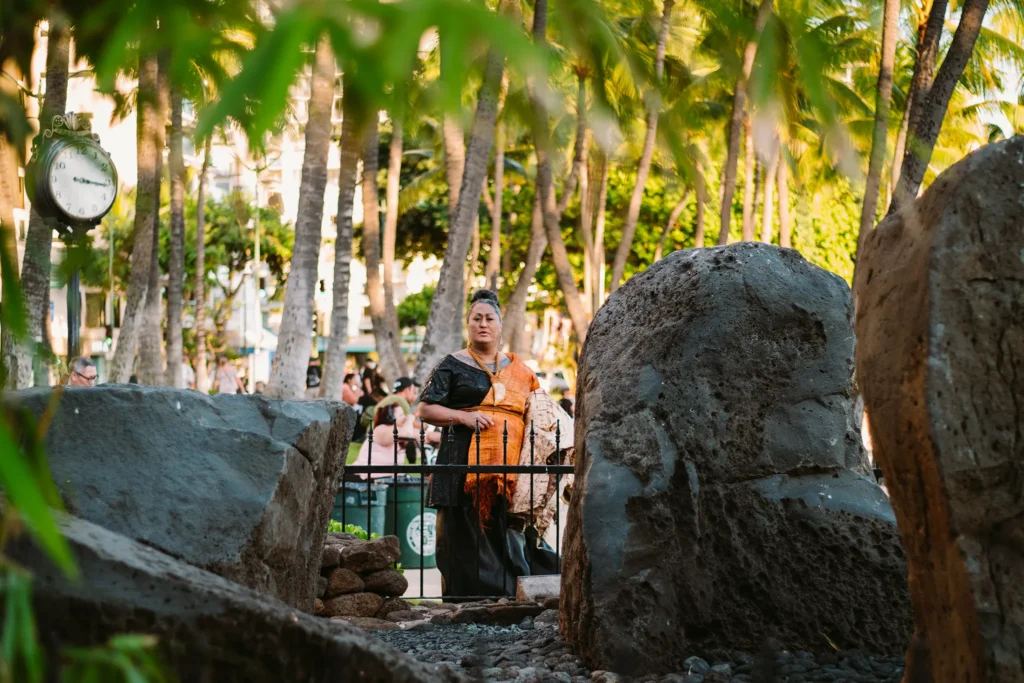
The healer stones of Kapaemahu on Waikīkī Beach honors gender fluid heroes in Hawaiian culture.
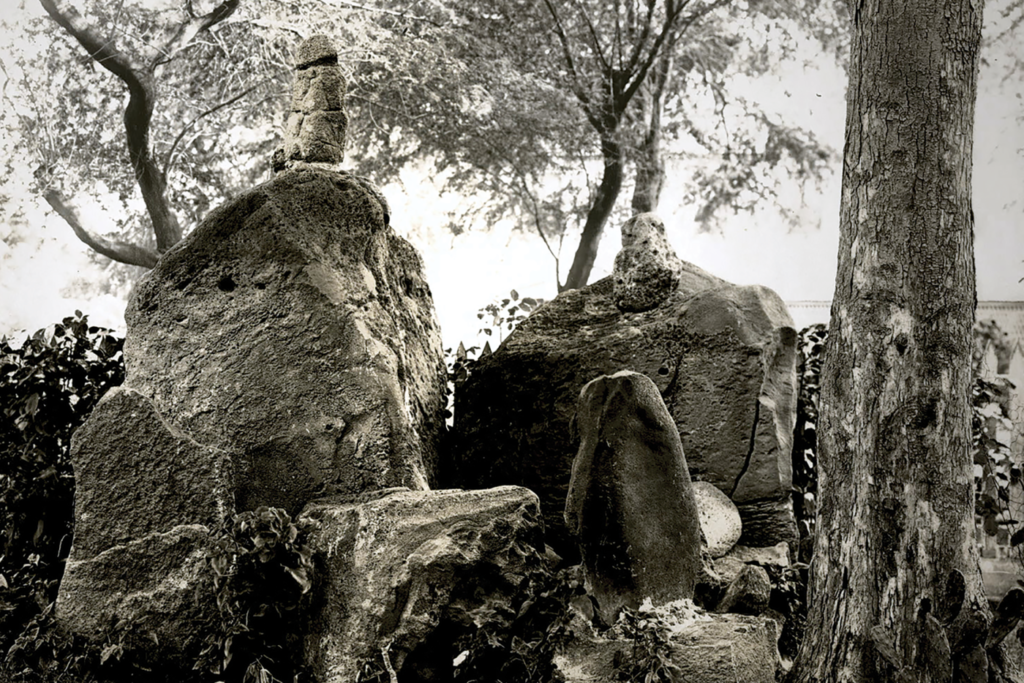
Just off the sparkling waters of Waikīkī Beach and a kukui nut’s throw from Duke Kahanamoku’s bronze statue, a monument from precolonial Hawai‘i survives.
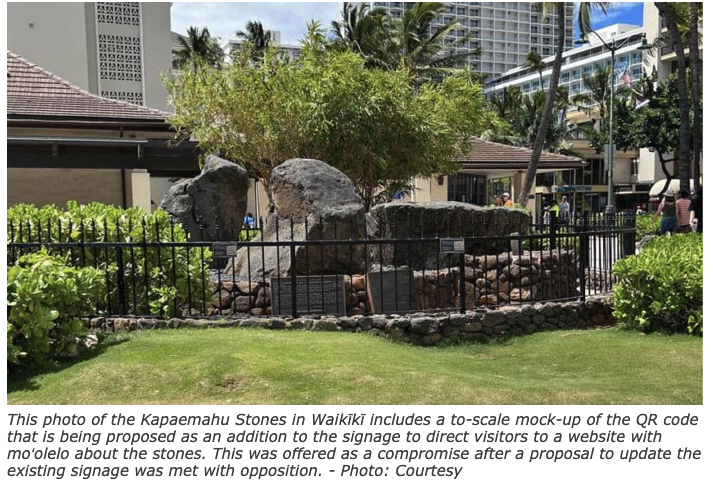
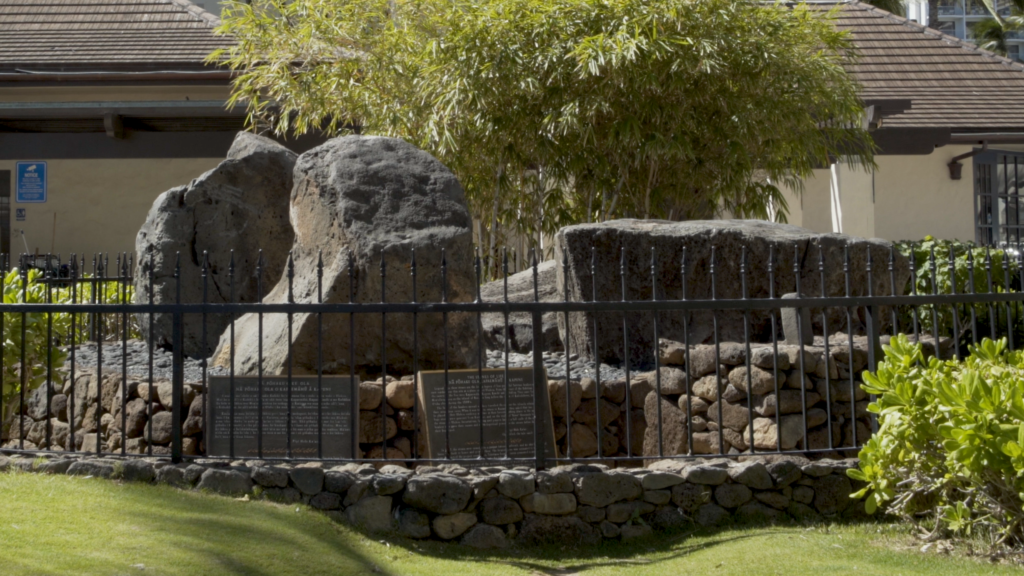
Four boulders, originally excavated from the hills of Kaimukī, dwell together in varying natural shapes. Unassuming in appearance, the stones are erected on an ahu and circled by a low steel fence, passed unnoticed by thousands of locals and tourists daily.
I, too, am guilty of such cultural blindness. After countless surf sessions out at Canoes surf break, as I waited for my dad to finish showering, I often rested on the grassy patch in front of the monument to avoid the bustling crowds and sticky sand.
Oblivious as the pigeons that nestled on their sun-soaked surfaces, I never took the time to read the plaque that told of the stones’ significance. Yet, thinking back, there was always evidence of the stones’ reverence, however few at the time: a crinkly and browning tī leaf lei draped over the fence, its braid still tight from skilled hands; a freshly-bought purple orchid lei laid to rest on the ahu.
As the mo‘olelo goes, long before Queen Lili‘uokalani and King David Kalākaua each ruled the Hawaiian Kingdom, long before the first Western missionaries disturbed these sands, four travelers from Tahiti arrived humbly and with pure intent.
Their names were Kapaemahu, Kapuni, Kinohi, Kahaloa, and they were healers, each with a distinct touch. They were, also and foremost, māhū—a fact censored over time by Western influence and its confining notions of gender.
A term unfamiliar to most Westerners, māhū is derived from Pacific Islander cultures which describes a person of dual male and female mind, heart, and spirit. Closely related to two-spirit identities of Indigenous communities, māhu points to a cultural acceptance of and respect for gender fluidity, attitudes withheld toward trans people today.
These four māhū healers were “tall and deep in voice, yet gentle and soft-spoken,” as recounted in the animated short film Kapaemahu (2020), and kindly accepted by the Hawaiians to whom they offered their services. Already highly spiritual beings for their ability to access both male and female parts of themselves, the visitors performed magical feats of healing on the community from Ulukou in Waikīkī, looked over by the crater of Lēʻahi. The healers were generous and passed on their knowledge to the Hawaiians, who in turn created a monument for them before they departed. Inch-by-inch the people dragged the stones from the hills of Kaimukī to the sands of Ulukou, where an extended ceremony took place under a changing moon. Over the course of a full moon cycle, the healers chanted an ‘oli over their respective stone, transferring their mana into the monument, before disappearing.
As centuries went by and Hawai‘i transformed into a city unrecognizable, the Kapaemahu stones remained at the center of Waikīkī, giving the place a spirit of healing. Most notably, Queen Lili‘uokalani knew the mo‘olelo of the stones and experienced their power. After being injured in a carriage accident, she spent time at Hamohamo, an area which adjoins Ulukou.
“Hamohamo is justly considered to be the most life-giving and healthy district in the whole extent of the island of O‘ahu,” she wrote. “There is something unexplainable and peculiar in the atmosphere at that place, which seldom fails to bring back the glow of health to the patient, no matter from what disease suffering.”
Although ali‘i such as the Queen and her niece Princess Ka‘iulani often resided in Waikīkī, it remained a place welcoming of all maka‘āinana. All Hawaiians could harness the healing powers of the stones, if they so believed.
Although as time went on, the knowledge and existence of the stones were put at risk of erasure. In 1941, the stones, once revered and protected by the ali‘i family of Princess Ka‘iulani, were covered over by a bowling alley. It wasn’t until two decades later that they were rightfully restored to Ulukou, but the mo‘olelo had become esoteric and censored.
“Growing up, I remember those very stones were the ones that we played on as children,” recounts kumu Hinaleimoana Wong-Kalu, Native Hawaiian teacher and co-producer of Kapaemahu. “We climbed on them and laid on them in the sun after swimming the day at Waikīkī. We had no knowledge of their significance. We had no knowledge of their importance.”
Although Wong-Kalu was fortunate to learn the mo‘olelo when she was 18, a narrative integral to her own journey as māhū, many other Hawaiians, locals, and malihini remain unaware to the stones at the heart of Waikīkī. For this reason, Wong-Kalu and filmmakers and life partners Dean Hamer and Joe Wilson produced Kapaemahu, an animated retelling of the mo‘olelo told in the Ni‘ihau dialect that was most likely spoken by the māhū healers. Through the artistry of animator Daniel Sousa, the film is bathed in earthy colors and told through soft and unadorned figures, modesties which underscore the magic of the narrative.
“Dean, Hina, and I all emerged in a society that was not only negative but cast aspersions toward people like us that made our walk even more difficult,” Wilson explains. “When we learned about this site, these stones, and the story it reflects, we saw the potential it had to be one of those amazingly powerful symbols, not just for people in Hawai‘i but for people who visit Hawai‘i, who could start to see a place for themselves in the world through this mo‘olelo and site that celebrates this aspect of life.”
Although Waikīkī is much changed since Kapaemahu, Kapuni, Kinohi, and Kahaloa first brought healing to the community, their mana lives on in the stones, in every retelling of their mo‘olelo, and every māhū who proudly lives their truth. Consider their presence as an invitation to venture a few short blocks along Kalākaua Avenue and visit the stones of Kapaemahu with the same humility and pure intent as those healers once showed us.
See the full article and photo collection as published in Flux HERE.
-

Four Stones Sit in Waikiki. Their Story? Unknown to Most Who Pass By
Four Stones Sit in Waikiki. Their Story? Unknown to Most Who Pass By
by Dillon Ancheta – Hawai’i News Now – October 12, 2022:
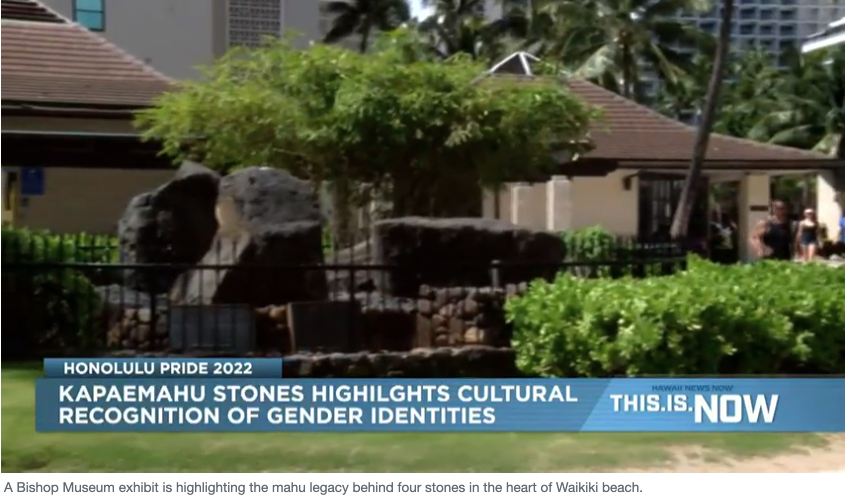
HONOLULU (HawaiiNewsNow) – On the side of Kuhio Avenue in Waikiki, four stones sit behind a black fence.
Thousands of people pass them every day.
“But those people, very few of them know the true story about what the stones represent,” Bishop Museum Historian and Archives Curator DeSoto Brown said.
“They are called the healer stones of Kapaemahu.”
Legend says, four ancient healers came to Hawaii sometime around the year 1500.
“They were māhū. They were what we would call today transgendered, perhaps. They brought to the Hawaiian islands with them healing knowledge that they had and each of the four had specialized healing knowledge,” Brown said.
They requested four large stones be moved from Kaimuki to Waikiki.
“The four healers imbued their powers into the stones and then they vanished. Those stones are still present today in Waikīkī,” Brown said.
The stones have been documented throughout recent history sitting on the property of Archibald Cleghorn, who outlines their protection in his will.
In 1941, they were buried under a bowling alley that was torn down 21 years later.
They were moved a few times more until resting at their current location next to HPD’s Waikiki substation.
“Now, finally, they’ve been placed in a way that treats them with respect and that people can’t touch them or try to put things on them,” Brown said.
A Bishop Museum exhibit honors the story of the healers and the stones. It also explains that throughout the Pacific, genders other than just male and female are rooted in culture.
“People who were sexually different, who identify differently, who looked different we’re not the objects of scorn,” Brown said. “They weren’t pushed aside. They weren’t hated. They were accepted as part of the normal array of different types of human beings. And that’s very true for the four Kapaemahu healers.”
As the exhibit explains, part of the stone’s history has been covered up. Some suppress the fact the healers were māhū.
“With the introduction of Christianity, with the introduction of western morality and western perceptions starting in the late 1700s, people like the Kapaemahu healers, people who are different, became not accepted, but disliked. Actively hated. Suppressed.”
Brown says the purpose of the exhibit is to shed light on the full history of the legend.
“We talk about healing we talk about the development of Waikīkī. We talk about entertainment. We talk about all kinds of things. So if somebody walks out of here having learned just one thing, whatever it may be, then we succeeded,” Brown added.
He also hopes people will come to understand being māhū is a powerful cultural identity.
“There are people that are māhū, and there always have been, and there always will be,” he said. “Yeah there are these people — don’t hate them, don’t destroy them, just accept them as part of everything that we are as humans,” Brown said.
The exhibit will be open until Sunday Oct. 16. After that, parts of the display will move to its new permanent home at the Hawaii Convention Center.
-

Kapaemahu on Display in the SFO Museum
Kapaemahu on Display in the SFO Museum
The mission of SFO Museum, a division of San Francisco International Airport, is to delight, engage, and inspire a global audience with innovative programming, and to provide visibility to a range of contemporary artists and filmmakers who are at the leading edge of their craft. In Kapaemahu, the story of four extraordinary beings of dual male and female spirits from Tahiti, filmmakers Hinaleimoana Wong-Kalu, Dean Hamer, and Joe Wilson reveal how these beings passed their healing arts to the people of Hawai’i.
More info on the museum display – in the Departures – Level 3, Gallery 4E Sep 29, 2022 – Nov 02, 2022 – here.
-

5 New Books By Hawai‘i Authors
5 New Books By Hawai‘i Authors
October heralds a season of change, the first nod toward the holidays and the coming of cooler weather (we hope). If you’re starting your holiday shopping early, you’ll find a variety of new books to excite local bibliophiles of all ages. And you might find something for yourself, too. See the full list here.
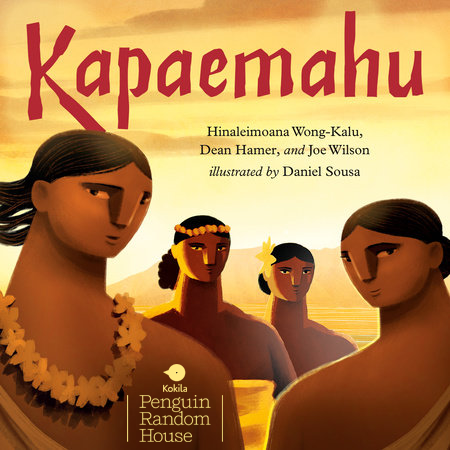
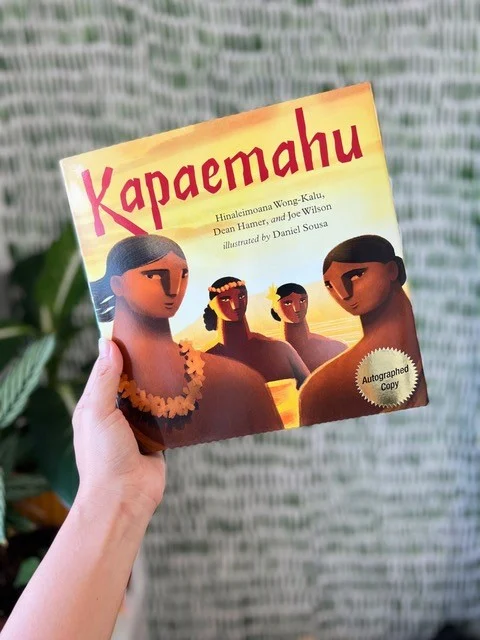
Kapaemahu
by Hinaleimoana Wong-Kalu, Dean Hamer and Joe Wilson, illustrated by Daniel Sousa
Kapaemahu is a powerful picture book, written in ‘ōlelo Ni‘ihau and English, about the four travelers who held both male and female spirit, brought healing to Hawai‘i and imbued their healing powers into four large stones that sit in Waikīkī today. Vivid imagery by Daniel Sousa recalls the illustrative style of the Oscar-nominated animated short film of the same name. It’s a moving story from Hinaleimoana Wong-Kalu, known to many as Kumu Hina, that teaches and affirms Native Hawaiian healing practices, the honored role of māhū in Hawaiian culture, and the history of the healer stones of Kapaemahu.
SEE ALSO: Experience the Story Behind Waikīkī’s Healer Stones of Kapaemahu
-
Kapaemahu Exhibit Prompts Call to Update Signage at Waikīkī
Kapaemahu Exhibit Prompts Call to Update Signage at Waikīkī
by Puanani Fernandez-Akamine – Ka Wai Ola News – October 1, 2022:
An exhibit at Bishop Museum is bringing attention to the once-forgotten story about four māhū (people of dual male and female spirit) who brought healing arts from Tahiti to Hawaiʻi.
Titled, “The Healer Stones of Kapaemahu,” the exhibit is based on the handwritten manuscript of a moʻolelo “Ka Pōhaku Kahuna Kapaemahu” that was passed down through the family of Queen Liliʻuokalani and eventually published in 1907 in the Hawaiian Almanac.
In the original story, the dual male and female traits of the healers were an essential component of their power. Before leaving Hawaiʻi, they transferred their powers to four large stones as a permanent reminder of their gifts.
After years of neglect, the stones are now protected as a City and County of Honolulu monument at Kūhiō Beach. However, over time, external influences have altered the story and obscured the nature of the healers. Today, the signage at the site does not mention that the healers were māhū or that their duality was intrinsic to their healing abilities.
This obvious omission highlights the ongoing struggle for acceptance and inclusion of gender diversity in Hawaiʻi, inspiring efforts by advocates and supporters to have the signage at the Kapaemahu monument corrected.
Council for Native Hawaiian Advancement CEO Kūhiō Lewis is one such advocate. “The current informational plaques at the Kapaemahu site tell part of the history, but critical elements of the moʻolelo passed down by our kūpuna were omitted,” Lewis said. “This censorship does harm to those whose existence it erases, to the Kānaka MaoIi whose histories it suppresses, and to the residents and visitors who lose the opportunity to learn about Hawaiʻi’s long traditions of diversity and inclusion.”
Hawaiʻi Health and Harm Reduction Center is a nonprofit public health organization that includes the Kuaʻana transgender health project. The center’s director, Heather Lusk, notes that, “although māhū have a long history as community caregivers in Native Hawaiian and other Pasifika cultures, their role has been under appreciated and even ignored over the past century plus. Information about these stones should be historically accurate and reflective of the important cultural role māhū played in Native Hawaiian society.”
Elizabeth Char is director of the Hawaiʻi State Department of Health. She adds that Hawaiʻi’s sexual and gender minorities have unique health experiences and needs and often face barriers to acceptance and belonging that profoundly affect their overall health and wellbeing. “Updating historical information at what might be the world’s only public monument to the important role that māhū played in Indigenous culture could have transformative and beneficial impacts on those who visit this prominent site,” Char said.
Hinaleimoana Wong-Kalu is a curator of the exhibit and co-director of the Kapaemahu project. “Our kuleana has been to continue this tradition by restoring this inspiring moʻolelo and making it accessible in every way we can,” she said. “Whether through the exhibition, animated film, documentary or the children’s book that have emerged, we have endeavored to stay true to the moʻolelo and to tell it in our own language from a kānaka perspective.”
Another advocate is Mālia Sanders, executive director of the Native Hawaiian Hospitality Association (NaHHA). “The 1990s were simply ‘not ready’ to receive what it meant to be māhū and how the story of these healers are an integral part of the fabric of society of the ancient and modern Native Hawaiian people,” said Sanders. “Today we are privileged to have access to 21st century technologies and mediums which allow us to do justice to the retelling of cultural stories.”
NaHHA was founded by scholar and author George Kanahele who proposed that the stones be designated as a wahi pana in his 1994 book, Restoring Hawaiianness to Waikīkī. In 1997, the stones were restored, elevated and protected behind a fence through a project led by venerated kūpuna and traditional healer Papa Henry Auwae.
At a March meeting of the Commission on Culture and the Arts, a proposal to replace the existing signage was met with resistance from representatives of a group who help to maintain the stones.
Proposals to update the information at the stones are currently with Honolulu Mayor Rick Blangiardi.
“This is a wonderful opportunity for the City and County of Honolulu to show both its respect for Hawaiian history and culture and its support for modern concepts of diversity and inclusion” said Wong-Kalu.
Honoring the story of Kapaemahu is especially important to the local LGBTQ+ community whose members continue to experience prejudice and discrimination. Brandy Lee, who was an entertainer in the 1960s, had to wear an “I Am a Boy” button to avoid arrest. “Back then, we didn’t know anything about the stones of Kapaemahu in Waikīkī. Knowing about those stones that recognize and honor people like me might have made me feel like I had a place and was deserving of dignity and respect – things sorely lacking in my youth.”
The Board of Directors of the Hawaiʻi LGBT Legacy Foundation said in a statement that updating the Kapaemahu signage will, “ensure that we [do] not actively participate in the erasure of māhū from our history; honor and affirm the incredible role māhū play in both historical and modern day Hawaiʻi; and serve as a catalyst for other mo‘olelo that may have been sanitized inadvertently through time or for more insidious reasons.”
Adds Lewis, “When any part of our past is erased, for whatever reason, future possibilities are removed. It is time to assure that our public monuments in Hawaiʻi, including the stones of Kapaemahu, are a site of inspiration and opportunity for the next generation.”
See article on the Ka Wai Ola News site HERE.
The Kapaemahu exhibition at Bishop Museum is open through October 16. In addition to advocacy for updating signage at the stones, plans for the Kapaemahu project include a display of the centerpiece banners and replica stones at the Hawaiʻi Convention Center; teacher workshops with the Kanaeokana educational network and Kamehameha Schools to help educators apply the lessons of the moʻolelo of Kapaemahu in classrooms; and an augmented reality application that will allow viewers to learn more about the stones. For more information or to help end the erasure of māhū from Hawaiian history go to: www.kapaemahu.com.
-

City Might Add Dual-Gender History to Waikiki Monument
City Might Add Dual-Gender History to Waikiki Monument
by Allison Schaefers – Honolulu Star-Advertiser – September 12, 2022:
In the 1960s when a Waikiki bowling alley was demolished to create more beach, four large boulders were unearthed at the site near where they had been erected to honor four Tahitian healers.
A historical plaque was erected at the stones, which date back more than 500 years and are protected by a fenced enclosure near the Honolulu Police Department substation in Waikiki. But the version of history that recognized these healers as mahu, someone of dual male and female spirit, remained buried even in 1997 when the monument’s signage was last updated.
Some members of the community have asked the city to consider revising the monument’s signage or adding a QR code to provide more information about the mahu aspect of the stones for those who are interested. The movement is an outgrowth of “The Healer Stones of Kapaemahu,” an exhibit at Bishop Museum that runs through Oct. 16.
Joe Wilson, Dean Hamer and Hinaleimoana Wong-Kalu helped curate the exhibit for the Kapaemahu project, which also includes an award-winning animated short film, a children’s book published by Penguin Random House, a feature-length PBS documentary film broadcast on Pacific Heartbeat, and school curriculum.
The exhibit, which was planned for about two years and occupies Bishop Museum’s Castle Memorial Hall, has built on other aspects of the Kapaemahu project by starting a community-driven conversation about updating the site as a permanent and unique reminder of Hawaii’s inclusivity.
Wilson said it’s understood that in 1997, when the city fenced Kapaemahu and last updated its signage, “you could not say the word ‘mahu’ in public. It was a derogatory word.”
But now, Wilson said, that’s changed “because people like Hina are reclaiming that word and using it proudly.”
Wong-Kalu said gender fluidity has always been a part of the greater Polynesian and Hawaiian cultures, which “have a place for male and female culture and the space in between.”
She said to be mahu was and is seen as a “gift and a responsibility.”
“There is no written documented evidence that mahu was anything but a normal part of society. We have no evidence prior to the coming of Christian missionaries of whom took the greatest issue with mahu and living that truth,” she said. “Only then do you see that there is a collision between cultures and religious and spiritual beliefs.”
Ian Scheuring, Honolulu Mayor Rick Blangiardi’s spokesperson, said the mayor toured the exhibit and met with the Kapaemahu group afterward about “the desire to have the signs either changed or amended at the existing monument.”
“I would describe that meeting as very educational and very helpful for us to understand that perspective. In the weeks after that meeting, the mayor also met with the cultural caretakers of that monument,” Scheuring said. “They appear to have a different perspective on the history of that monument than the Kapaemahu group does.”
Scheuring said the mayor and his administration are still conducting fact finding on the monument. He said the Kapaemahu group has proposed adding a QR code to the site, and discussions about that idea are ongoing with both parties.
“We are hopeful that we can come to a solution that is amenable for both parties and a solution that makes everyone happy,” Scheuring said.
Support for updating the monument to include the role of mahu in its history has come from the Council for Native Hawaiian Advancement, state Department of Health, Hawaii Health & Harm Reduction Center, Kanaeokana Kula Hawaii Network, Hawaii LGBT Legacy Foundation, Bishop Museum and other organizations.
CNHA CEO Kuhio Lewis said, “The recent short film ‘The Healer Stones of Kapaemahu’ has touched and inspired audiences around the world with the universal message that everyone has a role in society. CNHA supports enhancing the signage at the Kapaemahu Stones site in Waikiki to include this version of the moolelo (story) alongside others to present a more comprehensive depiction of our Hawaiian culture.”
Brandy Lee, whose work as a mahu performer and entertainer at The Glade nightclub in Chinatown in the 1960s was spotlighted in the gender fluidity portion of the Kapaemahu Stones exhibit, is among the people who support updating the monument.
Lee, now 80, faced significant prejudice as a mahu entertainer in an era where law enforcement required them to wear “I Am a Boy” buttons. Lee said in a letter of support: “Our schools didn’t teach Hawaiian culture or history, and even if they had, they wouldn’t have talked about a subject with the word ‘mahu’ with it. But I wish they had. Knowing about those stones that recognize and honor people like me might have made me feel like I had a place and was deserving of dignity and respect, things that were sorely lacking in my youth.
“For the sake of current and future generations, I hope things will change and that this important wahi pana (legendary place) will be clearly marked, for all to see, as a remembrance of all the good that mahu bring to Hawaii and the world. It deserves to be recognized.”
But members of Na Haumana Laau Lapaau o Papa Auwae, or NHLLOPA, who have served as kahu, or guardians, of the monument for nearly 25 years, said in a statement to the Honolulu Star-Advertiser that they “cannot support the alteration of this sanctified historic object and area with its specific cultural instructions and spiritual requirements.”
“The many honorable kupuna who sanctified the wording, articulated a commonality of the moolelo (story) of healing, kinship and spiritual significance that has survived centuries of change,” NHLLOPA said. “Like many moolelo, it has several valid ancient versions yet to be reconciled, including those of our Tahitian ohana from whose shores, and teachings the seers originated.”
The kahu added: “We have been working with the city on the best way to provide further information that can be accessed by the visiting public, without disrupting the deep spiritual significance within the boundaries of the area.
“Care for protocol, the needs of the site itself, and safety contribute to a careful balance of pono and needs to be maintained, with aloha.”
Hamer said the story of the healing stones was mostly passed down through oral transmission. However, in 1906, he said, James Alapuna Harbottle Boyd’s written manuscript “Tradition of the Wizard Stones of Ka-Pae-Mahu” said the healers’ “ways and great physique were overshadowed by their low, soft speech, and they became as one with those they came in contact with.”
Boyd also said that the healers “were unsexed, by nature, and their habits coincided with their womanly seeming, although manly in stature and general bearing.”
Hamer said historians view Boyd as a particularly strong source as he was the son-in-law of Archibald Cleghorn, who owned the Waikiki property where the stones were at that time. He said Cleghorn’s wife, Princess Likelike, and daughter, Princess Ka‘iulani, were said to have revered the stones.
Wilson said the stones have just as much importance in today’s society.
“We believe it is possibly, and likely, the only monument in the world to celebrate the very idea of gender-fluid beings being recognized as heroes in their society,” he said. “You often now will see memorials to transgender people who have been killed whose lives have been cut short because of violence and bigotry. This stands separate and apart from that understanding. This is a wonderful and beautiful manifestation that has yet to be recognized in its fullness.”
The Associated Press contributed to this report.
See story on the Honolulu Star-Advertiser site here.
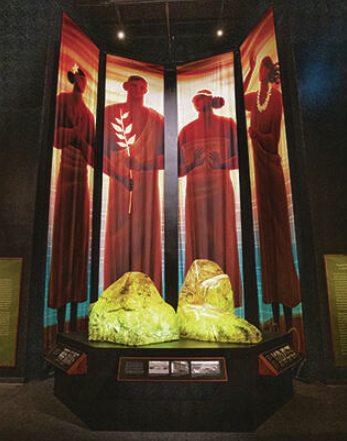
Photo of Kapaemahu Bishop Museum exhibit by Cindy Ellen Russell – Honolulu Star-Advertiser -

Children’s Book Tells Legend of Kapaemahu Monument about Sacred Stones and Mahu Healers
Children’s Book Tells Legend of Kapaemahu Monument about Sacred Stones and Mahu Healers
Every day, thousands of Waikiki tourists overlook a monument of four massive stones on Kuhio Beach, encircled by a low iron fence, walking quickly by to take photos of the legendary Duke Kahanamoku statue next to it.
Few will stop to read the plaque describing the Healer Stones of Kapaemahu, imbued with healing power by four Tahitian kahuna or wizards, over five centuries ago. Yet if they did, the plaque fails to mention that the healers were “mahu,” a Hawaiian word for those who are both male and female in mind, body and spirit.
Their gender duality was intrinsic to their healing power, but the plaque omits this vital piece of information after suppression by Christian missionaries and decades of social and political censorship, say the co-authors of a new children’s picture book, “Kapaemahu.”
“It’s a great loss. A deep shame,” they write. “For only when you understand the true history of these stones shall you behold their living power.”
The book, just released, is the first-ever U.S. publication in both English and Olelo Niihau, the Niihau dialect of Hawaiian, said co-author Hinaleimoana Wong-Kalu. Identifying herself as “mahu” or transgender, she is a Native Hawaiian teacher, filmmaker and an activist for gender minorities.
Her co-authors include Dean Hamer and his partner, Joe Wilson, both Emmy Award-winning filmmakers, who have collaborated with Wong-Kalu to make five films on transgender people and society’s outsiders. The book is based on their latest film, “Kapaemahu,” released in 2020 and shortlisted for a 2021 Oscar. It is illustrated by Daniel Sousa, an Academy Award-nominated animator.
The book, released by Kokila, an imprint of Penguin Random House, coincides with a Bishop Museum exhibition on “The Healer Stones of Kapaemahu” that will run until Oct. 16, also a collaboration of the three co-authors. The story was based on a Hawaiian legend, passed on orally over generations, but first published at the turn of the 20th century by James Aalapuna Harbottle Boyd, who used the term “wizard stones.”
Hamer said it’s especially important now that the story be known by visitors and local residents alike “as we see this rise in prejudice and discrimination towards gender diversity.”
“This is such a good story for combating that. Imagine some kid, who is (gender) fluid or questioning, hears about this great story. I think it’s really great for them to have some place to go and say: Hey, that’s for us; we can be heroes, not just the butt of jokes or something worse,” he said.
Hamer said the authors didn’t intend to create a film aimed at children. They wanted to tell a universal story, a Hawaiian legend, in the most understandable way for people of all ages. However, film festival programmers, publishers and librarians felt it would appeal to younger audiences (ages 4 to 8), and Hamer sees the advantage.
“Children are always our best audience because they’re the ones who will pass the story on and are important for the next generation. And children are in many ways the most open-minded to this story because when they hear about these amazing people who are part male and part female, they’re like: Oh cool — that’s magic, that’s something wonderful! And they don’t have the preconception that it’s something that should be questioned or whatever.”
Wong-Kalu said she grew up hearing the word “mahu” used as a derogatory term. “I would like our people to de-weaponize this word,” she said.
People may affiliate the concept of mahu with the LGBTQ movement, but Hawaiian gender duality goes beyond the physical aspect, which was once an accepted part of island culture, she said.
“Why were they these amazing, wondrous healers? It’s because of their duality of the spirit, and the heart, and the mind.”
In the book, the description of the healers is elegant and simple:
“The visitors were tall and deep in voice yet gentle and soft-spoken. They were not male. They were not female. They were mahu — a mixture of both in mind, heart and spirit.”
Wong-Kalu said, “It’s important to tell this story for the purpose of uplifting Kanaka history, culture and language.”
It was not enough to tell the story only in English, but in the Niihau dialect, the only form of Hawaiian that has been continuously spoken since prior to the arrival of foreigners.
“For far too long, the narrative of history has been relegated to foreigners or those other than Hawaiian, who have been heavily colonized, and have articulated it through their eyes. I want my people to tell elements of Hawaiian history and be unafraid to tell it in its raw form,” she said.
According to the authors’ notes, the sacred stones fell victim to colonization, militarization and the growth of tourism, which led to drastic changes in Hawaiian life. In 1941, the stones were buried to make room for a bowling alley in Waikiki. When the bowling alley was demolished in 1963, a few Hawaiian elders insisted on the stones’ recovery.
Hamer said they were later moved a short distance, where they stand between the Duke statue and the police substation, to make way for a public restroom, their original location.
Although flushing toilets may not be the best backdrop to the stones, Hamer said the location works.
“In a way it’s very fitting that they’re there in the midst of millions of tourists. That was the original purpose; it wasn’t to make a prayer spot or healing spot, it was to make a monument so people would remember what these incredible mahu healers did.”
Hamer said he and the team are working with the city to update signage at the monument site to tell the complete story.
The highlight of the Bishop Museum exhibition is a three-dimensional artistic re-creation of the stones, lit from within and surrounded by four 30-foot-tall banners of the healers. It includes traditional healing artifacts and a timeline of the history of the stones. A separate room is devoted to the Glade Show Lounge, a former Chinatown nightclub featuring transgender performers, who were forced to wear buttons that proclaimed, “I Am A Boy,” to avoid arrest and fines in the 1960s.
-
Pacific Connections: Gender Diversity Across Moana Nui – Kapaemahu Speaker Series
Pacific Connections: Gender Diversity Across Moana Nui – Kapaemahu Speaker Series
Bishop Museum’s Atherton Hālau and livestreamed via YouTube Live – July 29, 2022
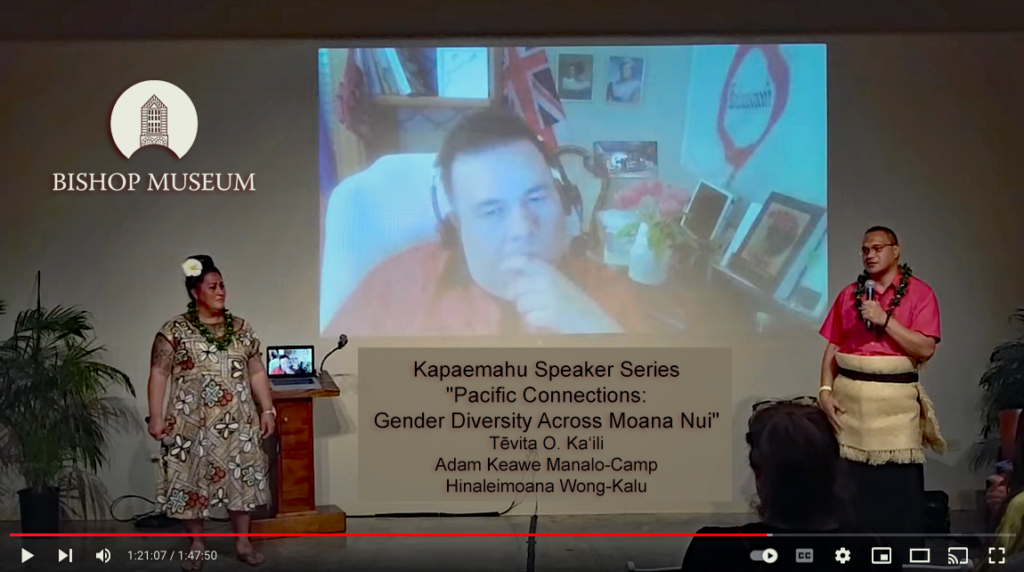
In Hawaiʻi, the creation chant, the Kumulipo, traces the origins of life to the combining of paired opposites: light and dark, earth and sky, wet and dry, male and female.
In conversation with co-curator Hinaleimoana Wong-Kalu, Professor Tēvita O. Kaʻili shares stories of gender duality from his native Tonga, and Hawaiian historian Adam Keawe Manalo-Camp discusses his research and storytelling initiatives to help revive Hawaiian understandings and histories of gender fluidity and same-sex relationships, including among revered rulers and nobles.
Watch the YouTube Live recording here.
Speakers include:
— Adam Keawe Manalo-Camp, Hawaiian cultural historian, President of Indigenous Pasifika
— Tēvita O. Kaʻili, Anthropologist and Dean of Pacific Studies at Brigham Young University — Hawaiʻi
— Hinaleimoana Wong-Kalu, co-curator of “The Healer Stones of Kapaemahu,” Kanaka Maoli teacher, cultural practitioner, and community leader
The Kapaemahu Program Series is generously supported by McInerny Foundation, Bank of Hawaii, Trustee.
Learn more about the exhibition: https://www.BishopMuseum.org/Kapaemahu
-
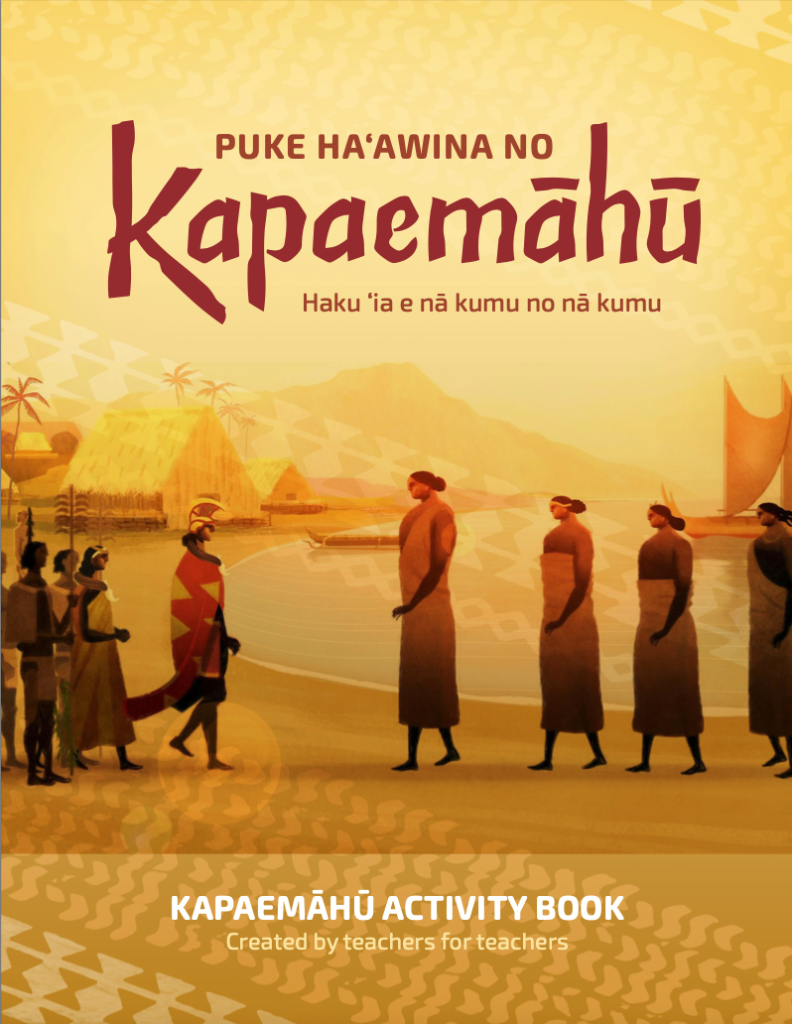
Kanaeokana Unveils Kapaemahu Activity Book
Kanaeokana Unveils Kapaemahu Activity Book
July 29, 2022:
Kanaeokana – a network of 80 Hawaiian culture, ʻōlelo and ʻāina-based schools (preschool-university) and community organizations – has unveiled a Kapaemahu Activity Book.
Created by teachers for teachers, the activity book is part of Kanaeokana’s efforts to develop and share educational resources that support the Hawaiian education system.
The Kapaemahu Project creators hope the book will also serve as a guide to help perpetuate the enduring legacy of The Healer Stones of Kapaemahu.
Free download here: Kapaemahu Activity Book Dual Language.
Learn more about Kanaeokana.