Author: Joe Wilson

  • Review of Kapaemahu Book, Documentary, and Museum Exhibition

    Review of Kapaemahu Book, Documentary, and Museum Exhibition

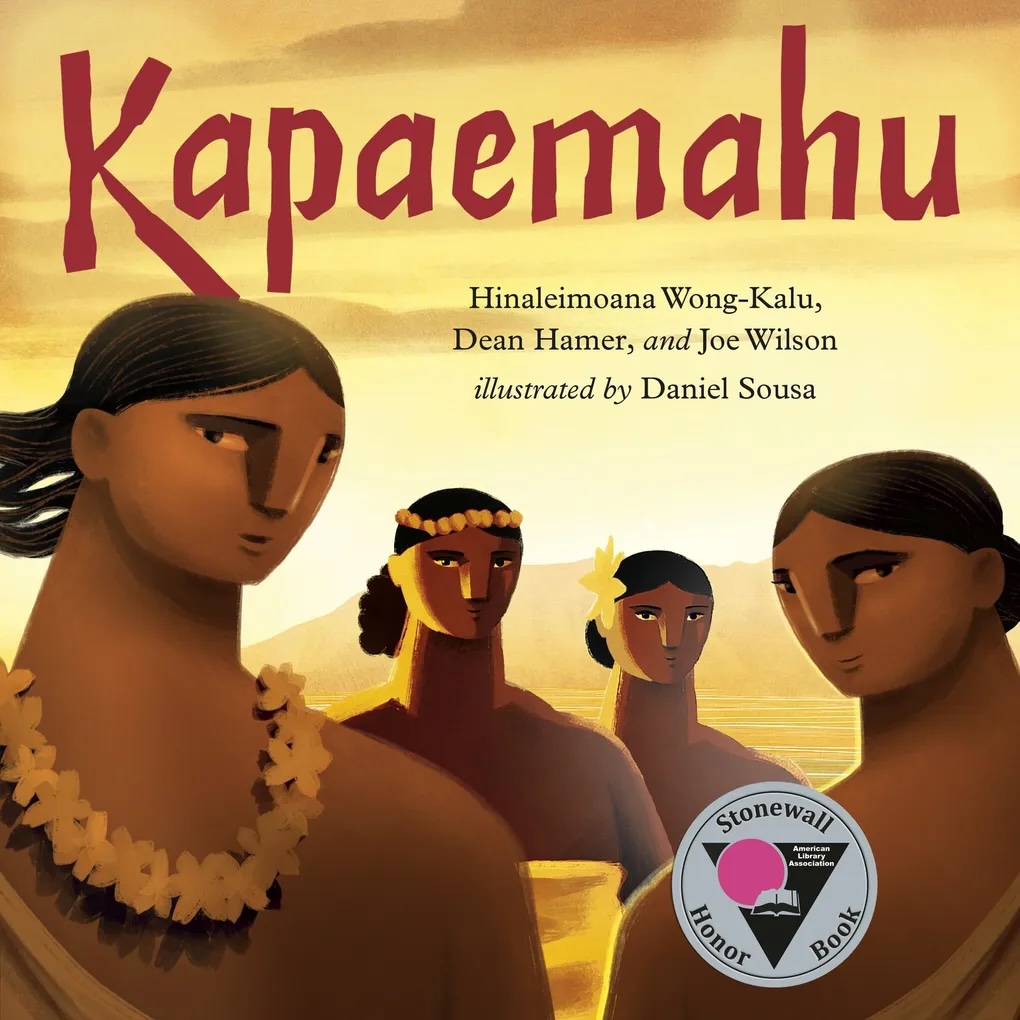
    The children’s book Kapaemahu, and documentary film and museum exhibition titled The Healer Stones of Kapaemahu, all by Dean Hamer, Joe Wilson, Daniel Sousa, and Hinaleimoana Wong-Kalu, reviewed by Tatiana Kalaniʻōpua Young for The Contemporary Pacific, Volume 36, Number 1, published by University of Hawaiʻi Press, 2024.

    Cari slot gacor hari ini? Link gacor terbaru sudah tersedia di Situs Gacor, platform slot online paling dipercaya yang selalu menyediakan link gacor maxwin dengan RTP tertinggi. Di Situs Gacor kamu bisa langsung akses game slot gacor pragmatic, pg soft, dan provider top lainnya yang sedang gacor malam ini. Dengan link gacor resmi yang selalu update, Situs Gacor menjadi pilihan utama para pecinta slot untuk mendapatkan kemenangan besar secara konsisten. Segera daftar dan rasakan sensasi bermain di link gacor paling ampuh saat ini!

  • Cast and Crew Reflect on Waikīkī Hula Show about Hawaiʻi’s LGBTQ History

    Cast and Crew Reflect on Waikīkī Hula Show about Hawaiʻi’s LGBTQ History

    by Catherine Cruz for Hawaiʻi Public Radio – December 31, 2025:

    With the end of 2025, you may have been wondering if New Year’s Eve would be the last performance of “The Return of Kapaemahu” hula show.

    The story of the stones there in Waikīkī was mounted by Kumu Hula Patrick Makuakāne and producers Joe Wilson and Dean Hamer.

    The producing duo spent $200,000 of a grant from the Mellon Foundation as part of their ongoing queer histories project in Hawaiʻi.

    The Hawaiʻi Tourism Authority also provided $50,000, and it’s unclear if this will be the end of its run or just the end of the first season.

    The Conversation caught up with some of the performers on Christmas Eve. It was supposed to be dark for the holiday, but the dancers decided to mount a show for visiting families.

    HPR heard from a number of the performers, but let’s start with sound and light engineer Peter Sturges, who shared what made this production so special.

    “I’ve been doing hula shows here on the mound for close to three years, but this show is so special because the quality of the cast and the production is so high,” Sturges said.

    Mark Mauikānehoalani Lovell is a teacher at Waikīkī Elementary and a cast member who believes providing a sense of place is important.

    “As a teacher, it’s important for me to find examples, not just of authentic culture, which I teach, but also of instances within the culture that still bear relevance to current events, to national politics, to things that my students may see,” Lovell said.

    He added that there has been a challenge for the Native Hawaiian community to find moments that resonate with others who do not come from the same culture, though Makuakāne’s approach has created an impact with people.

    “He has that gift. There’s not a lot of people who can do that,” Lovell said.

    “We can translate our stories into books. We have amazing storytellers. We have incredible theatrical productions. This is one of those few events that actually coordinates all three into a package that cultural people, non-cultural people, Indigenous people, non-Indigenous people, Hawaiʻi people, non-Hawaiʻi people can find common ground on. The fact that it centers the story of the māhū so unapologetically makes it all the more relevant and all the more important.”

  • 6 books for Asian American and Pacific Islander Heritage Month

    6 books for Asian American and Pacific Islander Heritage Month

    By Misha Stone and Mahina Oshie in The Seattle Times 5/14/25

    The Seattle Public Library loves to promote books and reading. This column, submitted by the library, is a space to share reading and book trends from a librarian’s perspective. You can find these titles at the library by visiting spl.org and searching the catalog. 

    May is Asian American and Pacific Islander Heritage month, but often, Pacific Islander and Filipino books and authors are less acknowledged in publishing, articles and displays. Here are some Pacific Islander and Filipino voices to discover in May and beyond.

    Kapaemahu,” a picture book by Hinaleimoana Wong-Kalu, Dean Hamer and Joe Wilson, illustrated by Daniel Sousa, resurrects a story suppressed for over a century.

    Based on the short animated film of the same name released in 2020, the book tells the journey of four Māhū healers from Tahiti to O’ahu. Each visitor — Kapaemahu, Kapuni, Kinohi and Kahaloa — brings their gentle ways and unique healing gifts to share with the people of Hawaii. In gratitude, four large stones were erected in their honor at Waikīkī. Buried under a bowling alley for two decades, the stones and their story have now been restored.

    The text, in English and ʻōlelo Niʻihau (the only surviving form of Hawaiian that was spoken prior to European contact), is accompanied by beautiful, warm-toned illustrations. For pronunciation help, download the audiobook narrated by Wong-Kalu to listen as you read along.

    See the full article and list of books here.

  • Local Filmmakers Dive into Hidden LGBTQ Histories among Hawaiʻi’s Cultural Communities

    Local Filmmakers Dive into Hidden LGBTQ Histories among Hawaiʻi’s Cultural Communities

    Local Filmmakers Dive into Hidden LGBTQ Histories among Hawaiʻi’s Cultural Communities

    by Catherine Cruz – The Conversation on Hawaiʻi Public Radio – April 22, 2024:

    From marriage equality in recent political times to acknowledging māhū voices in Native Hawaiian culture, sexual diversity is part of Hawaiʻi’s history. Those stories will be told on a wider scale thanks to a three-year, $900,000 grant from the Mellon Foundation.

    The project called Lei Pua ʻAla: Queer Histories of Hawaiʻi builds on a recent production by filmmakers Joe Wilson and Dean Hamer about the Kapaemahu stones in Waikīkī.

    The stones pay homage to four māhū healers who came to Hawaiʻi from Tahiti to treat diseases. Māhū describes someone with dual male and female spirits. According to the moʻolelo, the healers transferred their power into the stones, which have remained in Waikīkī for hundreds of years.

    Wilson and Hamer collaborated with cultural practitioner Hinaleimoana Wong-Kalu to tell that story through a short film, a children’s book, an exhibit at Bishop Museum, and even augmented reality.

    “Having these ancient stones that do celebrate gender fluidity and that are a place a kid can go to, or his family can go to, or a school troop can go to, that was really amazing. So it made us think, wow, it’d be great if we had more places like that and more reflections for lots of different people,” Hamer told The Conversation.

    Hamer and Wilson are in the early stages of a broader project documenting queer histories. They’ve teamed up with the Hawaiʻi Council for the Humanities, historian DeSoto Brown, Kumu Hula Patrick Makuakāne, Wong-Kalu and more.

    The project aims to bring forward hidden histories about LGBTQ experiences in all the cultures and ethnic groups that call Hawaiʻi home, such as a former Chinatown nightclub called The Glade that hosted what people today might call a drag show.

    “We’re doing all types of research and not just in the Hawaiian language newspapers, but also in the Chinese and Japanese newspapers. People sometimes forget that they have their own cultures that have same-sex experiences and gender-fluid experiences,” Hamer said.

    The project team is also interested in hearing from people about their experiences in Hawaiʻi that may not be written down anywhere.

    “We want to create a whole landscape that reveals what community life was like under the surface for people like us, essentially,” Wilson said.

    “We want to reveal the everyday people who are involved in making such, in the case of Hawaiʻi, positive change possible. You know, ups and downs, two steps forward, one step back, you know, occasional backlash, but it has been good — and we want to reveal some of those things here.”

    This interview aired on The Conversation on April 22, 2024. The Conversation airs weekdays at 11 a.m. on HPR-1. Sophia McCullough adapted this story for the web.

    Listen to the interview here.

  • Preserving the Original Story of Kapaemahu

    Preserving the Original Story of Kapaemahu

    Preserving the Original Story of Kapaemahu

    As a child in the 1980s, Hinaleimoana Wong-Kalu remembers swimming with her friends at Waikīkī Beach and then, cold and wet, sitting on the warm Kapaemahu Stones to dry off a bit before going home. At the time, she and her friends did not know the significance, or the story, of the stones, nor did she think that 30 years in the future she would be part of an effort to preserve and document the moʻolelo behind them.

    For decades, the Kapaemahu Stones were actually forgotten, neglected, and – during WWII – buried beneath a bowling alley as the wahi pana of Waikīkī was irrevocably transformed from a wetland ecosystem into an urban playground for tourists.

    In 1963, the stones were rediscovered after the bowling alley was demolished. Renowned teacher and historian Mary Kawena Pukuʻi knew the story of the stones, understood their cultural significance, and insisted they be preserved.

    Pukuʻi said that the name, Kapaemahu, means “a row of māhū.” But the plaque that was installed at the site called them “The Wizard Stones of Kapaemahu” (without translating “Kapaemahu”) and said they represented four “soothsayers” famous for their healing skills.

    In 1997, as part of an effort to restore Hawaiian culture and history in Waikīkī, the site was renovated and rededicated. The stones were placed on an elevated platform, enclosed inside a fence and the surrounding area was planted with native medicinal plants. The effort was led by historian George Kanahele and traditional healer “Papa” Henry Auwae. To this day, Auwae’s haumāna serve as the caretakers of stones.

    Still, the story about the stones shared on the signage did not include the detail that the healers were māhū or, significantly, that this contributed to their miraculous abilities.

    Wong-Kalu heard a moʻolelo about Kapaemahu while she was studying at UH Mānoa in the 90s. Years later, she shared the moʻolelo with filmmakers Dean Hamer and Joe Wilson while working with them on a documentary. But there were other versions of the story out there too.

    Intrigued, Hamer began to research the moʻolelo and incredibly, in 2015, he discovered an original manuscript recounting the story of Kapaemahu. It was written by James ʻAʻalapuna Harbottle Boyd, who served both King Kalākaua and Queen Liliʻuokalani. Boyd’s manuscript was published in Thrum’s Almanac in 1907.

    Kapaemahu is the story of four travelers who bring healing arts to Hawaiʻi from Kahiki. They are described as “māhū” being masculine in appearance, but feminine in nature. The account related by Boyd, which some speculate was told to him by Liliʻuokalani herself, leaves little room for debate as to the true nature of the four healers. Moreover, Boyd says that it was their duality of spirit that augmented their healing powers.

    “When I discovered the original manuscript, then dug through all the available newspapers and other sources from then until now, I began to understand how and why the story had been changed,” Hamer recalled. “That’s when it dawned on me that Kapaemahu is more than a story – it is a living record of a century of suppression and censorship.”

    In addition to working on an academy-award nominated animated short film about the moʻolelo, a children’s book, and an exhibit at Bishop Museum, Hamer, Wilson and Wong-Kalu began working to get the signage for the monument changed.

    That turned out to be a decade-long process that involved the City & County of Honolulu, the Mayor’s office and negotiation with the caretakers of the stones.

    “After learning the deeper meaning of the moʻolelo and thinking about all that’s lost when people are denied knowledge of their history, it was clear that this was something we had to do,” Wilson reflected. “Not doing something to help right the wrongs of the past would simply be maintaining the status quo, which is unacceptable.

    In traditional times, māhū had a place of honor and respect in Hawaiian society. Tuti Kanahele, a native speaker and university language instructor, says that māhū had kuleana for genealogy, healing, storytelling and hula and that without them, this knowledge would be lost.

    Lynette Paglinawan, a social worker and expert in hoʻoponopono explains that Hawaiians recognized that duality exists within everyone: “We have a ʻKu’ and a ‘Hina.’ We have a hard and a soft. We have a male and we have a female.”

    This understanding and social acceptance of māhū was shared throughout the Pacific. Similarly, the notion of duality is characterized as “two-spirit” in many Native American tribes. According to the Indian Health Service, “In most tribes they were considered neither men nor women; they occupied a distinct, alternative gender status.”

    Sadly, assimilation into Western culture and adoption of a Western lens has diminished the status and role of māhū within many Indigenous communities and precipitated discrimination against them.

    On Oct. 24, 2023, a new bronze plaque for the stones was dedicated – a victory after so many years of advocacy and negotiation. It features a QR code which takes visitors to www.kapaemahu.info. The site includes detailed information about the history and cultural significance of the stones, a guided virtual tour app, and a link to the animated short film, Kapaemahu.

    “It is a testament to the sophistication of Hawaiian society that our people knew there was much more than simply a gender binary existence, much more than just the physicality of our existence – that the heart, mind and spirit all culminate to make a whole person,” Wong-Kalu said. “They understood that one’s sexuality and preference, and one’s gender expression, is irrelevant in articulating who our people are and insufficient in speaking to our roles and responsibilities in society or the contributions we can make.”

    Full article here.

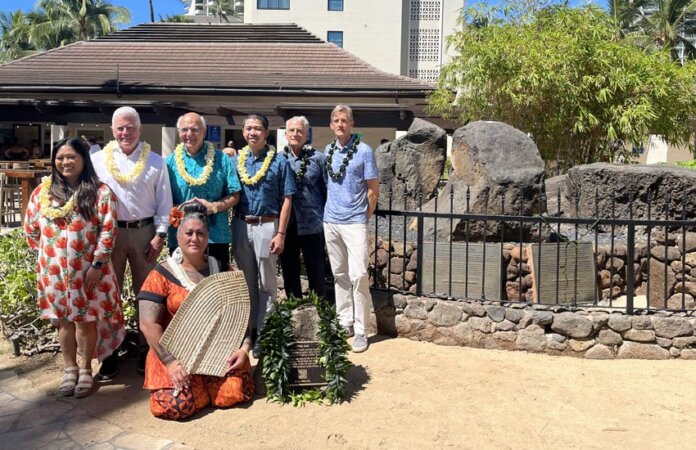
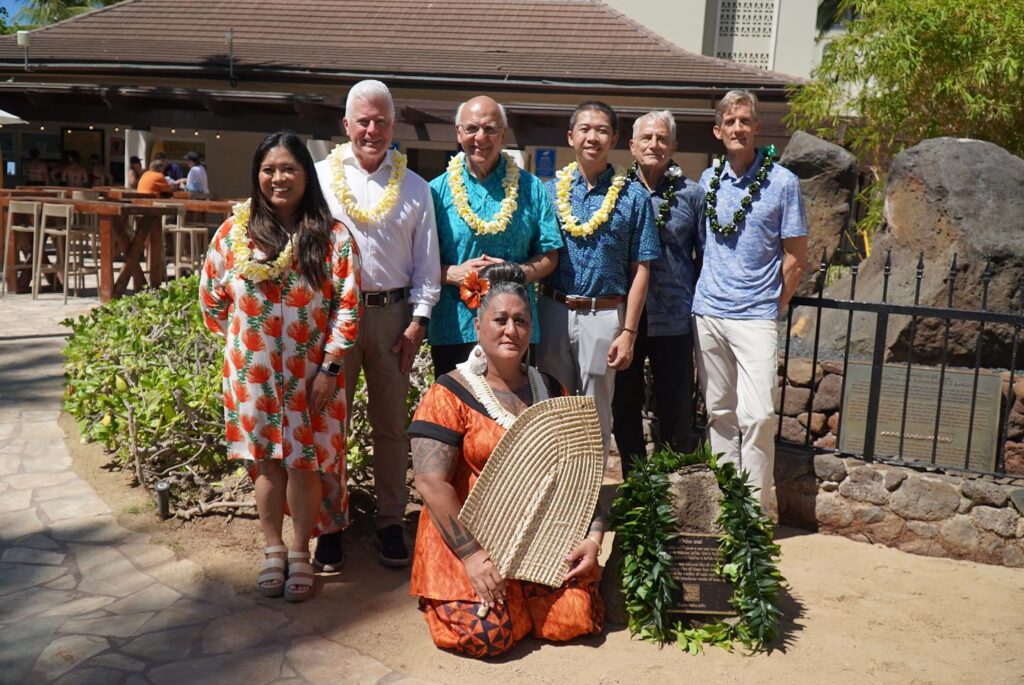
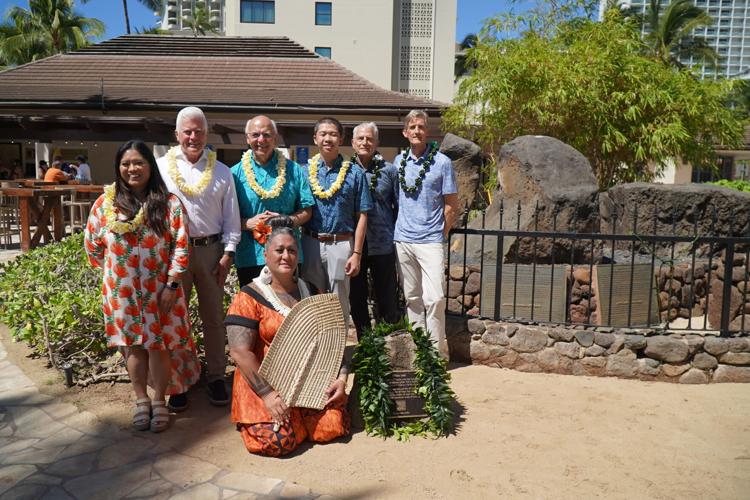
    The dedication of a new plaque at the Kapaemahu Monument in Waikīkī in late October was an effort 10 years in the making. Local leaders in attendance included (standing l-r) City Councilmember Radiant Cordero, City Managing Director Mike Formby, Mayor Rick Blangiardi, Rep. Adrian Tam, Dean Hamer and Joe Wilson. Kneeling is Hinaleimoana Wong-Kalu. – Photo: Puanani Fernandez-Akamine
  • Oscar-Qualified Queer Love Story ‘Aikāne’ Debuts Online

    Oscar-Qualified Queer Love Story ‘Aikāne’ Debuts Online

    Oscar-Qualified Queer Love Story ‘Aikāne’ Debuts Online

    by Mercedes Milligan – Animation Magazine – November 23, 2023

    Aikāne, the latest award-winning animated short from the team behind Kapaemahu, has been made available to watch online for free through queer news and culture outlet Them. Titled after the Hawaiian term for an intimate companion of the same sex, the 14-minute 2D piece is a supernatural romance about a brave warrior and his shape-shifting lover and advisor who make a stand against colonial forces.

    A valiant island warrior, wounded in battle against foreign invaders, falls into a mysterious underwater world. When the octopus who rescued him transforms into a handsome young man, they become aikāne, intimate friends bound by love and trust, and an epic adventure begins.

    The short was conceived by Dean Hamer and Joe Wilson, a married couple who began their filmmaking careers with a documentary about the reaction to their own same-sex marriage in Wilson’s small hometown. While the film most prominently draws from Native Hawaiian mythology, it also takes inspiration from LGBTQ+ legends from around the world — including Celtic Europe, ancient Greece and the Isle of Man in the Irish Sea. The settings are based on the couple’s free-diving experiences.

    Important guidance was provided by producer Hinaleimoana Wong-Kalu, a mahu (transgender) Native Hawaiian culture bearer. The team also included director and animator Daniel Sousa, who honed the look of the film’s imaginative settings; executive producers Judith Light and Daniel Karslake; and Dan Golden providing music and sound design. The film is a production of Qwaves and Kanaka Pakipaka.

    Aikāne made its festival premiere at Animayo and the Seattle International Film Festival in May, and has since earned a flurry of awards — including Academy Awards qualifiers from the Hawai’i International Film Festival (Best Made in Hawai’i Short), New Hampshire Film Festival (Animated Shorts Jury Award).

    In addition to the online screening on Them, festival goers can catch screenings of Aikāne at the current Native Cinema Showcase at the National Museum of the American Indian in Washington, DC (Nov. 17-24) and the upcoming Palermo International Film Festival (January 31) and AniMate (Sydney, March 3).

    Watch Aikāne on Them.us now. Check out the trailer below and learn more about the film and other works by the filmmaking team at qwaves.com.

    Full article here.
  • 2024 Oscars Short Film Contenders: ‘Aikāne’ Directors Daniel Sousa, Dean Hamer, And Joe Wilson

    2024 Oscars Short Film Contenders: ‘Aikāne’ Directors Daniel Sousa, Dean Hamer, And Joe Wilson

    2024 Oscars Short Film Contenders: ‘Aikāne’ Directors Daniel Sousa, Dean Hamer, and Joe Wilson

    by Jamie Lang – Cartoon Brew – November 9, 2023:

    Welcome to Cartoon Brew’s series of spotlights focusing on the animated shorts that have qualified for the 2024 Oscars. There are several ways a film can earn eligibility. With these profiles, we’ll be focusing on films that have done so by winning an Oscar-qualifying award at an Oscar-qualifying festival.

    Today’s short is Aikāne from directors Daniel Sousa, Dean Hamer, and Joe Wilson. The film earned its Oscars qualification by winning the New Hampshire Film Festival jury award for best animated short.

    The short tells the story of a courageous island warrior wounded in battle against foreign invaders. After the warrior falls into a mysterious underwater world, he is saved by an octopus that transforms into a handsome young man. The two become aikāne, intimate friends bound by love and trust.

    Cartoon Brew: A good portion of this film takes place underwater. Could you talk about the challenges that posed and how you overcame them?

    Daniel Sousa: Handling underwater scenes was certainly challenging in terms of character movement. As an animator, you’re always trying to give weight to a character, but in a weightless underwater environment, the focus shifts to how a character can navigate and propel himself convincingly through water resistance. Additionally, color and light operate differently in water, so handling the color palette and atmosphere effects was also a fun puzzle to figure out. Regardless of the technical challenges, what drew me to want to direct the film in the first place was that it was a love story, which I had not tackled before. So, the biggest challenge for me was developing characters with believable arcs and telling a universal story without words that a wide audience could understand and relate to. And to do it all within a 12-minute screen time.

    What was it about this story or concept that connected with you and compelled you to direct the film?

    Dean Hamer: We made this film because we believe that telling a queer love story with a happy ending is a form of resistance. The idea began during the pandemic when our previous short, Kapaemahu, was gaining traction on the festival circuit, even as a new swell of hate and discrimination rose against so-called “groomers and pedophiles” like me and my husband, Joe. We wanted our next work to show what happens when people are free to love who they love.

    The problem was that no existing myth fit the bill, so we had to write our own. The inspiration came in a flash during a dive in the ocean near our home. Deep under the surface, all the noise and rage above disappeared, and we experienced a uniquely tranquil togetherness. That was the feeling we wanted the story to convey and the setting in which we wanted the relationship to live.

    What did you learn through the experience of making this film, either production-wise, filmmaking-wise, creatively, or about the subject matter?

    Joe Wilson: The biggest lesson we learned from this film is the power of telling a story without words. Pantomime frees us from having to explain what is happening, letting the viewer experience what the protagonists are going through at a visceral level. It also makes the film more accessible and focuses visual attention; every glance, gesture, and movement are significant.

    But the biggest, unexpected benefit was that it freed us up to imagine a world that is difficult to describe in words because it does not yet exist. A world free of homophobia and prejudices, where the relationships we form and the trust we give are not limited by anyone or anything but the strength of our love. That is the world we hope to show in Aikāne.

    Can you describe how you developed your visual approach to the film? Why did you settle on this style/technique?

    Daniel Sousa: Right from the start, we were informed by the environments of Hawaii that Dean and Joe were very familiar with, but for which I needed a lot of reference, working from Rhode Island. We wanted to explore the rich underwater colors of coral reefs and the majestic landscapes of the islands. In a lot of my previous work, the color palette has been very monochromatic, so it was a completely new way to approach color. For movement, we looked at an old Tarzan with a beautiful tandem underwater dance and the hypnotic movements of octopus tentacles as they swim or crawl. The visual language for the film needed to be nimble and not too limited by abstract design rules because the story covered a wide range of locations and character interactions. Instead, we focused on light as an overarching design principle that helped to set the tone for each dramatic moment.

    Full article here.
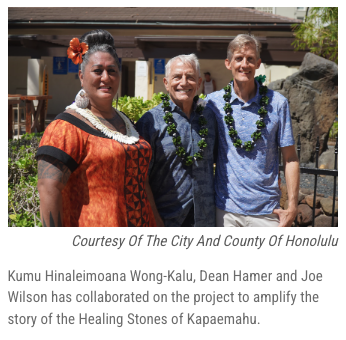
  • New plaque unveiled at Kapaemahu stones

    New plaque unveiled at Kapaemahu stones

    New plaque unveiled at Kapaemahu stones

    by Linsey Dower – Honolulu Star-Advertiser – October 26, 2023:

    The City and County of Honolulu held a blessing this week at the Healer Stones of Kapaemahu, where a new plaque was unveiled that includes a QR code to an online website with additional history and information.

    The two stones date back more than 500 years, and they were placed there in honor of four healers from Tahiti who made significant impacts throughout the Hawaiian Islands with their practice.

    “This is a historic day for the city,” Honolulu Mayor Rick Blangiardi said Tuesday. “I’m very proud that we’re actually here today and this has become a reality.”

    The stones honor four mahu (someone of dual male and female spirit) healers named Kapaemahu (the leader of the group), Kapuni, Kinohi and Kahaloa. They were placed in Waikiki at the request of the healers, near where they had taken up residence to ensure that they would be remembered, said Dean Hamer, a researcher, director, producer and editor on the Kapaemahu team.

    “They actually wanted people to know about the stones and know about them,” Hamer said. “So we’ve been doing everything we can to get the story more widely known.”

    The stones were cherished by Native Hawaiian nobility until the early 1900s, when they began to see an era of neglect alongside the growing sense of disrespect toward mahu. In 1941 a bowling alley was constructed on top of the stones, until they were recovered in 1963.

    In 1997 the stones were placed on an elevated platform amid an effort to restore a sense of Hawaiian culture to Waikiki. However, with nationwide debates over same-sex marriage being a major topic of controversy at the time, the plaque installed that year excluded information about their connection to gender diversity.


    While the story of the stones’ connection to mahu became lost to the general public, Hamer noticed the absence of its mention on the plaque when kumu Hinaleimoana Wong-Kalu told him of the four healers about 11 years ago. The realization sparked a 10-year search for the stones’ full story, which concluded when it was rediscovered in the Hawaiian language newspapers at the University of Hawaii at Manoa archives, Hamer said.

    The research shed light on the fact that the healer stones, which were known as the Wizard Stones for a time, were actually called Ka Pohaku Kahuna Kapaemahu (The Healer Stones of Kapaemahu). It also clarified the healers’ intentions and their desire to be remembered.

    “It’s not like we’re commercializing the story,” Hamer said. “It’s more like we’re doing what the healers themselves wanted us to do.”

    Since then, those involved on the Kapaemahu Project have been doing everything they can to share the story, Hamer said.

    Joe Wilson, Hamer’s partner and director, producer and impact strategist on the Kapaemahu team, expressed that while the original story of the stones displays an appreciation for the healers and their abilities, as well as a society of love and inclusion, it also conveys a deeper message.

    “I now see that somehow these great visionaries of old knew that in the future, things might change,” Wilson said. “Kapaemahu should and will be a shining example of a city that honors and celebrates its culture, diversity and all who visit or call it home.”

    To continue perpetuating the history of the stones, a free virtual reality app called KAPAEMAHUAR was created so that those interested in the site can take a virtual self-guided tour of it. The link to download the app is included on the newly installed plaque.

    “We wanted the app to be succinct, so that it would be something like a short introduction to before they come to the stones,” said the KAPAEMAHUAR software developer, Kari Kehau Noe. “We want to interest everybody and get them excited and know about the stones, but we want them to actually come and see the stones and appreciate their existence.”


    Since beginning their research on the Kapaemahu stones, word of its story has drawn feedback from those who have said it has been helpful in feeling accepted in their gender identity, Wilson said.

    Others have said the story has helped them find connection to their own gender identity, Hamer added.

    “We didn’t know how people would react, but when kids that are especially sort of gender fluid, or they’re wondering about their sexuality, or they’re wondering about their gender — when they hear that story, they see themselves reflected and it’s just incredibly powerful,” he said. “That’s been incredibly moving for us.”

    Original article here.

  • The Stones of Kapaemahu in Waikīkī get a new plaque and AR experience

    The Stones of Kapaemahu in Waikīkī get a new plaque and AR experience

    The Stones of Kapaemahu in Waikīkī get a new plaque and AR experience

    Hawaii Public Radio | By Cassie Ordonio | October 25, 2023

    A new plaque in front of a popular Waikīkī’s monument commemorates the story of four mahu healers from Tahiti who came to Hawaiʻi to treat diseases.

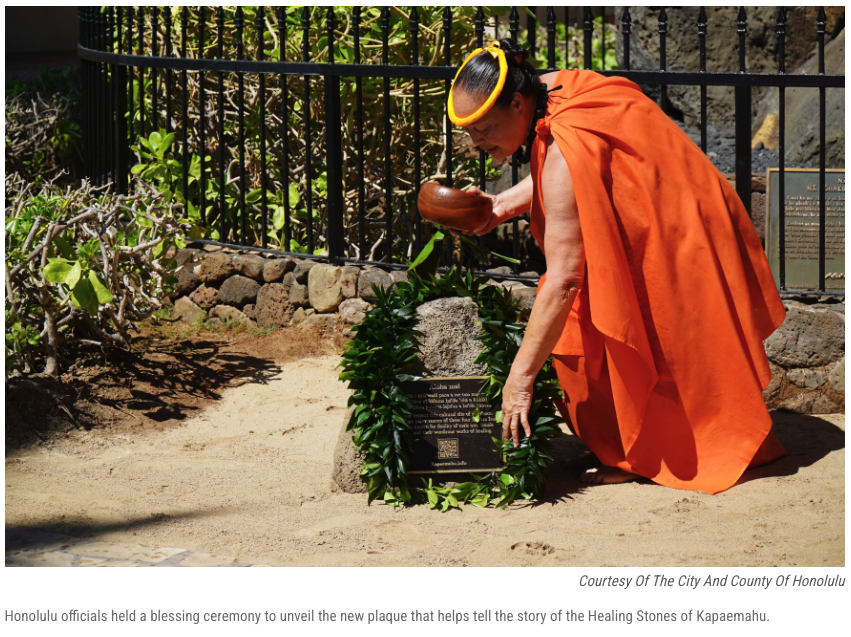
    Honolulu officials held a ceremony Tuesday to unveil the new plaque installed on a stone outside of the gated Healer Stones of Kapaemahu.

    The stones pay homage to the healers’ contributions in Hawaiʻi. According to the moʻolelo, the Tahitian healers transferred their powers into the stones that had remained in Waikīkī for hundreds of years. They were mahu, people of dual male and female spirit.

    The stones have endured years of neglect, including being buried under a bowling alley for over two decades until they were recovered in 1963. The stones are now located at the western end of Kūhiō Beach Park.

    Many visitors have passed the site, unaware of the history behind the stones. While older plaques exist inside the fence, they can be difficult to read.

    There were incidents where people sat on the stones or placed their boards on them, according to Kehau Noe, a computer science PhD student at the University of Hawaiʻi at Mānoa. She’s part of the project to diversify and share the stones’ history.

    “The stones are in a highly tourist-centric area,” Noe said. “People don’t realize how important they are.”

    A QR code engraved in the plaque takes visitors to a webpage providing stories and interpretations. What’s new is a virtual reality tour guide of the stones, created by Noe in collaboration with cultural advocate Kumu Hinaleimoana Wong-Kalu and filmmakers Dean Hamer and Joe Wilson.

    Noe helped create an augmented reality application, which is the real-time use of virtual audio and graphics woven into real-world environments. The team came up with scripts and filmed Wong-Kalu telling the story.

    The AR app will briefly introduce the stones, their genealogy and history while providing a creative outlet for visitors to experience the stones virtually in detail.

    “By telling it through all these different mediums, we’re finding different ways to bring life to the story and to perpetuate it in ways that will work for everyone,” Noe said.

    The stones are well-protected today, Hamar said.

    “They’re beautifully displayed, but as Hawaiʻi changed, so did the story,” Hamer said. “The part about the healers being mahu and the connection to gender duality was nearly erased. But fortunately, it wasn’t completely forgotten.”

    Hamer emphasized that the news AR app will help reach a broader audience.

    “The Stones of Kapaemahu are more than a tourist site, and they deserve to be better understood by locals and visitors alike, “Wong-Kalu said in a news release. “They are an insight into our Pacific understandings of male and female, life and healing, and the spiritual connections between us all.”

    Listen and read full article here.

  • Honolulu tells story of healers with dual male and female spirit through new plaque in Waikiki

    Honolulu tells story of healers with dual male and female spirit through new plaque in Waikiki

    Honolulu tells story of healers with dual male and female spirit through new plaque in Waikiki

    by Audrey McAvoy – AP News – October 24, 2023:

    HONOLULU (AP) — Honolulu officials on Tuesday introduced a new interpretive plaque for four large boulders in the center of Waikiki that honor Tahitian healers of dual male and female spirit who visited Oahu some 500 years ago.

    The centuries-old boulders — one for each of the four visiting healers — are protected by an iron fence in a beachside park surrounded by hotels and shops in the heart of the world-renowned tourist district. The monument is known as the stones of Kapaemahu, after the group’s leader.

    According to stories handed down orally, the boulders were placed on Waikiki’s shore at the time of the healers’ visit. But the stones became neglected more recently. In 1941, a bowling alley was even built over them and remained there for two decades.

    The earlier plaque dates to 1997. It doesn’t acknowledge the healers were “mahu,” which in Hawaiian language and culture refers to someone with dual male and female spirit and a mixture of gender traits.

    Scholars blame that omission on the homophobia and transphobia pervasive in Hawaii after the introduction of Christianity. Missionaries pushed aside gender fluidity’s deep roots in Hawaiian culture and taught believers to suppress anything that deviated from clearly defined male and female gender roles and presentations.

    The new plaque is attached to a stone in front of the iron fence.

    “Please respect this cultural site of reverence,” the sign says. “There are many stories of these four healers from Tahiti, known for duality of male and female spirit and their wonderous works of healing.” The plaque includes a QR code and the address to a website with more information about the stones and their history.

    Kumu Charlani Kalama, whose title “kumu” is the Hawaiian language term for master teacher, performed a blessing with ti leaves and salt. Kumu Hinaleimoana Wong-Kalu draped lei on the fence.

    Joe Wilson, a member of a group that pushed for signage acknowledging a more complete story of the stones, said monuments and public art are powerful symbols of who and what are valued by a community.
     

    “Kapaemahu should and will be a shining example of a city that honors and celebrates its culture, diversity and all who visit or call it home,” Wilson said at the blessing ceremony.

    The story of the stones was initially handed down orally, like all tales in Hawaii before the introduction of the written language in the 1800s. The first written account appeared in a 1906 manuscript by James Alapuna Harbottle Boyd, the son-in-law of Archibald Cleghorn, who owned the Waikiki property where the stones were at the time.

    Wong-Kalu, who is mahu and a community leader, said she stopped by Boyd’s grave before the ceremony to pay her respects and express her gratitude that he wrote down the story for subsequent generations.

    “If not for his recordation of this, we would not be able to tell this story today,” Wong-Kalu said.

    Honolulu’s mayor said the future of tourism lies in teaching visitors about the culture of a place so they appreciate it for more than its beautiful beaches and the ocean. The stones can help do that, he said.

    “I’m hoping that the people who are interested will realize that it’s just not four stones in Waikiki. There’s a meaning and a history and even a spirituality,” Mayor Rick Blangiardi said after the ceremony.

    Full article here.