Category: News

  • ‘The Healer Stones of Kapaemahu’: an Exhibit on Gender and Erased History

    ‘The Healer Stones of Kapaemahu’: an Exhibit on Gender and Erased History

    by Zoe Dym – Hawai’i Public Radio – June 22, 2022:

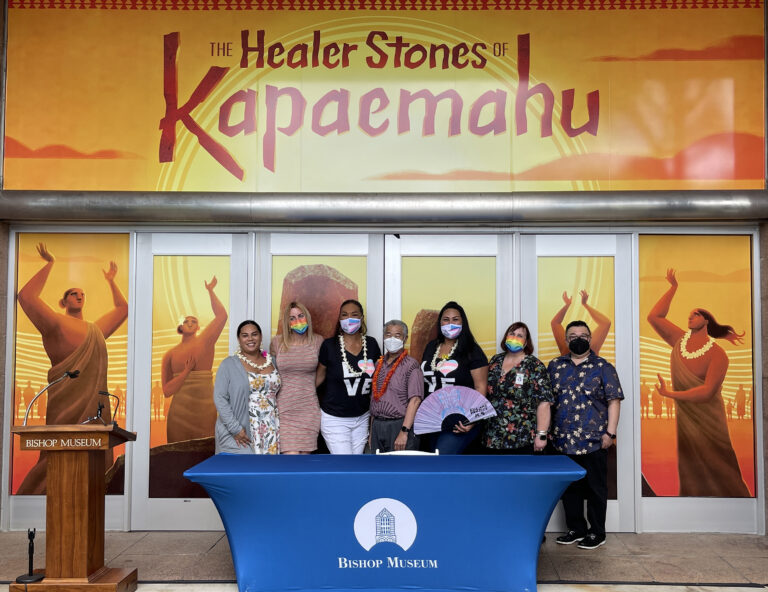
    The Bishop Museum opened a bilingual exhibit in English and ʻŌlelo Niʻihau on the history of māhū over the weekend. Māhū means to have a dual male and female spirit.

    The exhibit is called “The Healer Stones of Kapaemahu.”

    According to a moʻolelo, four māhū healers from Tahiti came to Waikīkī and treated diseases. Kapaemahu was the leader of the group. The healers transferred their mana into four stones before leaving the island.

    Today there are four large stones between the Duke Kahanamoku statue and the public shower facility at Waikīkī Beach. These are the healer stones of Kapaemahu.

    The plaque in front of the stone provides a story about the healers, but omits any detail on their gender.

    “The Healer Stones of Kapaemahu” exhibit showcases the erased history of gender fluidity in Hawaiʻi.

    Dean Hamer, the co-curator of the exhibit, says the healers’ powers and skills are embedded in their māhū identity.

    The idea for an exhibit on the Kapaemahu stones began 10 years ago when Hamer and his partner Joe Wilson were filming their documentary, “Kumu Hina.” It focuses on Native Hawaiian māhū Hinaleimoana Wong-Kalu.

    The conversation to build an exhibit on Kapaemahu started when Wong-Kalu began chanting to the healer stones.

    Visitors are recommended to watch an animated short film before walking through the rest of the exhibit. The film explains the moʻolelo in ʻŌlelo Niʻihau with English subtitles.

    After watching the animation, guests can walk through the history of the Kapaemahu stones, healing arts, and sex and gender diversity.

    A section of the exhibit is dedicated to contemporary topics of gender diversity in Hawaiʻi.

    Hidden behind a curtain is a replica of the Glade Show Lounge — a now-closed nightclub in Chinatown with transgender performers.

    Performers from Glades were forced to wear a pin that read “I Am A Boy.” A state law passed in 1963 deemed the performers and other transgender residents were dressing as women with the intent to deceive.

    “The Healer Stones of Kapaemahu” features contemporary voices of people across the gender spectrum in the Pacific Islands.

    The exhibit is open until Oct. 16 in the Castle Building. Bishop Museum is open daily from 9 a.m. to 5 p.m. More information at bishopmuseum.org/kapaemahu
  • Gov. Ige’s Remarks at LGBTQ+ Bill Signing Ceremony

    Gov. Ige’s Remarks at LGBTQ+ Bill Signing Ceremony

    Governor David Ige’s Remarks at LGBTQ+ Bill Signing Ceremony

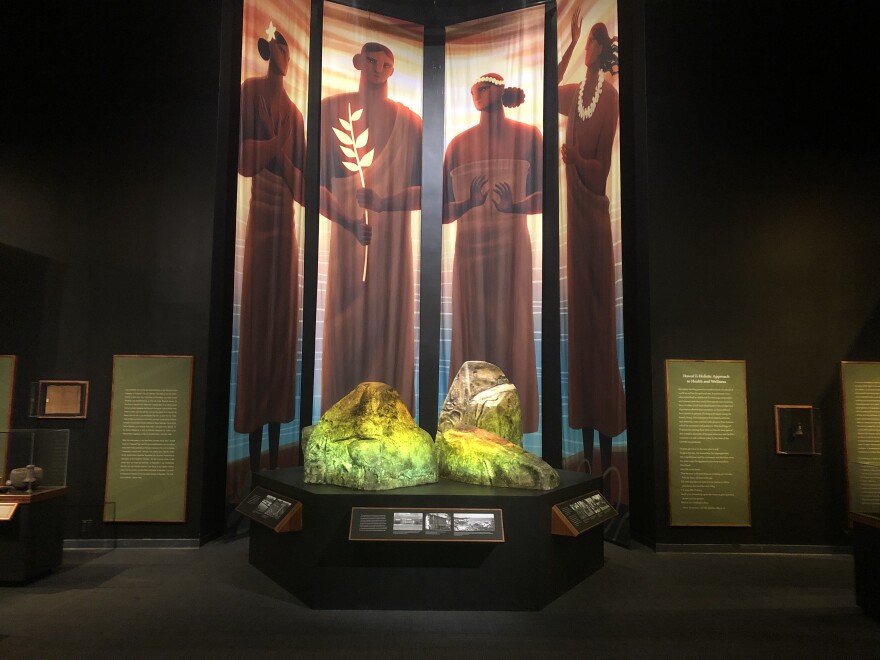
    Hawaii Governor David Ige chose The Healer Stones of Kapaemahu exhibition at the Bernice Pauahi Bishop Museum, which represents Hawaii’s long history of acceptance and inclusion, as the backdrop for the June 16, 2022 signing of three bills passed by the State Legislature to address needs and concerns of the Mahu / LGBTQ+ community.

    Here’s what will now become law in Hawaiʻi:

    1) Insurance providers will be prohibited from excluding gender affirming treatments when medically necessary and will require health plans to provide information on gender transition services. (HB2405)

    2) Measure signed to ensure gender identity or expression cannot be a reason for excluding a citizen from jury service (making sure discrimination plays no part in our legal system). (SB2136)

    3) The Hawaiʻi state Lesbian, Gay, Bisexual, Transgender, Queer, Plus commission will be established on a permanent basis. (SB2670)

  • New “Kapaemahu” Exhibit at Bishop Museum

    New “Kapaemahu” Exhibit at Bishop Museum

    New “Kapaemahu” exhibit at Bishop Museum

    by Kamaka Pili | June 16, 2022 | KHON2 News

    HONOLULU (KHON2) – When you’re walking through Waikiki, next to the police station there are four stones within a fenced enclosure. 

    It’s known as the Wizard Stones, but that is not the most accurate depiction of what they are and the stories they share.

    At the Bishop Museum, there is a brand new exhibit entitled “The Healer Stones of Kapaemahu” to help all of us to learn more about these stones and the message that it carries. 

    So, to find out more, we’re here with one of the curators and historian of Bishop Museum, DeSoto Brown. 

    Tell us a little bit about this exhibit and what can we expect to see.

    “This is an exhibit in Bishop Museum’s Castle Building.  It runs from right now to October of this year and it is telling the story, as you said, of the healer stones of Kapaemahu which are located in Waikiki,” said Brown.

    “The stones themselves have been through an amazing transition from a rural area into the modern bustling, crowded city that they are located in now.  And one of the things we want to get across mainly is the story of who the healers really were. Who is commemorated by these stones?  They are the Kapaemahu, the role of mahu. That’s the story we want to tell. How else does that fit into society now, what was the traditional role of people who were mahu in the past, what’s the role of people who are mahu in the pacific today?  And not only that, but the fact also that they were healers, the fact that we have lost a lot of the traditional healing knowledge which was associated with the mahu who we are talking about here.”

    Thank you very much, DeSoto. 

    But I want to get in another person who can speak more about this and that is Kumu Hina who is a very prominent figure within not just this exhibit, but the film that this has been based off of. 

    If you don’t mind, Kumu Hina, can you share your perspective of what Kapaemahu represents.

    “Kapaemahu, for me, represents rendering of our history, rendering of 4 wonderful, marvelous individuals that journeyed from across thousands of miles of ocean from the lands of Kahiki and they brought with them the knowledge of healing and the skill of making people well,” said Kumu Hina.

    I have to say that the time that this comes out in the world that we live in today, there is no better time than now. 

    What does that mean for you that this exhibit is here for people to learn from?

    “This exhibit is here during this time where we come away from a world that has been impacted by the covid, the coronavirus. And we see that everybody has now been on heightened sensitivity,” said Kumu Hina.

    “And what better story can we bring to the world than the story of healing and it just so happen that these healers that brought their skill and knowledge to Hawaii happen to be of dual spirit. They were of male and female spirit and that’s what made them the powerful healers that they were. They were not just one or the other, but they had elements of both that made them all the more special.”

    Here at the Bishop Museum, the Healer Stones of Kapaemahu exhibit opens up to the public this Saturday, June 18.

    And separately, to find out more about what mahu means, be sure to catch our previous Aloha Authentic episode where I speak with Kumu Hina to learn more about that.

    For all the information on this exhibit, click here.

  • Historic LGBTQ+ Bills Signed into Law by Governor Ige at Bishop Museum

    Historic LGBTQ+ Bills Signed into Law by Governor Ige at Bishop Museum

    Historic Mahu/LGBTQ+ Bills Signed into Law by Governor Ige at Museum Exhibition

    by Cynthia Yip | June 16, 2022 | KITV4 News

    HONOLULU (KITV4) — Governor David Ige signed three bills into law today that protect the rights of the LGBTQ+ communities in Hawaii.

    The historic bill signing event took place at Bishop Museum. Several representatives of Hawaii’s LGBTQ community were on hand for the bill signing ceremony today. Two of the bills address insurance coverage for gender affirming treatments and jury participation for the LGBTQ community. The third measure establishes the Hawaii LGBTQ+ Commission.

     “Collectively, these 3 bills are critical in supporting the LGBTQ+ members in our communities,” says Gov. Ige. “They will help us identify social and community issues more effectively and ensure that we can work to prevent discrimination in many areas of our society.”

    “My hope is that we send a strong message across the nation that while some states are looking backwards, Hawaii will continue to move forward,” said Rep. Adrian Tam (D).

    “These bills while important each in their own merits, mean so much more because it is not just about a commission, or jury service or anything else this is about fundamentally rejecting the politics of division,” said Senator Chris Lee (D).

    On the same day of the historic signing of the 3 bills that protect the Mahu and LGBTQ community, the Healer stones of the Kapaemahu Exhibition opened at the Bishop Museum.

    Dean Hamer – Co-curator , The Healer Stones of Kapaemahu , “These stones honor 4 Mahu people of dual male and female spirit who long ago brought the healing arts long ago from Hawaii.

    Hamer adds, “These bills protect the rights of LGBTQ people and it makes sure our community is at the table as decisions are made and reflects that these are not new or radical ideas these are old ideas. That have been here long before Westerners arrived.

    Rep. Adrian Tam (D) Waikiki – Ala Moana “This monument that we are showcasing is the only gender fluid monument in the world.”

    The Real Healer Stones of Kapaemahu, from which the stones at the Bishop Museum are recreated, are located on Waikiki Beach. 

    The immersive exhibit includes the animated film Kapaemahu which was produced by Co-curators, Dean Hamer, Joe Wilson and Hinaleimoana Wong-Kalu.

  • New Book, ‘Kapaemahu,’ Illuminates Native Hawaiian Legend about Individuals of Dual Male & Female Spirit

    New Book, ‘Kapaemahu,’ Illuminates Native Hawaiian Legend about Individuals of Dual Male & Female Spirit

    New Book, ‘Kapaemahu,’ Illuminates Native Hawaiian Legend About Individuals of Dual Male & Female Spirit

    by Lia Kamana, KITV4

    HONOLULU (KITV4) – For the first time in U.S. history a picture book has been published in both English and Olelo Niihau.

    Olelo Niihau is the only form of Hawaiian that has been continuously spoken since the overthrown of the Hawaiian Queen.

    Joining GMH is Hinaleimoana Wong-Kalu and Dean Hamer the authors of ‘Kapeamahu’

    The book goes on sale Tuesday June, 7. 

    Watch video interview here.

  • “Kapaemahu is a Glorious Picture Book” – School Library Journal

    “Kapaemahu is a Glorious Picture Book” – School Library Journal

    “Kapaemahu is a Glorious Picture Book” – School Library Journal

    by Terry Hong – School Library Journal – May 2, 2022:

    Moving across the Pacific to Hawaii finds Hinaleimoana Wong-Kalu, the co-creator, with Dean Hamer and Joe Wilson, of the glorious picture book Kapaemahu (2022). The mythic legend of the Kapaemahu regales four Tahitian healers who arrived in Waikiki centuries ago. Neither male nor female, “they were mahu—a mixture of both in mind, heart, and spirit,” the book reveals. The people built a monument in gratitude, but the “four great boulders” eventually disappeared in the wake of U.S. colonialism and destructive tourism. The stones were finally recovered, but without their history: “The fact that the healers were mahu has been erased.” Kapaemahu reclaims the monument’s true origins by honoring the mahu.

    Before the book, Kapaemahu was an animated short film that garnered international acclaim, including a 2021 Oscars short list nod. The film’s production team adapted their gorgeous moving images to the page. The book, like the film, is bilingual, presented in Olelo Niihau first, followed by the English translation. Olelo Niihau, Wong-Kalu explains in the author’s note, is “the only form of Hawaiian that has been continuously spoken since prior to the arrival of foreigners.” Wong-Kalu, who is “Kanaka—a native person descended from the original inhabitants of the islands of Hawaii,” rightfully insists, “We need to be active participants in telling our own stories in our own way.”

    Like many native Hawaiian youth of her generation and generations that followed, Wong-Kalu “didn’t grow up with the presence of Hawaiian history and culture,” she says. Her broader education that began in the late 1990s at the University of Hawai’i at Manoa “cumulatively heightened [her] awareness of being Hawaiian,” including discovering the legend of Kapaemahu. Wong-Kalu, too, is neither male nor female, but mahu. “It was quite liberating to learn that something associated with mahu was so positive,” she says.

    For Wong-Kalu, claiming and preserving her native heritage in a climate of cultural erasure is of critical importance: “Evidence of anything Hawaiian is fleeting or at least diminished greatly—the history of Hawaii continues to be rewritten by foreigners who are replacing our story with their story,” she says. With Kapaemahu, Wong-Kalu fights back: “I view the telling of this story as a stepping-stone to inspire others to tell their stories and histories.”

  • “A Spectacular Picture Book Reclamation” – Smithsonian Book Dragon

    “A Spectacular Picture Book Reclamation” – Smithsonian Book Dragon

    “A Spectacular Picture Book Reclamation” – Smithsonian Book Dragon

    Review by Terry Hong for the Smithsonian Asian Pacific American Centerʻs Book Dragon – April 19, 2022:

    Kapaemahu began as an animated short film that garnered international recognition. The award-winning production team of Hinaleimoana Wong-Kalu, Dean Hamer, and Joe Wilson now sets their script onto the page, resulting in a spectacular picture book featuring stills from animation director Daniel Sousa’s moving images. The story here has been waiting for reclamation for centuries.

    “Long ago,” four Tahitians arrived in Hawaii, settling in Waikiki. “The visitors were tall and deep in voice yet gentle and soft-spoken.” Most importantly, “They were not male; they were not female. They were mahu – a mixture of both in mind, heart, and spirit.” Their leader was the titular Kapaemahu; each member of the quartet was skilled “in the science of healing.” In gratitude, the people erected a monument of “four great boulders” into which “the healers began to transfer their powers.” Then the mahu disappeared. Eventually, “everything changed.” Wordlessly, hauntingly, Sousa shows how Christianity took hold, foreign soldiers took charge, progress eventually brought high rises and tourists. And “the stones of Kapaemahu were forgotten, even buried under a bowling alley.” The stones were finally recovered, but not their history: “the fact that the healers were mahu has been erased.”

    The book, like the film, is bilingual, with the film’s Olelo Niihau language followed by an English translation that differs slightly from the animated subtitles. Olelo Niihau, Wong-Kalu explains, is “the only form of Hawaiian that has been continuously spoken since prior to the arrival of foreigners.” Wong-Kalu, who is “Kanaka – a native person descended from the original inhabitants of the islands of Hawaii,” rightfully insists, “We need to be active participants in telling our own stories in our own way.” She adds, “I am also mahu, which like many Indigenous third-gender identities, was once respected but is now more often a target for hatred and discrimination.” Co-creators Hamer and Wilson offer hope: “We are especially excited about bringing this story to the next generation, who often have an easier time than their parents in accepting that not everybody is the same.”

    Sousa’s full-page bleeds and saturated palette of predominantly deep earth colors display potent images that can’t – won’t – be contained. Light heightens Sousa’s superb imagery: glowing golds underscore gentle strength; soft, wispy white captures healing energy; fiery reds display the mahus’ tenacious fortitude. Power continues to flow through transparent prose and magnificent visuals, gifting audiences with ancient insights celebrating acceptance and inspiring strength.

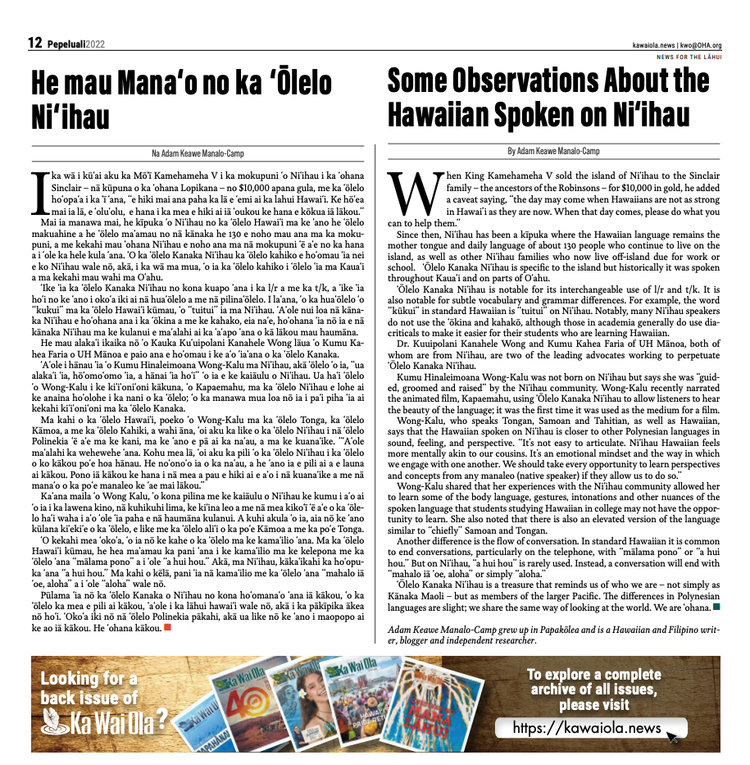
  • Observations About the Hawaiian Spoken on Niʻihau

    Observations About the Hawaiian Spoken on Niʻihau

    Observations About the Hawaiian Spoken on Niʻihau

  • THE HEALER STONES OF KAPAEMAHU: June 18 – Oct 15, 2022

    THE HEALER STONES OF KAPAEMAHU: June 18 – Oct 15, 2022

    THE HEALER STONES OF KAPAEMAHU: June 18 – Oct 15, 2022

    Bernice Pauahi Bishop Museum announces a new, original exhibition that will explore the hidden history and contemporary meaning of what may be the world’s only public monument celebrating gender fluidity – The Healer Stones of Kapaemahu.

    Honolulu, Hawaiʻi — Bernice Pauahi Bishop Museum announces a new, original exhibition coming to its Castle Memorial Building in June: The Healer Stones of Kapaemahu. The exhibition emerged from the research behind an Oscar-contending short film, Kapaemahu, that brought the unexpurgated legend to life.

    The Healer Stones of Kapaemahu will explore the history and contemporary meanings of four large pōhaku (stones) on Waikīkī Beach. These pōhaku were placed long ago as a tribute to four māhū, people of dual male and female spirit, who brought healing arts from Tahiti to Hawaiʻi. Although the stones have survived for centuries, the story behind them has been suppressed and the respected role of māhū erased. Using immersive media and innovative storytelling approaches, the exhibition revitalizes this traditional story to help restore this sacred site as a permanent reminder of Hawaiʻi’s history of inclusion and acceptance.

    “This exhibition presents our Hawaiian view of gender duality as a natural aspect of the human experience,” said Hinaleimoana Wong-Kalu, a curator of the exhibition who herself identifies as māhū. “It brings knowledge and wisdom of the past into the present-day conversation.” The Healer Stones of Kapaemahu will be a multifaceted exhibition that combines film, art, archival documents and images, storytelling, and other interactive elements, sharing that for Hawaiian history and culture to be understood and appreciated, it must be seen from a Hawaiian perspective. In the case of Kapaemahu, this perspective centers gender duality, erased from a beloved moʻolelo (story) over time by foreign influences, as a natural and respected aspect of the human experience and a central element of the science of healing.

    In presenting the original moʻolelo, and examining the ways in which it, and the monument erected to honor its heroes, were altered in the 20th century, the exhibition also challenges visitors to ponder how other aspects of Hawaiian history and culture might have been suppressed, changed, or lost. More importantly, visitors will understand that these aspects of Hawaiian culture now have the opportunity to be restored and elevated.

    On View June 18 – October 15, 2022
    Museum Hours: Open Daily 9 am – 5 pm
    Ages: All Ages
    Location: Castle Memorial Building

    Media Preview Opportunity on Thursday, June 16, 2022
    Bishop Museum invites members of the media to attend an exclusive, pre-opening, closed-door Media Preview of The Healer Stones of Kapaemahu:
    Thursday, June 16, 2022
    1-4 p.m. HST
    Bishop Museum, Castle Memorial Center

    Details at: bishopmuseum.org/kapaemahu/
  • The Queer Indigenous Artists Reclaiming a Fluid Sense of Gender

    The Queer Indigenous Artists Reclaiming a Fluid Sense of Gender

    The Queer Indigenous Artists Reclaiming a Fluid Sense of Gender

    by Ligaya Mishan – T: The New York Times Style Magazine – February 17, 2022:

    Colonialist conceptions of gender have long sought to erase more expansive views. But a new generation is making work that honors their cultures’ beliefs on their own terms.

    Excerpt on Kapaemahu:

    To recover the past, then, can be an act of resistance. In the animated short film “Kapaemahu” (2020), directed by Hinaleimoana Wong-Kalu, Dean Hamer and Joe Wilson, an ancient mo‘olelo (“oral story”) is given new life, recounting the voyage of four healers from Tahiti to the Hawaiian Islands many centuries ago. Like Wong-Kalu, who narrates the film, and the dancer and singer Kaumakaiwa Kanaka‘ole, who composed and performs the chant in it, the healers were māhū, “not male nor female … a mixture of both in mind, heart and spirit,” as the film puts it. They brought knowledge of how to ease pain and cure illness and were welcomed and beloved. When the time came for them to depart, the grateful community hauled four boulders to the beach at Waikiki, in what is now Honolulu; the māhū infused the stones with their spirits, then vanished.

    In 1941, the stones were threatened by the construction of a bowling alley, and in the decades that followed, they were moved several times, with attendant news stories that subtly erased the gender fluidity of the māhū as told in the original mo‘olelo, which was collected by the folklorist Thomas G. Thrum from a telling by James Harbottle Aalapuna Boyd. (Boyd was a colonel of the Hawaiian Kingdom before its overthrow in 1893 and husband to Helen Mani‘iailehua Cleghorn, a half sister of Princess Ka‘iulani, the last heir to the throne.) As the Pacific Islands studies scholar Teoratuuaarii Morris has documented, where Boyd identified the māhū as explicitly “unsexed by nature,” with “feminine appearance, although manly in stature,” a journalist in 1963 described them more evasively, as “handsome, kindly and soft-spoken,” and later, in the 1990s and early 2000s, they were referred to outright as “men.” “Kapaemahu” corrects the record with its woodcut-like animation, abstract yet expressive, and in so doing affirms the stones — now protected and honored on a platform in Waikiki, albeit with no mention of the māhū — as part of an ancestral landscape.

    Full article here.