Category: News

  • Tribeca 2020 Review: Animated Shorts Curated By Whoopi Goldberg

    Tribeca 2020 Review: Animated Shorts Curated By Whoopi Goldberg

    Tribeca 2020 Review: Animated Shorts Curated By Whoopi Goldberg

    by Stephanie Archer – May 6, 2020:

    Every year, the animated shorts at the Tribeca Film Festival are a staple and a must-see experience. With the postponement of the festival this year due to the global pandemic, I found a sadness that at, least for now, the animated shorts showcase would be put on pause.

    Yet, as we all must evolve during this time, so too did Tribeca to meet the challenge. Releasing a plethora of their intended festival content online, Tribeca has lived up to the classic Hollywood mantra – “The show must go on.”

    Receiving a special jury mention at this year’s Tribeca Film Festival, Kapaemahu is the latest film to highlight the culture and history of the Pacific. Much like Moana before, Kapaemahu brings to light a lost and forgotten story of a people who were bestowed a true gift that has become mostly lost with time. With Kapaemahu, the history finds a new audience and a new light.

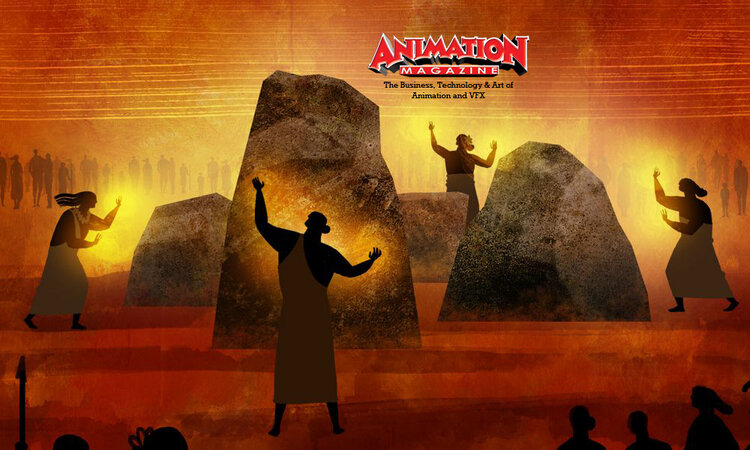
    According to legend, four mahu (third-gender individuals) traveled to Hawaii from Tahiti, bringing healing powers to the people on Waikiki Beach. As their healing powers transformed a community, the people of Waikiki did not want the mahu to leave them. During a ritual, the mahu embed their powers into four stones on the beach, disappearing after the transfer was complete. For centuries after, the stones were regarded as sacred, many leaving gifts of thanks and appreciation. Though as with many things throughout history, the stones became lost to time. Their legend lost to the ears of those who might listen.

    With the arrival of the missionaries, the sacred stones become merely that – stones. As cities arose around them, the stones sunk away until they were finally removed from the sand in 1997 and placed on platform for perseverance. While the legend may be just that, the mahu powers within wait patiently for those who may be enlightened – for those who may see the healing powers they represent and contain.

    Kapaemahu is a fascinating short film, one that I desired more information about at its conclusion. This is no Moana, but rather its own doctrine into cinema, a medium that is truly starting to tell the stories of the world for the masses.

    Full article and all films reviewed HERE.

  • Kapaemahu Receives Special Jury Mention in Tribeca Film Fest Awards

    Kapaemahu Receives Special Jury Mention in Tribeca Film Fest Awards

    Kapaemahu Receives Special Jury Mention in Tribeca Film Fest Awards

    IndieWire – April 29, 2020: Though it postponed its annual in-person gathering, the Tribeca Film Festival on Wednesday handed out awards for the 2020 juried competition.

    In mid-March, festival organizers postponed the festival just weeks before it was set to bow in New York City. In the interim, some programming for the 19th annual festival was made available online, while its brass still hopes to hold a traditional festival in the coming months.

    “We are fortunate that technology allowed for our jury to come together this year to honor our filmmakers,” said Tribeca co-founder and CEO Jane Rosenthal in an official statement. “Despite not being able to be together physically, we were still able to support our artists, which has always been at the heart of the festival.”

    Here are the Short Film Competition Winners

    Best Narrative Short: “No More Wings,” director Abraham Adeyemi

    Jury Comments: “It checked every box in terms of authenticity, and heart, and it was funny!” “It’s such an elegant piece of filmmaking.”

    Art Award: Robert Nava: Medusa’s Walk, 2020. Acrylic, oil stick, crayon, and pencil on paper.

    Special Jury Mention: “Soup”

    Best Animated Short: “Friends,” director Florian Grolig

    Jury Comment: “Gorgeous, sparse, monochromatic animation.”

    Art Award: Stephen Hannock’s Wallsend Morning on the River Tyne, 2019. Oil on board

    Special Jury Mention: “Kapaemahu”

    Best Documentary Short: “My Father The Mover,” director Julia Jansch

    See the full list of awards here.

  • Rediscovering the Story of Kapaemahu – Ka Wai Ola News

    Rediscovering the Story of Kapaemahu – Ka Wai Ola News

    Rediscovering the Story of Kapaemahu – Ka Wai Ola News

    Kapaemahu: A Lost Story Found

    By Puanani Fernandez-Akamine -March 30, 2020

    A journey to Raiatea and the discovery of a handwritten manuscript from 1906 in a forgotten box of papers at UH Mānoa’s Hamilton Library has resulted in the creation of Kapaemahu, an animated short film that was selected to premier at the 19th Annual Tribeca Film Festival as part of a program curated by renowned actress Whoopi Goldberg.

    Kapaemahu is the mo‘olelo of four healers who voyaged from Tahiti to Hawai‘i in the 15th century. The healers were mahu; neither male nor female but a mixture of both in mind, heart and spirit. Kapaemahu is a passion project of Hinaleimoana Wong-Kalu, a kumu, cultural practioner and OHA Community Advocate who understands the power that stories have to shape cultural narratives.

    According to the mo‘olelo, the healers settled in Waikīkī and were beloved by the people there for their gentle ways and miraculous cures. When it came time for them to depart, the people memorialized them by placing four great stones near their dwelling place. The healers then transferred their names and healing powers to the stones and vanished.

    This duality of male and female spirit was highly revered in traditional Polynesian culture, but religious, political and cultural influences in Hawai‘i during the 19th and 20th centuries led to the suppression of this aspect of the mo‘olelo and may be one reason why the story itself was nearly lost.

    The stones remained a wahi pana for centuries, until 1905 when they were excavated from the Waikīkī Beach property of Princess Likelike and her husband, Governor Archibald Scott Cleghorn. The legend of Nā Pōhaku Ola Kapaemahu was subsequently conveyed to Thrum’s Hawaiian Almanac by noted cultural expert James Harbottle Boyd, Cleghorn’s son-in-law and a confidant of Queen Lili‘uokalani.

    During the 20th century the stones underwent varying degrees of neglect. They were buried under a bowling alley in 1941, recovered in the 1960s, and, after being unattended for many years, restored in a 1997 dedication ceremony on Waikīkī Beach near the Police Station. But despite carrying the name “Kapaemahu,” which noted scholar Mary Kawena Pukui translated as “the row of mahu,” the fact of the healers’ gender duality was omitted from the public record.

    Upon her discovery of the manuscript in 2015, Wong-Kalu was determined to bring the mo‘olelo back from obscurity and share it with the world. “As Kānaka we need to be active participants in telling our own stories in our own way,” said Wong-Kalu, director and narrator of the film. To do this she partnered with Hawai‘i-based filmmakers Dean Hamer and Joe Wilson, Oscar-nominated animator Daniel Sousa, and Pacific Islanders in Communications who co-produced the film. Intensive archival research, interviews with cultural experts, and a trip to the healers’ home on Raiatea informed the team’s creative approach.

    The resulting film is a lyrical masterpiece. The animation employs a textured, hand-painted style of art rooted in Polynesian visual culture, with designs and palettes informed by the traditional art forms of tapa-making and lauhala weaving. The mo‘olelo is narrated using the Ni‘ihau dialect, which is the only form of Hawaiian that has been continuously spoken since before Western contact and the closest to the language of Tahiti that would have been spoken by the healers. This gives viewers an opportunity to hear the mo‘olelo of Kapaemahu as it might have been originally shared.

    Since the arrival of foreigners in Hawai‘i, Kānaka Maoli culture has been under duress. Despite this, many aspects of traditional life, such as hula and navigation, have been successfully reclaimed and preserved. But other aspects, including language, healing practices and respect for gender diversity are still in progress. Mo‘olelo like Kapaemahu offer insight into traditional culture and thought, and the way that Hawaiian narratives have been, and continue to be, shaped by contemporary social and political forces.

    “In telling this story I hope that people will understand that what some people call legends are actually elements of our history,” said Wong-Kalu. “The stones of Kapaemahu are more than a tourist site. They are an insight into our Pacific understandings of male and female, life and healing, and the spiritual connections between us all.”

    In addition to being an official selection of the Tribeca Film Festival, Kapaemahu is the subject of a feature-length PBS documentary currently in production, and will be the centerpiece of a major exhibition at the Bishop Museum exploring the contemporary history of Nā Pōhaku Ola Kapaemahu and related themes. The exhibition is scheduled to open in Spring 2022.

  • Tribeca Announces Short Film Lineup For 2020 Fest – Deadline Magazine

    Tribeca Announces Short Film Lineup For 2020 Fest – Deadline Magazine

    Tribeca Announces Short Film Lineup For 2020 Fest – Deadline Magazine

    By Jill Goldsmith – Deadline Magazine:

    The Tribeca Film Festival announced its 2020 Shorts Program lineup Thursday including the world premiere of DreamWorks Animation’s To Gerard and projects with Benedict Cumberbatch, Dennis Quaid and Ruth Bader Ginsberg.

    As cancellations and postponements rock the entertainment landscape, Tribeca said it’s still a go. “We are tracking the COVID19 (coronavirus) situation closely. If we receive pertinent information that requires us to make any changes to the Tribeca Film Festival taking place from April 15-26, we will provide an updated statement. As of right now, there are no direct impacts to our festival.”  a spokesperson said Thursday.

    The shorts roster for the 19th annual fest has 64 shorts from 20 countries, including 46 world premieres, selected from a record 6,100 submissions, organizers said.

    Whoopi Goldberg again curated the animated portion. And back for a second year are two portrayals of diverse women from the Queen Collective by Procter & Gamble in partnership with Queen Latifah. Tribeca said that for the fourth consecutive year, 40% of the selections are directed by female filmmakers.

    The 2020 shorts lineup is programmed by Sharon Badal and Ben Thompson.

    “In this important election year we have a political doc shorts program that illustrates contemporary issues facing our country, as well as a music doc shorts program that’s very diverse,” said Sharon Badal, VP of Filmmaker Relations and Shorts Programming,

    Tribeca Film Festival. “Everyone needs some escapism too, so our comedy shorts, sci-fi shorts, and New York shorts programs are back by popular demand.”

    The short films will be presented in 10 competition programs – five narrative, four documentary and one animation.

    The 2020 Tribeca Film Festival Shorts Program

    Animated Shorts Curated by Whoopi Goldberg

    Grandad Was A Romantic, directed, written, and by Maryam Mohajer. (UK) – New York Premiere, Short Animation. Grandad first fell in love with granny seeing her picture. It sounds like a fairy tale. All it needs is a happy ending. With Maya Naraghi.  

    Umbrella, directed and written by Helena Hilario, Mario Pece. Produced by Helena Hilario. (Brazil) – New York Premiere, Short Animation. Inspired by true events, Umbrella is a short film that follows Joseph, a boy who lives in an orphanage and dreams of having a yellow umbrella.

    The Tiger Who Came to Tea, directed by Robin Shaw, written by Joanna Harrison, Judith Kerr. Produced by Ruth Fielding, Camilla Deakin. (UK) – World Premiere, Short Animation. A mysterious tiger turns up unannounced and invites himself in for afternoon tea. With David Oyelowo, Benedict Cumberbatch, Tamsin Greig, Clara Ross, David Walliams.

    Beyond Noh, directed by Patrick Smith, written by Patrick Smith, Kaori Ishida. Produced by Kaori Ishida. (USA) – World Premiere, Short Animation. Beyond Noh rhythmically animates 3,475 individual masks from all over the world.

    Kapaemahu, directed by Hinaleimoana Wong-Kalu, Dean Hamer, Joe Wilson. Produced by Hinaleimoana Wong-Kalu, Dean Hamer, Joe Wilson. (USA) – World Premiere, Short Animation. Four mysterious boulders on Waikiki Beach have a hidden history; within them, there are legendary transgender healing spirits. In Hawaiian with English subtitles.

    Bathwell in Clerkentime, directed, written, and produced by Alex Budovsky. (Colombia, USA) – World Premiere, Short Animation. This is the animated short that completes the trilogy about cuckoos from Clerkenwell going nuts. In this episode birds face problems with marriage, raising kids, and alcohol.

    Friends, directed, written, and produced by Florian Grolig. (Germany) – North American Premiere, Short Animation. The “small” one is, well, small, and the “big” one is definitely very very big. They are friends.

    To Gerard, directed and written by Taylor Meacham. Produced by Jeff Hermann. (USA) – World Premiere, Short Animation. A sprightly elderly man brightens the day of a little girl through magic.

  • Tribeca World Premiere for Kapaemahu

    Tribeca World Premiere for Kapaemahu

    Tribeca World Premiere for Kapaemahu

    Animated Hawaiian Legend Receives World Premiere at Tribeca Film Festival

    A unique collaboration by a Hawaiian cultural leader, an award-winning documentary duo, and an Oscar-nominated animator has resulted in a provocative short film that reveals the hidden history behind a prominent monument on Honolulu’s Waikiki Beach.

    New York, NY – March 5, 2020: The 19th annual Tribeca Film Festival today announced its 2020 lineup of diverse and engaging films in competition, including 8 animated shorts curated by Whoopi Goldberg. Among them is the world premiere of Kapaemahu, a story about the hidden history of four mysterious boulders on Waikiki Beach, and the legendary spirits within them.

    Based on original research and the discovery of a century’s old handwritten manuscript, Kapaemahu reveals the true nature of four legendary figures said to have brought the healing arts from Tahiti to Hawaii long ago. The healers were mahu – individuals of dual male and female spirit highly revered in traditional Polynesian culture – but this aspect of the story has been suppressed due to the religious, political, and cultural influences that shaped modern Hawai’i throughout the 19th and 20th centuries.

    As Kanaka, we need to be active participants in telling our own stories, in our own way,” said Kumu Hinaleimoana Wong-Kalu, director and narrator of the film. “That’s why I wanted to make a film about Kapaemahu, as seen through the eyes of a curious child, and to narrate it in Hawaiian language.

    The film, a co-production with Pacific Islanders in Communications, was animated by acclaimed Oscar-nominated artist Daniel Sousa and co-directed and produced by Oahu-based filmmakers Dean Hamer and Joe Wilson.

    Millions of tourists and locals walk by these stones on Waikiki Beach with no idea what they represent,” said Hamer. “We’re excited about the ways in which this film will remind people of the important contributions made by individuals across the gender spectrum, and how this monument honors them.

    The animated short will also be the centerpiece of an exhibit at Honolulu’s Bishop Museum, exploring these and other themes including the healing arts, Pacific voyaging, and language loss and recovery. The exhibit is scheduled for Spring 2022.

    Contact:

    Joe Wilson, Qwaves Media

    e: QwavesJoe@yahoo.com t: 808-629-9864

    ###

    Film synopsis:

    On Honolulu’s famed Waikiki Beach stand four mysterious boulders that represent a Hawaiian tradition of healing and gender diversity that is all but unknown to the millions of locals and tourists passing by. According to legend, the stones are a tribute to four mahu – people of dual male and female spirit – who long ago brought the healing arts from Tahiti to Hawai’i. Beloved by the people for their gentle ways and miraculous cures, they transferred their powers to the stones, then disappeared. Although the stones still stand on a popular section of the beach, the true story behind them has been hidden – until now. Based on new research and narrated in the only continuously spoken Hawaiian dialect, Kapaemahu brings this powerful legend back to life in vivid animation, seen through the eyes of a curious child.

    About the Filmmakers:

    Hinaleimoana Wong, best known as Kumu Hina, is a Native Hawaiian teacher, cultural practitioner, composer and filmmaker who uses digital media to protect and perpetuate indigenous languages and traditions. She began her film work as a protagonist and educational advisor for the award winning documentaries Kumu Hina and A Place in the Middle, and received a National Education Association Human Rights Award, Native Hawaiian Educator of the year and White House Champion of Change for the groundbreaking impact campaigns associated with those films. Continuing her journey to the other side of the lens, Hina produced the PBS/ARTE feature documentary Leitis in Waiting and award-winning short Lady Eva about her transgender sisters in the Kingdom of Tonga. Hina is also a transgender health advocate, burial council chair, and composer of Ku Haaheo E Kuu Hawaii, the internationally-known anthem for the protection of Mauna Kea.

    Dean Hamer and Joe Wilson are Emmy and GLAAD Award-winning filmmakers dedicated to telling stories that emanate from the voices of those on the outside. Their work has screened and won awards at festivals around the world including Berlin and Toronto, been viewed by millions of viewers on PBS and international broadcasts, and received widespread attention for their role in promoting social change. Dean and Joe’s films and impact campaigns have been supported by Sundance, Ford, ITVS and Pacific Islanders in Communications. This is their fifth film on Pacific Islander voices and issues in collaboration with Wong-Kalu.

    Daniel Sousa is an Academy Award-nominated animation director who uses the themes embedded in myths and legends to examine archetypes of human nature. Born on Cape Verde, he approaches filmmaking from a painter’s perspective, focusing on the fragility of fleeting moments, memories and perceptions. His short films include Feral, which was supported by a Creative Capital Foundation grant and premiered at Sundance, and Fable, which won awards at festivals around the world. He recently completed animating several native legends for the four-part PBS special Native America, which weaves history and science with living indigenous traditions. Sousa has taught at the Rhode Island School of Design, Harvard University, The Museum School, The Art Institute of Boston and the Animation Workshop in Denmark.

    About Pacific Islanders in Communications:

    Established in 1991 in Honolulu Hawai‘i, Pacific Islanders in Communications (PIC) is the only national public media organization that supports media content specifically about Native Hawaiian and Pacific Islanders. PIC works to promote a deeper understanding of Pacific Islander history, culture and contemporary issues that define our communities. PIC addresses the need for media content that reflects America’s growing ethnic and cultural diversity by funding independently produced media, and by providing hundreds of hours of innovative content about Pacific Islanders to National PBS including its flagship series Pacific Heartbeat. For more information about Pacific Islanders in Communications and Pacific Heartbeat, visit www.piccom.org

    About the Tribeca Film Festival:

    The Tribeca Film Festival, presented by AT&T, brings visionaries and diverse audiences together to celebrate storytelling in all its forms, including film, TV, VR, gaming, music, and online work. With strong roots in independent film, Tribeca is a platform for creative expression and immersive entertainment. The Festival champions emerging and established voices; discovers award-winning filmmakers and creators; curates innovative experiences; and introduces new technology and ideas through premieres, exhibitions, talks, and live performances.The Festival was founded by Robert De Niro, Jane Rosenthal, and Craig Hatkoff in 2001 to spur the economic and cultural revitalization of lower Manhattan following the attacks on the World Trade Center. Now in its 19th year, the Festival has evolved into a destination for creativity that reimagines the cinematic experience and explores how art can unite communities. The 19th annual edition will take place April 15 – 26, 2020. www.tribecafilm.com/festival #Tribeca2020