Author: Nicholas Griffith

  • Kapaemahu Wins at India’s Bengaluru International Short Film Fest

    Kapaemahu Wins at India’s Bengaluru International Short Film Fest

    Kapaemahu Wins at India’s Bengaluru International Short Film Fest

    by Sharmindrila Paul – AnimationXpress – August 19, 2020:

    The BISFF (Bengaluru International Short Film Festival) winners have been announced!

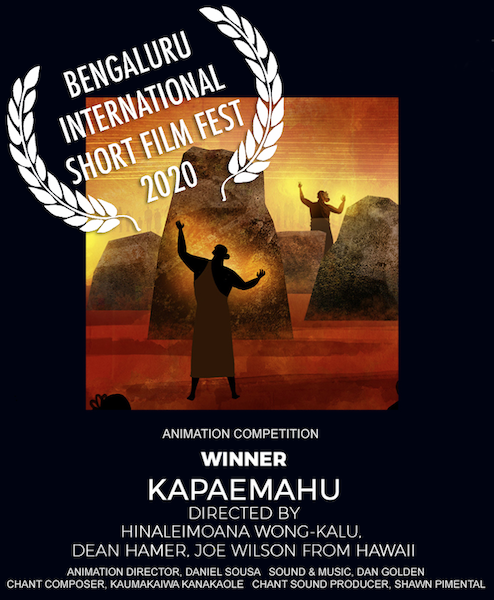
    The Oscar accredited film festival is a reputed one and has lately announced the winners for its animated short films category. Based on legend from Hawaii, animated short Kapaemahu about transgender spirits, is the winner in the category followed by Avarya and Radha: The Eternal Melody as first and second runners up respectively. 

    Co-created by director-producers Hinaleimoana Wong-Kalu, Dean Hamer and Joe Wilson, Kapaemahu reveals the healing power of four mysterious stones on Waikiki Beach – and the legendary transgender spirits within them. 

    Overwhelmed by the win, Wong-Kalu on behalf of the entire team, told AnimationXpress, “We were initially surprised by the win for Kapaemahu because India seems so far from Hawai’i.  But upon deeper reflection, we realised that Polynesian and Indian culture share much in common, including a more holistic understanding of gender diversity, and a colonial history that brought unwelcome political and societal changes. We also share the need for healing in this time of pandemic, and Kapaemahu teaches us how all healers should be respected for the good they do. In this context, the award from BISFF is incredibly meaningful for our team and makes us feel hopeful about the things that unite us across the distances. Here’s to the power of film, art and storytelling shining their light and bringing people together around the world.”

    Full article HERE.

  • Kapaemahu Co-Director Kumu Hina Named One of Hawaiiʻs “Women of the Century”

    Kapaemahu Co-Director Kumu Hina Named One of Hawaiiʻs “Women of the Century”

    Kapaemahu Co-Director Kumu Hina Named One of Hawaiiʻs “Women of the Century”

    Surfing champion, hula masters, educators and advocates on Hawaii Women of the Century list

    Lindsay Schnell, USA TODAY – August 14, 2020:

    Is this a mana wahine

    In Hawaiian, mana wahine translates to “powerful woman,” and as a panel of experts worked to select Hawaii’s Women of the Century, they kept coming back to this phrase.

    Did this woman motivate and inspire others to be courageous? How has she given back to Hawaii and its people? Is she committed to keeping Hawaiian traditions and stories alive? Those are the characteristics of a mana wahine, and it was crucial that every woman on the list fit them. 

    This year, to commemorate the 100th anniversary of the 19th Amendment, when American women won the right to vote, the USA TODAY Network is naming 10 women from every state, plus the District of Columbia, as “Women of the Century.” These women have made significant contributions to their communities, states and country with documented achievements in areas like arts and literature, business, civil rights, education, entertainment, law, media, nonprofits and philanthropy, politics, science and medicine, and sports. The women had to have been alive during the last 100 years — 1920 to 2020.

    Hawaii has a long history of powerful women, the most notable being Queen Liliʻuokalani, Hawaii’s only queen regent and the last sovereign monarch, who ruled from 1891 until the overthrow of the Hawaiian kingdom in 1893. She is revered across the state, with numerous hula events held in her memory, and various centers and events named in her honor. 

    Queen Liliʻuokalani, however, did not possess one important piece of criteria for the Women of the Century project: She hasn’t been alive since 1920, the year the 19th Amendment passed (she died in 1917).

    But her legacy lives on in many of the women on our final list, matriarchs of their families who fought to ensure that the Hawaiian language and traditions would not only survive in the modern era, but thrive. Most of the women on this list are Hawaii’s Hulu kupuna, highly prized elders who possess an inspirational spirit and wisdom that’s cherished on the islands. Some of the younger women on the list, like 27-year-old surfer Carissa Moore, aren’t yet old enough to be elders – but they’re on that trajectory. 

    Choosing just 10 women proved to be challenging given the number of amazing women who have called the state home. Some women almost made the list, like former U.S. Sen. Mazie Hirono, the first Asian-American woman in the Senate and the first woman Hawaiian voters sent to the Senate. Puanani Burgess, a Buddhist priest, poet and cultural translator, who now embraces her role as “community Aunty,” also was a contender. Michelle Wie, the youngest player to ever qualify for an LPGA Tour event, inspired generations of aspiring golfers. 

    All are worthy choices but in the end, did not make our top 10. The final list is comprised of women who represent Hawaii with honor, pride and aloha, or love. To outsiders, aloha seems like a simple, friendly greeting; but to those who know Hawaii, it is a word rife with deep cultural and spiritual meaning. To represent Hawaii with aloha is one of the highest honors bestowed on a Hawaiian resident. 

    HINALEIMOANA WONG-KALU

    Hinaleimoana Wong-Kalu, also known as Kumu Hina, is a Kanaka Maoli, or Native Hawaiian, teacher, Kumu Hula (hula master), filmmaker, cultural practitioner, community leader and a modern transgender woman. She was the founding member of Kūlia Nā Mamo, a community transgender health organization established in 2003 to help improve the quality of life for māhū wahine, a traditional third gender person who exists between male and female. 

    Kalu spent 13 years as the Director of Culture at Hālau Lōkahi Public Charter School in Honolulu, and was one of the first transgender candidates for statewide political office in the U.S. Previously, she served as the chair of the O’ahu Island Burial Council, which oversees the management of Native Hawaiian burial sites.

    She now serves as community advocate for the Office of Hawaiian Affairs, where she helps Native Hawaiian inmates prepare to be productive members of society. Kalu co-directed and produced the film, “Lady Eva,” and a feature documentary, “Leitis in Waiting,” about the struggle of the Indigenous transgender community in Tonga. Both won awards at several film festivals and have been broadcast on stations across the world. 

    See full list HERE.

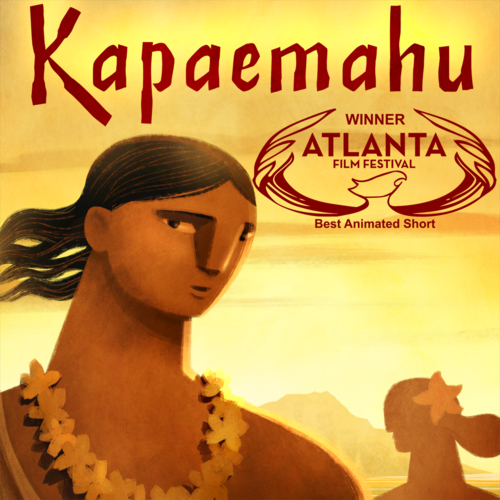
  • Best Animated Short at Atlanta Film Festival

    Best Animated Short at Atlanta Film Festival

    Best Animated Short at Atlanta Film Festival

    ATLANTA, GA (October 8, 2020) — The 44th annual Atlanta Film Festival + Creative Conference is proud to announce today the distinguished jury and audience award winners for the 2020 festival, which took place from September 17, 2020 – September 27, 2020.

    Today’s announcement recognizes filmmakers in 10 categories for their achievements and cinematic excellence. Winners of the Narrative Short, Animated Short and Documentary Short Jury Awards not only proudly took home their awards, but now also qualify for the 2021 Oscar® short list. ATLFF is one of the few festivals in the country that is Oscar-qualifying in three or more categories.

    The award winners were chosen by distinguished jurors from all backgrounds across the film industry. They include Danielle Deadwyler, an actress and filmmaker known from her roles in series such as “Atlanta” and HBO’s “Watchmen;” Dawn Porter, an award-winning filmmaker who recently directed JOHN LEWIS: GOOD TROUBLE; Toby Wilson, an art director for Sony Pictures Animation; and Logan Hill, a veteran arts journalist who has spent 20 years reporting for the likes of The New York Times, Rolling Stone and GQ; among over a dozen others.Atlanta Film Festival

    Jury Statement:

    “Above all, Kapaemahu is a beautifully crafted story. We love the themes of acceptance, selfless giving, and the importance of passing knowledge down to future generations. The concept of the film exemplifies the voice and message of humanity, creating a blend of male and female as one: human. The visual styling evokes feelings of ancient storytellers and weaves patterns, vibrant colors and legend into the imagery in a natural flowing way. The sound design and music composition underscores its powerful themes to transfix the viewer. Amazing cinematic choices all around make Kapaemahu our choice as Best in Show for animation.” All awards HERE.

  • Special Jury Mention for Kapaemahu

    Special Jury Mention for Kapaemahu

    Special Jury Mention for Kapaemahu

    August 2, 2020:

    The New Zealand International Film Festival jury made special mention of Kapaemahu by Hinaleimoana Wong-Kalu, Dean Hamer and Joe Wilson.


    Kapaemahu is an animated film which tells of mahu – “four extraorindary individuals” who travelled from Tahiti to Hawaii in ancient times to share their healing and restorative powers. The observation of the dismissal of this rich legacy in modern times is poignant and the narration in Hawaiian and the powerful chants add potency to this beautiful indigenous story which holds so much weight here in Aotearoa.”

    Ngā Whanaunga Māori Pasifika Shorts was curated by Leo Koziol (Ngāti Kahungunu, Ngāti Rakaipaaka), Director of the Wairoa Māori Film Festival, with guest co-curator Craig Fasi (Niue), Director of the Pollywood Film Festival. This year was the first year awards have been offered for this collection.

    The seven films in the collection are Purea (director: Kath Akuhata-Brown), Forgive Me (director: Chelsea Winstanley), Kapaemahu (director: Hinaleimoana Wong-Kalu, Dean Hamer and Joe Wilson), Emily (director Mark Papalii), I Am The Moment (director: Robert George), Money Honey (director: Isaac Knights-Washbourn), and Gurl (director: Mika X).

  • “The Film Looks Like Poetry In Motion”

    “The Film Looks Like Poetry In Motion”

    “The Film Looks Like Poetry In Motion”

    Legends and myths have always intrigued me. Through these, various fascinating stories have come down the ages with different interpretations and versions. One such legend has now been created into an amazing animated short film titled Kapaemahu

    Co-created by director-producers Hinaleimoana Wong-Kalu, Dean Hamer and Joe Wilson, Kapaemahu reveals the healing power of four mysterious stones on Waikiki Beach – and the legendary transgender spirits within them. The animated short has been officially selected for BISFF (Bengaluru International Short Film Festival), a qualifier for the Oscars.

    Commenting on the selection, Wong-Kalu told AnimationXpress, “To be included in the BISFF is an extraordinary honour, because firstly, it was created in the spirit of bringing new voices and new stories into the media-making industry. Secondly, because of India’s similar history with third gender identities, who were embraced and deified in mythology, demonised by British colonists, revered by many as demigoddesses and reviled by others as deviant victims, but are now, themselves, reclaiming their lost position in society through spirituality. We have much in common across the distances of time and culture and we hope BISFF audiences feel the same.”

    The official synopsis of Kapaemahu reads: Long ago, four extraordinary individuals of dual male and female spirit brought the healing arts from Tahiti to Hawaii. The name of their leader was Kapaemahu.  Beloved by the people for their gentle ways and miraculous cures, they imbued four giant boulders with their powers. The stones still stand on what is now Waikiki Beach, but the true story behind them has been hidden – until now.

    Wong-Kalu was inspired to make Kapaemahu by a quote articulated in 1865 by Hawaiian historian S. M. Kamakau : “He makemake ko’u e pololei ka moolelo o ko’u one hanau, aole na ka malihimi e ao ia’u I ka moolelo o ko’u lahui, na’u e ao aku I ka moolelo I ka malihini” which translates to – “I want the history of my homeland to be correct. The foreigner shall not teach me the history of my people, I will teach the foreigner.”

    “As a Kanaka – a native person in an island nation that was illegally overthrown and continues to be occupied by a foreign power – I believe that our survival as indigenous people depends on our ability to know and practice our cultural traditions, to speak and understand our language, and to feel an authentic connection to our own history. That’s why I decided to write Kapaemahu and narrate it in Olelo Niihau, the only form of Hawaiian that has been continuously spoken since before the arrival of foreigners. It is not enough to study Hawaiian in an American classroom, nor to read about our history in an English language textbook. We need to be active participants in understanding and telling our stories, and we need to have both the ancestral storytelling knowledge and the modern media tools to do so effectively and authentically,” noted she on the conceptualising the film. 

    Wong-Kalu is a ‘mahu’ (queer) herself, and like many indigenous third-gender identities was once respected but is now more often a target for persecution and exclusion due to the lingering effects of colonisation and Christianisation. While international awareness of gender fluidity has greatly increased of late, it has not always led to greater acceptance. Her experience as the protagonist of two documentary films, Kumu Hina and A Place in the Middle – directed by her Kapaemahu collaborators Hamer and Wilson, convinced her that portraying gender non-conforming people as strong, talented, and worthwhile individuals can make a real difference.

    “The team’s research on the animated film started five years ago. The original story was truly hidden. It took five years of research, two years of script writing and storyboarding, one year of planning with Daniel Sousa (animation director) followed by seven months of animating. The version seen in the final film is close to the story as it first emerged,” noted Wong-Kalu.

    As a Kanaka Maoli storyteller, the director felt that animation was the ideal medium to convey the mythical themes and characters of Kapaemahu. It is also the most culturally sensitive way to depict spiritual and abstract aspects of the tradition such as the presence of mana in the stones and the mixture of male and female spirits in mahu. So, for her the first step was to find an animator whose previous work and visual style inspired us and aligned with the aesthetic we had in our minds for bringing this story to life. 

    She found a perfect match in Daniel Sousa, whose earlier film Feral demonstrated a unique artistic, almost timeless, style and was nominated for an Academy Award. “He brought brilliant storytelling ideas to the collaboration, including telling the story through the perspective of a young person’s eyes. The characteristics of the four protagonists are as true to the original legend as possible. The opening scene, with the mahu healers on the boat crossing a vast ocean alludes to Polynesians’ history as great voyagers deeply connected to one another among all the islands of the Pacific. And the moana – the ocean and its waters – is a symbol of life and the power and energy that sustains us,” informed she.

    Apart from the three director-producers and Sousa, the Kapaemahu team is a diverse one. Sousa also storyboard and animation, Dan Golden looked after sound design and score; and Kaumakaiwa Kanakaole ideated and executed chant composition and performance of the four protagonists. The film was a co-production with Pacific Islanders in Communications, which supports work by and about Pacific Islanders.

    Kapaemahu uses 2D animation drawn on paper. The software used by the makers are Adobe Animate, Photoshop, After Effects and Blender.

    “Sousa developed a textured, hand-painted style for the animation that is deeply rooted in Polynesian visual culture, with designs and palette informed by the traditional art forms of tapa and lauhala weaving. In contrast to the caricatures of Polynesians typical of Disney animations, the characters in our work are presented as stately and dignified individuals. The emphasis was on telling the story clearly and beautifully,” stated Wong-Kalu.

    Kapaemahu has received many official selections and awards at many prestigious film festivals and premiered at the Tribeca Film Festival where it won Special Jury Mention. It also received the Grand Jury Prize in Spain’s Animayo Film Festival, qualifying it for an Academy Award nomination. It’s an official selection at a wide range of international, animation, indigenous, LGBT and children’s film festivals including Annecy, Hiroshima (only one out of 200 USA films submitted), Huesca, Palm Springs Short Fest, Frameline, Galway, Indy Shorts, Atlanta, Zlin Children’s, Woods Hole, Melbourne International and New Zealand International. 

    Kapaemahu takes one on a surreal journey, celebrates the power of the androgynous minds which are now being suppressed. The film looks like poetry in motion, and the chant/transferring of powers by the four ‘mahus’ into the stones, creates a meditative effect. The animation technique is unique and evokes a feeling of witnessing the legend and its history in person. 

    “We hope that the film provokes viewers to see Hawaii from a Kanaka, or native person’s, perspective, and to ask questions and pursue information and answers that are central to indigenous peoples, gender and sexual minorities, and marginalized people’s experiences the world over.

    Why do people seek to dominate, exploit, and harm others? Wouldn’t the world be a better place if the talents and gifts of all people were accepted and honored rather than judged, condemned, and then erased?,” concluded the director.

    We hope that the healing powers of Kapaemahu be eternal and all encompassing!
  • Pasifika filmmakers looking to shine at Whānau Mārama NZ International Film Festival

    Pasifika filmmakers looking to shine at Whānau Mārama NZ International Film Festival

    Pasifika filmmakers looking to shine at Whānau Mārama NZ International Film Festival

    Samoa News – July 15, 2020:

    Pasifika directors will be looking to make their mark when the Whānau Mārama: New Zealand International Film Festival gets underway next week.

    For the first time, a Pacific person is selecting the finalists for the festival’s NZ short film competition, and there’s a strong showing in other categories.

    New Zealand Best Short Film Competition entries have been chosen by the renowned Samoan-New Zealand film-maker Tusi Tamasese.

    Mr Tamasese is the first guest selector of Pacific heritage.

    The Orator and One Thousand Ropes director said being born and raised in Samoa has shaped his outlook.

    “How we see the world in a different way. Sometimes I’m looking for a certain sort of originality, something that I haven’t seen before,” he said.

    “It’s also because Pasifika films are coming through and it’s bringing just a little bit of how just how we see the world, Pasifika see the world, in story telling.”

    This year’s selection reveals a wide range of human emotions and experiences, he added.

    His views are echoed by one of the curators of the festival’s Ngā Whanaunga Māori Pasifika Shorts, Leo Koziol.

    For about nine years now, myself and Craig Fasi of the Pollywood Film Festival, we’ve put together a programme of Maori and Pasifika shorts and this year’s a great year once again to have the best of Maori and Pacific short film making, you know the real new talents coming through.”

    And the six talented Māori and Pasifika film-makers will be competing for the inaugural Wellington UNESCO City of Film Award for Best Film this year with a prize of $NZ3000. Jurors from fellow UNESCO cities of film Mumbai and Sarajevo join the third from Wellington to judge the competition.

    One of the talented film-makers competing, said Mr Koziol, is the Cook Island and New Zealand Maori audio-visual artist Robert George whose movie I Am the Moment profiles Tongan performance artist Kalisolaite ‘Uhila.

    “Who is based at Tokyo who does performance and art and is actually exploring the Japanese traditions of performance art and integrating them with Tongan and that’s a beautiful artistic film.”

    Another entry Kapaemahu, he explained, explores the relationship between the ancient healers of Tahiti, the Mahu, who brought their gifts to Hawai’i.

    In pre-colonial times, the Mahu were notable priests and healers of the third gender, similar to Samoa’s fa’afafine and fakaleiti of Tonga.

    “If you walk down Waikiki Beach,” there are some stones there that were dedicated to the Mahu that came in ancient times and brought these gifts and learnings of healing, and, you know, real traditions that were embraced by the Hawaiian people for centuries,” said Mr Koziol.

    “There are some stones there that were dedicated to the Mahu that came in ancient times and brought these gifts and learnings of healing, and, you know, real traditions that were embraced by the Hawaiian people for centuries.”

    Kapaemahu is by contemporary Hawaiian Mahu, Hinaleimoana Wong-Kalu.

    Leo Koziol said the competition’s emerging talent is Samoan-New Zealand film-maker Mark Papali’i who described his film Emily as a story of love and grief inspired by the loss of a loved one to cancer.

    “It was really hard for me to feel. There was nothing I could do to kind of help my friend, and in a way I wanted to see if showing this film could make other people feel the way I felt in that situation, kind of guide them.”

    Mr Papali’i said the strength of the two main characters’ relationship – Emily and her mother – was inspired by the strong women in his family, or aiga, which he said is central to both Fa’a Samoa culture and his story-telling.

    Other Pasifika highlights included at Whānau Mārama: New Zealand International Film Festival is the feature Loimata, The Sweetest Tears which honours the great Samoan va’a-tele, or ocean going yacht, maker Ema Siope.

    Also, Tupaia’s Endeavour which uncovers the history of the Tahitian priest, navigator and translator who accompanies James Cook aboard the Endeavour on his first Pacific voyage.

    Whānau Mārama: New Zealand International Film Festival runs from 24 July to 3 August and, due to Covid-19, is available online or in cinemas around Aotearoa.

    Check the festival website for details.

  • Kapaemahu Wins Nashville Film Fest Audience Award

    Kapaemahu Wins Nashville Film Fest Audience Award

    Kapaemahu Wins Nashville Film Fest Audience Award

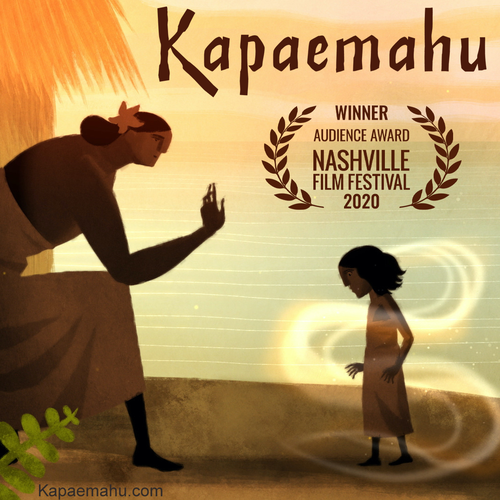
    The Kapaemahu film team is honored by the Nashville Film Festival audiences’ love for this story from the Pacific and hopes that the healing spirits of Kapaemahu stay in their hearts in the days ahead. Full winners list HERE.

  • “Kapaemahu Must Be Remembered Come Awards Season”

    “Kapaemahu Must Be Remembered Come Awards Season”

    “Kapaemahu Must Be Remembered Come Awards Season”

    By Richard Propes – The Independent Critic

    The word “beautiful” doesn’t do justice in describing Kapaemahu, an eight-minute animated short film screening as a finalist during this week’s Indy Shorts International Film Festival going on virtually and at Tibbs Drive-In in Indianapolis. There’s something majestic about Kapaemahu, a film that won the Grand Jury Award at Animayo 2020, an Academy Award-qualifying film festival, and is now a finalist at Indy’s own Academy Award-qualifying fest with Indy Shorts. 

    Kapaemahu reveals the healing power of four mysterious stones on Waikiki Beach – and the legendary transgender spirits living within them. The legend has it that long ago four extraordinary individuals of dual male and female spirit brought the healing arts from Tahiti to Hawaii. Kapaemahu was their leader and they were beloved for their gentle ways and miraculous cures. They imbued four giant boulders with their powers and these stones still stand on what is known now as Waikiki Beach. 

    Until now, their story has been hidden. 

    Now? It’s brought magnificently to life by the trio of directors behind Kapaemahu including Hinaleimoana Wong-Kalu, Dean Hamer, and Joe Wilson. Using the eyes of a curious child as their lens, the filmmakers have masterfully, there’s that word masterfully again, created a film with tremendous artistry and integrity and devotion to Indigenous people. The film is written and narrated in Olelo Niihau, the only form of Hawaiian that has been continuously spoken since prior to the arrival of foreigners. Chant composer and performer Kaumakaiwa Kanakaole’s work here is mesmerizing, a spiritual vibration reverberates throughout the film that companions Academy Award-nominated Animation Director Daniel Sousa’s extraordinary imagery to perfection. Dan Golden, an Oscar-nominated sound and visual designer, has created a composition that digs so deeply into this legend that you can practically feel it in your bones. The film’s narration embodies wisdom and nature. 

    Together? Kapaemahu simply must be remembered come awards season. It’s easily one of the most memorable, engaging, and vital animated shorts of the year or perhaps even years. 

    In addition to its Grand Jury Award, Kapaemahu received a Special Mention at Tribeca Film Festival and there’s no doubt its awards season is far from over. 

  • Animation. What else? At the Zlín Film Festival. Where else?

    Animation. What else? At the Zlín Film Festival. Where else?

    Animation. What else? At the Zlín Film Festival. Where else?

    More than 60 films from 25 countries have been selected for the International Short Animation Competition for Children, which will compete for several prizes in September.

    Variations of different animation techniques, diverse themes and exotic countries will delight the eye not only of our youngest viewers, but also of those who are interested in contemporary worldwide animated production.

    Festival films bring viewers audiovisual pleasure and education. This is no different in this year’s competition. They will follow the original inhabitants of the distant Hawaiian Islands in the film Kapaemahu , which represents the recent Grand Prize winner of the Animayo festival. Directors Dean Hamer, Joe Wilson, and Hinaleimoana Wong-Kalu, who comes from a local tribe, tells in her native language an engaging mythical story about magic stones on Waikiki beach. Children will add new information to the history of space conquest thanks to the film To the Stars by director Gemmy McGivern, which was captivated by the fate of the first Irish cosmonaut Dr. Norah Pattern. The collection of foreign rumors and legends will include the one about the Ukrainian city of Chernihiv from the animation The Towel Oksany Karpus.

    One of the attractive components of animated films has always been original humor. This truth is even more confirmed in those for children. An example is the Russian The Bear by director Svyatoslav Ushakov about a bear who works like a stuffed bear in a train station restaurant and longs for a career at a circus. The smiling animal children’s party was organized by the French director Loïc Bruyère in his animation The Kindergarten Show , which he will present during his next participation in the Zlín Film Festival. A slightly different, but very original version of the fairy tale About Seven Goats is presented to the world by Marina Karpova in The 7 Kids.

    This year’s competition show of worldwide animations for children is dominated by women’s work, and one of the proofs is all three Iranian films made by directors. Recently, very productive Reyhane Kavosh, just like last year, signed up with several films, and the dramaturgy of the Zlín Film Festival finally chose Coward Ghost about an unusually timid spirit. Maryam Kashkoolinia brings the somewhat bitter story of a lion cub from The Eleventh Step Zoo, and on the contrary, she put her story about the mysterious guard Reyhane Mirhashemi in the film Jebeer in the environment of a protected reserve .

    The playwrights of the competition animation section are always very happy to see that some creators are returning to the Zlín Festival. Among the loyal this year is Verena Fels, who, after participating in her films Rockin´ Rhino , Mobile and Frozen Fun , will fight for the Golden Shoe with her novelty Tobi and the Turbobus . Award-winning Russian director and screenwriter Evgenia Golubeva has submitted a humorous animation of The Witch & the Baby, which tells what happens when a royal couple acquires a local witch as a nanny. After the movies I Want to Live in the Zoo and I am not a MouseThis is her third participation in the prestigious Zlín competition. In addition to other faithful Russian directors, the name of Argentine director Nicólas Conte reappears, who made his debut in Zlín with his I Want It and this year contributed to the competition with another puppet animation Cracks in the Pavement .

    The annual Czech representation was again secured by Czech Television with the Kosmix evenings and Who would be afraid of the devils? and Tomas Bata University in Zlín with student films Shoot , About a Tree and A Ticket . The latter got to this year’s Generation competition in Berlin, and its director Aliona Baranova received financial support from the FILMTALENT ZLÍN Endowment Fund, to which money from the auction of the Film Clapper Salon goes every year. The creators of the popular series Live from the Moss, Filip Pošivač and Barbora Valecká, will also make a stop on the long journey to world festivals in Zlín . Their novelty Overboard! will introduce small and large spectators among the smaller and larger animals on Noah’s ark.

    It is also worth mentioning two names of Czech directors working abroad. After studying in the Czech Republic and Belgium, Martina Svojíková created the animation So High Up for the famous French-Belgian production company Les Films du Nord . At the University of Bournemouth in the UK, Rachel Portman is doing well, inserting memories of Czech Christmas and carp tradition into her student film Carpe Diem .

    More than 60 animated films from all over the world will compete at the Zlín Film Festival from September 4 to 10, 2020. See the full list of films HERE.

  • New Hawaiian short film Kapaemahu celebrates indigenous knowledge and LGBT+ rights

    New Hawaiian short film Kapaemahu celebrates indigenous knowledge and LGBT+ rights

    New Hawaiian short film Kapaemahu celebrates indigenous knowledge and LGBT+ rights

    If you’ve visited Hawaii’s popular tourist spot Waikiki Beach, you might have seen four really big stones there. 

    Millions of tourists from all around the world have walked past these stones, often not realising their significance to the ancient Hawaiian people. 

    According to an ancient legend, it’s said these stones represent four powerful beings, who are said to have come to Hawaii from Tahiti in 400AD. 

    Hawaiians say their names were Kapuni, Kahaloa, Kimohi and their leader Kapaemahu.

    Now this old story is being brought back to life in a new animated short film by Hinaleimoana Wong-Kalu, Joe Wilson and Dean Hamer. 

    Tahlea Aualiitia spoke to Dean Hamer in Oahu, Hawaii about the new short film, Kapaemahu.

    Listen to the Interview