Author: Nicholas Griffith

  • “Kapaemahu is a Glorious Picture Book” – School Library Journal

    “Kapaemahu is a Glorious Picture Book” – School Library Journal

    “Kapaemahu is a Glorious Picture Book” – School Library Journal

    by Terry Hong – School Library Journal – May 2, 2022:

    Moving across the Pacific to Hawaii finds Hinaleimoana Wong-Kalu, the co-creator, with Dean Hamer and Joe Wilson, of the glorious picture book Kapaemahu (2022). The mythic legend of the Kapaemahu regales four Tahitian healers who arrived in Waikiki centuries ago. Neither male nor female, “they were mahu—a mixture of both in mind, heart, and spirit,” the book reveals. The people built a monument in gratitude, but the “four great boulders” eventually disappeared in the wake of U.S. colonialism and destructive tourism. The stones were finally recovered, but without their history: “The fact that the healers were mahu has been erased.” Kapaemahu reclaims the monument’s true origins by honoring the mahu.

    Before the book, Kapaemahu was an animated short film that garnered international acclaim, including a 2021 Oscars short list nod. The film’s production team adapted their gorgeous moving images to the page. The book, like the film, is bilingual, presented in Olelo Niihau first, followed by the English translation. Olelo Niihau, Wong-Kalu explains in the author’s note, is “the only form of Hawaiian that has been continuously spoken since prior to the arrival of foreigners.” Wong-Kalu, who is “Kanaka—a native person descended from the original inhabitants of the islands of Hawaii,” rightfully insists, “We need to be active participants in telling our own stories in our own way.”

    Like many native Hawaiian youth of her generation and generations that followed, Wong-Kalu “didn’t grow up with the presence of Hawaiian history and culture,” she says. Her broader education that began in the late 1990s at the University of Hawai’i at Manoa “cumulatively heightened [her] awareness of being Hawaiian,” including discovering the legend of Kapaemahu. Wong-Kalu, too, is neither male nor female, but mahu. “It was quite liberating to learn that something associated with mahu was so positive,” she says.

    For Wong-Kalu, claiming and preserving her native heritage in a climate of cultural erasure is of critical importance: “Evidence of anything Hawaiian is fleeting or at least diminished greatly—the history of Hawaii continues to be rewritten by foreigners who are replacing our story with their story,” she says. With Kapaemahu, Wong-Kalu fights back: “I view the telling of this story as a stepping-stone to inspire others to tell their stories and histories.”


  • “A Spectacular Picture Book Reclamation” – Smithsonian Book Dragon

    “A Spectacular Picture Book Reclamation” – Smithsonian Book Dragon

    “A Spectacular Picture Book Reclamation” – Smithsonian Book Dragon

    Review by Terry Hong for the Smithsonian Asian Pacific American Centerʻs Book Dragon – April 19, 2022:

    Kapaemahu began as an animated short film that garnered international recognition. The award-winning production team of Hinaleimoana Wong-Kalu, Dean Hamer, and Joe Wilson now sets their script onto the page, resulting in a spectacular picture book featuring stills from animation director Daniel Sousa’s moving images. The story here has been waiting for reclamation for centuries.

    “Long ago,” four Tahitians arrived in Hawaii, settling in Waikiki. “The visitors were tall and deep in voice yet gentle and soft-spoken.” Most importantly, “They were not male; they were not female. They were mahu – a mixture of both in mind, heart, and spirit.” Their leader was the titular Kapaemahu; each member of the quartet was skilled “in the science of healing.” In gratitude, the people erected a monument of “four great boulders” into which “the healers began to transfer their powers.” Then the mahu disappeared. Eventually, “everything changed.” Wordlessly, hauntingly, Sousa shows how Christianity took hold, foreign soldiers took charge, progress eventually brought high rises and tourists. And “the stones of Kapaemahu were forgotten, even buried under a bowling alley.” The stones were finally recovered, but not their history: “the fact that the healers were mahu has been erased.”

    The book, like the film, is bilingual, with the film’s Olelo Niihau language followed by an English translation that differs slightly from the animated subtitles. Olelo Niihau, Wong-Kalu explains, is “the only form of Hawaiian that has been continuously spoken since prior to the arrival of foreigners.” Wong-Kalu, who is “Kanaka – a native person descended from the original inhabitants of the islands of Hawaii,” rightfully insists, “We need to be active participants in telling our own stories in our own way.” She adds, “I am also mahu, which like many Indigenous third-gender identities, was once respected but is now more often a target for hatred and discrimination.” Co-creators Hamer and Wilson offer hope: “We are especially excited about bringing this story to the next generation, who often have an easier time than their parents in accepting that not everybody is the same.”

    Sousa’s full-page bleeds and saturated palette of predominantly deep earth colors display potent images that can’t – won’t – be contained. Light heightens Sousa’s superb imagery: glowing golds underscore gentle strength; soft, wispy white captures healing energy; fiery reds display the mahus’ tenacious fortitude. Power continues to flow through transparent prose and magnificent visuals, gifting audiences with ancient insights celebrating acceptance and inspiring strength.

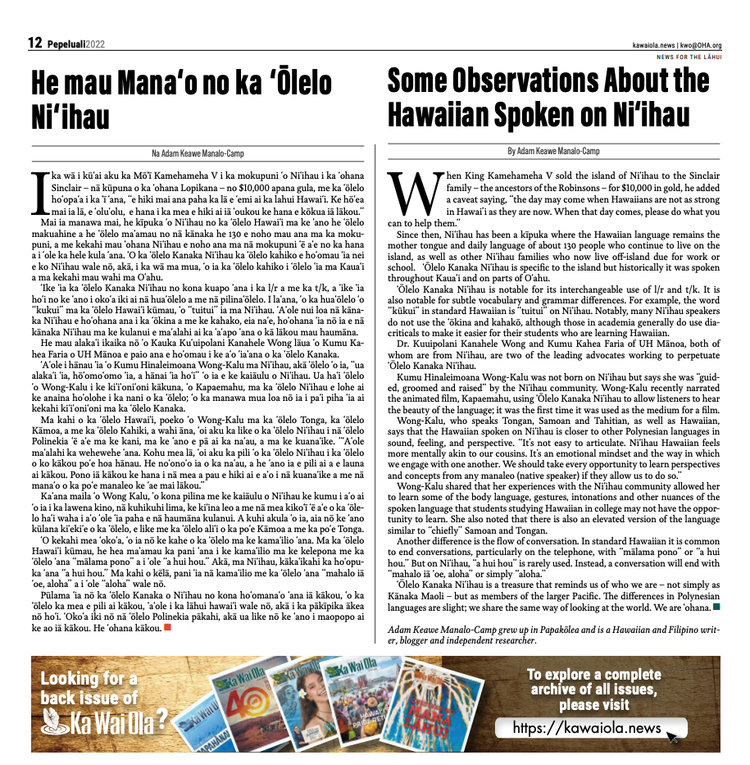
  • Observations About the Hawaiian Spoken on Niʻihau

    Observations About the Hawaiian Spoken on Niʻihau

    Observations About the Hawaiian Spoken on Niʻihau

  • THE HEALER STONES OF KAPAEMAHU: June 18 – Oct 15, 2022

    THE HEALER STONES OF KAPAEMAHU: June 18 – Oct 15, 2022

    THE HEALER STONES OF KAPAEMAHU: June 18 – Oct 15, 2022

    Bernice Pauahi Bishop Museum announces a new, original exhibition that will explore the hidden history and contemporary meaning of what may be the world’s only public monument celebrating gender fluidity – The Healer Stones of Kapaemahu.

    Honolulu, Hawaiʻi — Bernice Pauahi Bishop Museum announces a new, original exhibition coming to its Castle Memorial Building in June: The Healer Stones of Kapaemahu. The exhibition emerged from the research behind an Oscar-contending short film, Kapaemahu, that brought the unexpurgated legend to life.

    The Healer Stones of Kapaemahu will explore the history and contemporary meanings of four large pōhaku (stones) on Waikīkī Beach. These pōhaku were placed long ago as a tribute to four māhū, people of dual male and female spirit, who brought healing arts from Tahiti to Hawaiʻi. Although the stones have survived for centuries, the story behind them has been suppressed and the respected role of māhū erased. Using immersive media and innovative storytelling approaches, the exhibition revitalizes this traditional story to help restore this sacred site as a permanent reminder of Hawaiʻi’s history of inclusion and acceptance.

    “This exhibition presents our Hawaiian view of gender duality as a natural aspect of the human experience,” said Hinaleimoana Wong-Kalu, a curator of the exhibition who herself identifies as māhū. “It brings knowledge and wisdom of the past into the present-day conversation.” The Healer Stones of Kapaemahu will be a multifaceted exhibition that combines film, art, archival documents and images, storytelling, and other interactive elements, sharing that for Hawaiian history and culture to be understood and appreciated, it must be seen from a Hawaiian perspective. In the case of Kapaemahu, this perspective centers gender duality, erased from a beloved moʻolelo (story) over time by foreign influences, as a natural and respected aspect of the human experience and a central element of the science of healing.

    In presenting the original moʻolelo, and examining the ways in which it, and the monument erected to honor its heroes, were altered in the 20th century, the exhibition also challenges visitors to ponder how other aspects of Hawaiian history and culture might have been suppressed, changed, or lost. More importantly, visitors will understand that these aspects of Hawaiian culture now have the opportunity to be restored and elevated.

    On View June 18 – October 15, 2022
    Museum Hours: Open Daily 9 am – 5 pm
    Ages: All Ages
    Location: Castle Memorial Building

    Media Preview Opportunity on Thursday, June 16, 2022
    Bishop Museum invites members of the media to attend an exclusive, pre-opening, closed-door Media Preview of The Healer Stones of Kapaemahu:
    Thursday, June 16, 2022
    1-4 p.m. HST
    Bishop Museum, Castle Memorial Center

    Details at: bishopmuseum.org/kapaemahu/
  • The Queer Indigenous Artists Reclaiming a Fluid Sense of Gender

    The Queer Indigenous Artists Reclaiming a Fluid Sense of Gender

    The Queer Indigenous Artists Reclaiming a Fluid Sense of Gender

    by Ligaya Mishan – T: The New York Times Style Magazine – February 17, 2022:

    Colonialist conceptions of gender have long sought to erase more expansive views. But a new generation is making work that honors their cultures’ beliefs on their own terms.

    Excerpt on Kapaemahu:

    To recover the past, then, can be an act of resistance. In the animated short film “Kapaemahu” (2020), directed by Hinaleimoana Wong-Kalu, Dean Hamer and Joe Wilson, an ancient mo‘olelo (“oral story”) is given new life, recounting the voyage of four healers from Tahiti to the Hawaiian Islands many centuries ago. Like Wong-Kalu, who narrates the film, and the dancer and singer Kaumakaiwa Kanaka‘ole, who composed and performs the chant in it, the healers were māhū, “not male nor female … a mixture of both in mind, heart and spirit,” as the film puts it. They brought knowledge of how to ease pain and cure illness and were welcomed and beloved. When the time came for them to depart, the grateful community hauled four boulders to the beach at Waikiki, in what is now Honolulu; the māhū infused the stones with their spirits, then vanished.

    In 1941, the stones were threatened by the construction of a bowling alley, and in the decades that followed, they were moved several times, with attendant news stories that subtly erased the gender fluidity of the māhū as told in the original mo‘olelo, which was collected by the folklorist Thomas G. Thrum from a telling by James Harbottle Aalapuna Boyd. (Boyd was a colonel of the Hawaiian Kingdom before its overthrow in 1893 and husband to Helen Mani‘iailehua Cleghorn, a half sister of Princess Ka‘iulani, the last heir to the throne.) As the Pacific Islands studies scholar Teoratuuaarii Morris has documented, where Boyd identified the māhū as explicitly “unsexed by nature,” with “feminine appearance, although manly in stature,” a journalist in 1963 described them more evasively, as “handsome, kindly and soft-spoken,” and later, in the 1990s and early 2000s, they were referred to outright as “men.” “Kapaemahu” corrects the record with its woodcut-like animation, abstract yet expressive, and in so doing affirms the stones — now protected and honored on a platform in Waikiki, albeit with no mention of the māhū — as part of an ancestral landscape.

    Full article here.

  • New Exhibition to Explore a Suppressed Piece of Hawaiian History about Four Legendary Māhū

    New Exhibition to Explore a Suppressed Piece of Hawaiian History about Four Legendary Māhū

    New Exhibition to Explore a Suppressed Piece of Hawaiian History about Four Legendary Māhū

    by: Chelsee Yee – January 27, 2022 – KHON2:

    HONOLULU (KHON2) — Long ago, four extraordinary individuals of dual male and female spirit, known as māhū, brought their wisdom from Tahiti to Oahu, saving many lives with their healing abilities. Their indigenous leader Kapaemahu recounts the story that many have forgotten.

    In June, visitors to Bishop Museum will be reminded of that tale in a new exhibition called The Healer Stones of Kapaemahu, which will explore the history of the loss and rediscovery of four mysterious stones on Waikiki Beach. The exhibition is based on the Oscar-contending animated film.

    Kapaemahu tells the story of four legendary māhū who sail from Tahiti to Hawaii, sharing their gifts of science and healing with the people of Oahu. The islanders show their appreciation with a monument of four boulders in their honor, which the māhū heroes imbue with their healing powers before disappearing. The stones still stand on the beach, but the story behind them was hidden — until now.

    The film is directed, produced and narrated in ʻŌlelo Niihau by Hinaleimoana Wong-Kalu, who made history with Kapaemahu being the first Native Hawaiian film to become an official Oscars shortlist of 10 films in the ‘Animated Short Film’ category.

    Wong-Kalu, Dean Hamer, and Joe Wilson (co-curators) released this statement:

    “At a time when there is great need of healing in Hawai’i, and the world, we’re thrilled that the Bishop Museum is lifting up the story of The Healer Stones of Kapaemahu and celebrating the extraordinary skills, talents and accomplishments of these four legendary mahu.”

    HINALEIMOANA WONG-KALU, DEAN HAMER, AND JOE WILSON

    The exhibition will not only explore the suppression and resurrection of Kapaemahu — it will also help to restore the monument on Waikiki Beach as a reminder of Hawaii’s long tradition of acceptance.

    In addition to the Bishop Museum exhibition, Kapaemahu is being made into a children’s picture book by Penguin Random House, which is timed to hit the shelves when the exhibition opens.

    It’s the first-ever bilingual book in Olelo Niihau, just like the animated short film.

  • ‘Kapaemahu’ Expands with Book, Exhibition and Documentary Film

    ‘Kapaemahu’ Expands with Book, Exhibition and Documentary Film

    ‘Kapaemahu’ Expands with Book, Exhibition and Documentary Film

    by Samuel Patrick Bannon – Animation World Network – October 28, 2021:

    The acclaimed, award-winning 2D animated short, Kapaemahu, is expanding into multiple mediums to tell the beautiful and traditional Hawaiian story of the four healing stones and the hero’s they are dedicated to. The planned expansion includes a children’s picture book, an interactive museum exhibit at Bishop Museum, and a documentary, all designed to shed light on this suppressed and hidden piece of Hawaiian history.

    The indigenous legend recounts how four extraordinary individuals of dual male and female spirit, known as mahu, came to Oahu bringing wisdom and saving many lives with their healing abilities. The people of Oahu then placed four large stones on Waikiki Beach in memorial, and the mahu heroes imbued them with their healing spirits before disappearing. But these stones remained sacred to the people of Oahu for hundreds of years until outside settlers sought to hide the legend, and for a long time this tale of wisdom was forgotten.

    Now, Oahu’s Waikiki Beach is one of the most famous spots on the planet, its vibrant white sand, and beautiful turquoise waters make it a destination for millions every year. But this beach holds more than just beauty; it holds an inspiring and ancient history, and hopefully, because of the coming artistic exploration of its ancient legend, people will pay homage to that history, and the uncovered sacred stones that gave hope to the native people of Oahu. 

    Penguin Random House is publishing a large format picture book telling the ancient story. Richly illustrated by Kapaemahu animation Director, Daniel Sousa, it is the first-ever bilingual book in the ancient Niihau form of the Hawaiian language. “Kapaemahu is a monument to an indigenous Hawaiian legend and a classic in the making,” said Namrata Tripathi, editor of the Kokila Penguin Young Readers imprint. It’s expected to be on bookshelves by early 2022.

    Watch the Bishop Museum exhibition teaser here.

    The animated legend will also be the centerpiece of an immersive multimedia exhibition at the Bishop Museum in Hawaii, the largest collection of Hawaiian and Pacific culture in the world. Occupying the entire 8,500 square feet of Castle Memorial Hall, the exhibition will feature 30-foot replicas of the four mahu healers standing in front of glowing facsimiles of the stones dedicated to them on Waikiki beach. An animated timeline will document the suppression and resurrection of their story, and the work now being done to restore the stones as a permanent monument. The exhibition is scheduled for June 2022. 

    PBS will premiere the feature documentary The Healer Stones of Kapaemahu on Pacific Heartbeat, bringing this hidden Hawaiian history to life for millions of viewers across the U.S. “When I decided to tell the story of Kapaemahu in animated form, it was the best way I could imagine to express my understanding of this legend from a cultural point of view,” said director and producer Hinaleimoana Wong-Kalu, a Native Hawaiian who is herself mahu. “It’s exciting now to see that vision expanding, delving deep into history, and bringing it into view on multiple platforms that have the capacity to reach so many new and different audiences. It will be transformative”.

  • Kapaemahu LGBT Animation Short Now A Book and a Doc

    Kapaemahu LGBT Animation Short Now A Book and a Doc

    Kapaemahu LGBT Animation Short Now A Book and a Doc

    Zippy Frames – October 27, 2021:

    The animation short Kapaemahu will have its book and documentary premiere.

    ‘Kapaemahu’ animation short reveals the healing power of four mysterious stones on Waikiki Beach in Hawaii – and the legendary dual male and female spirits within them. An Oscar-shortlisted 2D animation film, it is co-directed by Hinaleimoana Wong-Kalu, Dean Hamer and Joe Wilson  with  Daniel Sousa (Oscar-nominated for Feral) as an animation director.

    The film went on to compete at the Annecy Festival and Tribeca Film Festival, among other festival selections.

    As Hinaleimoana Wong-Kalu, a native Hawaiian and herself mahu, said to Zippy Frames in a interview piece about the film, “we spent over five years researching the tradition of Kapaemahu before even starting the script. The breakthrough was the discovery of the original handwritten manuscript of the story, which had been recorded a century ago by a Hawaiian member of the noble class who may have heard it from the last queen of the Hawaiian Kingdom. Our script followed the manuscript closely”.

    Now the film will become a book (to be published by Penguin Random House), in a large format aimed at children and parents, and illustrated by Daniel Sousa. It is the first-ever bilingual book in the ancient Niihau form of the Hawaiian language. “Kapaemahu is a monument to an indigenous Hawaiian legend and a classic in the making,” said Namrata Tripathi, editor of the Kokila Penguin Young Readers imprint.  

    The animated legend will also be the centerpiece of an immersive multimedia exhibition at the Bishop Museum, the largest collection of Hawaiian and Pacific culture in the world.  Occupying the entire 8,500 sq.ft. Castle Memorial Hall, the exhibition will feature 30 foot tall replicas of the four transgender healers standing in front of glowing facsimiles of the stones dedicated to them on Waikiki  beach.  An animated timeline will document the suppression and resurrection of their story, and the work now being done to restore the stones as a permanent monument. The exhibition is scheduled for June 2022. 

    At the same time, PBS will premiere the feature documentary ‘The Healer Stones of Kapaemahu” on Pacific Heartbeat, bringing this hidden Hawaiian history to life for millions of viewers across the U.S.

    When I decided to tell the story of Kapaemahu in animated form, it was the best way I could imagine to express my understanding of this legend from a cultural point of view. It’s exciting now to see that vision expanding, delving deep into history and bringing it into view on multiple platforms that have the capacity to reach so many new and different audiences. It will be transformative  – Hinaleimoana Wong-Kalu.

    The ‘Kapaemahu’ book is expected to be on bookshelves by early 2022.

  • Book, Multimedia Exhibition and Documentary on Oscar-nominated Hawaiian Animated Short ‘Kapaemahu’ Announced

    Book, Multimedia Exhibition and Documentary on Oscar-nominated Hawaiian Animated Short ‘Kapaemahu’ Announced

    Book, Multimedia Exhibition and Documentary on Oscar-nominated Hawaiian Animated Short ‘Kapaemahu’ Announced

    Animation Xpress – October 25, 2021:

    Hawaiian animated short, Kapaemahu, created quite a stir at the 93rd Academy Awards this year, as it became the first ever Native Hawaiian film to clear the first round of voting and become an official Oscars shortlist of 10 films in the ‘Animated Short Film’ category. This amazing work is now evolving into other formats including a children’s picture book, immersive multimedia exhibition, and documentary film, all exploring the rich history brought to life by the animation.  

    “When I decided to tell the story of Kapaemahu in animated form, it was the best way I could imagine to express my understanding of this legend from a cultural point of view. It’s exciting now to see that vision expanding, delving deep into history and bringing it into view on multiple platforms that have the capacity to reach so many new and different audiences. It will be transformative,” said director-producer Hinaleimoana Wong-Kalu, a Native Hawaiian who is herself a mahu (transgender). 

    The picture book on Kapaemahu will be published by Penguin Random House in a large format aimed at children and parents. Richly illustrated by animator Daniel Sousa, it is the first-ever bilingual book in the ancient Niihau form of the Hawaiian language. It is expected to be on bookshelves by early 2022.

    The book tells the indigenous legend of how four extraordinary individuals of dual male and female spirit, known as mahu,  brought healing arts from Tahiti to Hawaii. 

    Kapaemahu is a monument to an indigenous Hawaiian legend and a classic in the making,” said Kokila Penguin Young Readers imprint editor Namrata Tripathi.

    The animated legend will also be the centerpiece of an immersive multimedia exhibition at the Bishop Museum, the largest collection of Hawaiian and Pacific culture in the world. Occupying the entire 8,500 square feet Castle Memorial Hall, the exhibition will feature 30 foot tall replicas of the four transgender healers standing in front of glowing facsimiles of the stones dedicated to them on Waikiki beach. 

    An animated timeline will document the suppression and resurrection of their story, and the work now being done to restore the stones as a permanent monument. The exhibition is scheduled for June 2022.

    Also, PBS will premiere the feature documentary The Healer Stones of Kapaemahu on Pacific Heartbeat, bringing this hidden Hawaiian history to life for millions of viewers across the U.S. 

    “Given the limited distribution opportunities for animated shorts, we think Kapaemahu is an interesting model for different ways to increase reach and marketing,” film’s co-producer Dean Hamer said in an official statement.

  • Celebrating Pride with Kapaemahu – A Talk Story with LGBTQ+ Communities in Hawai’i

    Celebrating Pride with Kapaemahu – A Talk Story with LGBTQ+ Communities in Hawai’i

    Celebrating Pride with Kapaemahu – A Talk Story with LGBTQ+ Communities in Hawai’i

    PBS Hawai’i – October 19, 2021:

    In partnership with POV and Open Society Foundations, PBS Hawai’i hosted an intimate virtual talk story on the challenges and opportunities faced by members of LGBTQ+ communities beyond urban Honolulu. Watch and Listen HERE.

    Panelists include:

    • Joe Wilson, Filmmaker, Kapaemahu

    • Thaddeus Pham, Co-Chair, Hawaiʻi Department of Health Sexual and Gender Minority Workgroup

    • Hao Le, President of Affirmation Hawai’i, Oʻahu

    • Keivalei Cadena, Harm Reduction Programs Manager at Kumukahi Health & Wellness, Hawai’i Island

    • Ian Tapu, Hawai’i LGBT Legacy Foundation and the Hawai’i Health & Harm Reduction Center

    This program is made possible by a grant from American Documentary | POV, with funding provided by the Open Society Foundations. This event is a collaboration with POV, the award-winning independent non-fiction film series on PBS www.pbs.org/pov.