Author: Nicholas Griffith

  • Kumu Hina on Western and Hawaiian Understandings of Gender and Sexuality

    Kumu Hina on Western and Hawaiian Understandings of Gender and Sexuality

    Kumu Hina on Western and Hawaiian Understandings of Gender and Sexuality

    Hawaii Public Radio interview by Noe Tanigawa:

    Oct. 11 was National Coming Out Day, referring to “coming out of the closet.” Today, Hinaleimoana Wong’s coming-out story. A respected educator and cultural leader, Kumu Hina met HPR in Waikiki. We visited Kapaemahu, the majestic healing stones at the edge of Kūhiō Beach that are linked to healers who were not specifically male or female. Kumu Hina co-produced an Oscar-nominated animation about Kapaemahu, Waikiki’s healing stones — and composed a Hoku award-winning anthem, “Ku Haʻaheo.”

    Interview Highlights

    On the differences between Western and Hawaiian understandings of gender, sexuality and more

    From a Western and American perspective, the understanding of transgender can take on a whole different kind of nuance, a whole different meaning and a whole different perspective. But from Hawaiian and other Pacific Islander views, those of us who occupy a space and place in the middle, those of us who have both elements of male and female, kane and wahine, each individual is to his or her own varying degree. We don’t necessarily fall into distinct categories.

    In Western culture, especially in American culture, there’s great emphasis placed on a label. Are you gay? Are you bi? Are you lesbian? Are you trans? What are you? And we as Hawaiians and other Pacific Islanders, we identify by our name, by our family. We identify by either the town or the village that we come from. We identify by the island that we call home. We know the streams and rivers and the mountains of our places — and we come from these places. We are attached to these places. We come from generations of a people who populated the Pacific. As Pacific Islanders, when we say who we are, my name is not just Hinaleimoana and from the American perspective — oh and by the way, I’m transgender. That’s not how we look at the world. I am Hinaleimoana, I am the keiki, I am the kama, I am the hanau — the offspring of Georgette and Henry.

    I do not have to identify by the articulation of my gender identity or by my sex. I do not have to tell you that I have a vagina or a penis between my legs. I do not have to tell you that I was born my family’s son, but I have fully transitioned to become their daughter. I don’t have to identify by those things because those things are rather irrelevant to what my family and the society that I come from say about me, and my worth, and my value. Western and American culture place great emphasis — it’s almost like they put a penis or a vagina on your forehead. So you have to identify by that. When you walk up and say, “Hi, I’m so and so and I’m gay.” Well, what’s the purpose of saying that? Why does somebody have to identify as that? Why can’t you and I look at each other — Hi, your name is Noe, my name is Hina. “Hi, what do you do?” “This is what I do.” You know — “where are you from?” “This is where I’m from.”

    On coming out to family and fulfilling familial expectations

    My personal preference, I am someone who is attracted to men, biological men, but my preference is irrelevant. In the culture that I come from, it shouldn’t matter. I will bring home whom I feel is worthy of not only my love, time and attention, but I will bring home somebody whom I feel that my family might take favor upon. And then again, even if they didn’t take favor, I might just bring them home with me anyway. But that’s my independent choice. And, you know, there are some families who would deal very well with that, and some families who won’t.

    Well, everybody, you know, initially focused on “are you changing?” In my Chinese family, I did exactly what was the expectation of me — and my father was very staunchly Chinese, even though he grew up here in Hawaiʻi. It was humility, and filial piety, and loyalty to the family. I was loyal to my father and my grandmother. I was loyal to the values and the ideals that were espoused in our household. And I did as my father said, and when my father said, “I only have two things that I want of you. I want you to finish school and take care of your grandmother; and after that, I don’t care what you go do, you can be a rubbish picker for all I care.” His exact words. And I fulfilled that. I fulfilled it, above and beyond the call of duty. So I earned my father’s love and respect. And no matter how much he may like, dislike, agree or disagree with my life’s direction and choices, it’s irrelevant because I fulfilled my father’s charge for me to do. I transitioned in front of my father. And no matter how many years pass, I will always have my father’s support. Even when I screw up, and when I mess up, I will always have my father’s support and unconditional acceptance. And I say, with confidence, will I be a disappointment? I might be to a certain degree, but it doesn’t mean that he’s going to stop loving me.

    I know I’m very fortunate. But Hawaiian society, in my Hawaiian household, same thing. I was raised by my grandparents on both sides. And my mom’s mom raised me and infused me with the understanding to be strong — in as much as I could do for Hawaiian language and people and culture. And to do things Hawaiian, and to honor it, to cherish it, to promote it, perpetuate it, promulgate it. And my grandfather, he was a man of prayer above all else. My grandfather was a staunch member of The Church of Latter-Day Saints. And so his being Hawaiian was secondary to that. But his prayer life is what I carry with me today. So too was it in my Chinese side, so too was it in my Hawaiian side, that I had to fulfill duties and responsibilities made of me. For that, I have earned the respect on both sides of my family. So now in my adult life, I really wanted to say that it doesn’t matter how you identify in Western terms. In Hawaiian and Pacific Islander understanding, again, I am the child of so-and-so, I’m the grandchild of so-and-so.

    Listen to full interview HERE.

  • Kapaemahu Children’s Picture Book Pre-Orders Available Now

    Kapaemahu Children’s Picture Book Pre-Orders Available Now

    Kapaemahu Children’s Picture Book Pre-Orders Available Now

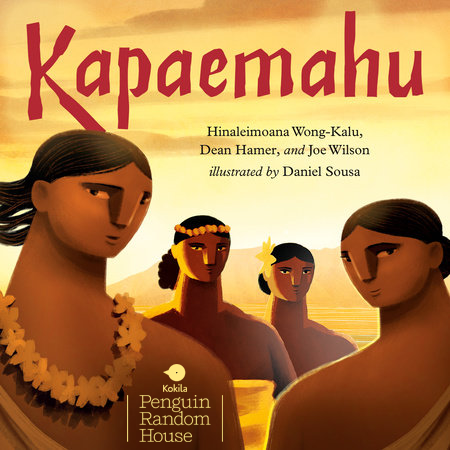
    Published by Penguin Random House, pre-orders of the children’s picture book are available here.

    An Indigenous legend about how four extraordinary individuals of dual male and female spirit, or Mahu, brought healing arts from Tahiti to Hawaii, based on the Academy Award–contending short film.
     

    In the 15th century, four Mahu sail from Tahiti to Hawaii and share their gifts of science and healing with the people of Waikiki. The islanders return this gift with a monument of four boulders in their honor, which the Mahu imbue with healing powers before disappearing.
     
    As time passes, foreigners inhabit the island and the once-sacred stones are forgotten until the 1960s. Though the true story of these stones was not fully recovered, the power of the Mahu still calls out to those who pass by them at Waikiki Beach today.

    With illuminating words and stunning illustrations by Hinaleimoana Wong-Kalu, Dean Hamer, Joe Wilson, and Daniel Sousa, KAPAEMAHU is a monument to an Indigenous Hawaiian legend and a classic in the making.

  • A Hawaiian Perspective on Monuments

    A Hawaiian Perspective on Monuments

    A Hawaiian Perspective on Monuments

    As part of the Mellon Foundation’s unprecedented new Monuments Project, Philadelphia-based nonprofit art and history studio Monument Lab undertook a comprehensive audit of our country’s commemorative landscape, scouring almost half a million records of historic properties to better understand the dynamics and trends that have shaped our nation’s monuments.

    The National Monument Audit includes this essay on Kapaemahu by Dean Hamer, Joe Wilson, and Hinaleimoana Wong-Kalu:

    “Aia ka piko I Mauliola ma Hawai‘i, ka one hānau, ka ʻāina makuahine o Kanaka.”

    The umbilical cord remains grounded in Hawaiʻi at Mauliola, the birth sands of the Hawaiian.

    The guiding principle in the work of Qwaves & Kanaka Pakipika is that Hawaii is the piko, or source: the navel where life begins, and the connection to the ancestral realm, family, and future descendants.  Exploring monuments and memorialization through this worldview lends to a holistic and inclusive view of the body, mind, and spirit, wellness, and the identities of ourselves and others.

    Our approach is grounded, first, in our place in Hawaii, and then in the Pacific, rather than vis-a-vis or in comparison to dominant Western frameworks of culture and history.

    Seen this way, monuments in Hawaii have a different meaning and context than those in the continental United States.  Each has its own unique story and name, often layered with multiple kaona, or hidden meanings.  When foreigners arrived in the islands, they often misinterpreted or suppressed these stories, a process that was not only a byproduct of colonization but was intrinsic to delegitimizing Indigenous thought and societal patterns.

    The monument landscape in Hawaii over the past decade has been dominated, and continues to be inspired, by the struggle to protect Mauna Kea, a deeply sacred mountain on which scientific research institutions have a mission to build an enormous telescope, despite Native Hawaiian and allied local opposition.

    But there are other sites that also demand attention. 

    As a small collective of independent media makers, we seek to discover the Indigenous stories and meanings of such sites, and to (re)invigorate them through creative and novel means of storytelling.  This provides the foundation for developing collaborative, community-rooted commemorative practices that are rooted in the sacred meanings of Hawaii’s storied places.

    Here we describe two sites with which we are directly involved.

    The Healer Stones of Kapaemahu

    The healer stones of Kapaemahu are a sacred site in the middle of Waikiki Beach, one of the most popular tourist destinations in Hawaii. According to tradition, the stones commemorate four extraordinary mahu – individuals of dual male and female spirit — who brought the healing arts from Tahiti to Hawaii.  After a long period of cultural neglect, which included being buried underneath a bowling alley, the stones were unearthed and are again accessible to the public. However, their significance as a memorial has been much diminished by the altering of their story and name to conform to foreign values and ideas.  The fact that the healers were mahu, beloved by the people, was erased from view.

    Our efforts to revitalize the significance of this monument began with ten years of research to understand both the origins of the story and the ways it had been suppressed and altered as the result of colonization, militarization, the rise of anti-transgender discrimination in the continental United States, and the fierce political debate over same-sex marriage that roiled Hawaii.  The identities of the healers as four mahu was first ignored, then changed to two males and females, and even misinterpreted to mean “not homosexual.”  Lost along the way was the very meaning of the name of the stones, Kapaemahu, which translates in English as “the row of mahu.”

    We were fortunate to discover the first written documentation of the narrative, in the form of a handwritten manuscript in the University of Hawaii archives, which became the foundation for the next step, which was to tell the original story in as close as possible to the original form.

    We chose animation, which combines the immediacy and imagination of great storytellers with modern accessibility, and narrated the film in the ancient Niihau dialect, the only uninterrupted form of the Hawaiian language. The resulting short film, Kapaemahu, which premiered at the 2020 Tribeca Film Festival and was shortlisted for an Oscar at the 93rd Academy Awards, has been widely viewed in Hawaii and around the world and, as a result, has created an opportunity for a historical reckoning at the site.

    We are currently working with a variety of stakeholders to increase the reach, depth, and impact of this story through a bilingual children’s book, a PBS / Pacific Islanders in Communications feature documentary, and an exhibition at the Bernice Pauahi Bishop Museum, all scheduled to launch in Spring 2022.

    The Healer Stones of Kapaemahu are a unique memorial to Hawaiian concepts of healing, gender diversity, and inclusion.  Every resident and visitor to Hawaii should know the meaning of this monument.  Its name and story deserve to be treated with the same respect and dignity as the stones themselves and understood as Hawaiians themselves once did.

    Kohelepelepe

    Kohelepelepe, which translates in English as “the fringed vulva,” is the traditional name for the crater of a large volcanic cinder cone located in the southeast corner of the island of Oahu.  Oral tradition holds that the crater is the imprint of the flying vagina of Kapo, who detached it to use as a decoy to help her sister Pele, goddess of fire and volcanoes, avoid being raped by the overzealous pig god Kamapuaa.  Missionaries renamed this prominent feature Koko Head, perhaps because they did not know the story of its name, or perhaps because they did.

    Hawaiians have long regarded genitals (mai) with honor and respect, and there are many chants and hulas written in praise of the procreative organs of Hawaiian royalty.

    Kohelepelepe, which is now part of a heavily hiked Honolulu District Park, should have its name and story restored.

    Similar to our work to bring the Hawaiian understanding of the legend of Kapaemahu back to life, we are first creating a short animated film that will help to restore the story of Kapo’s Flying Vagina to its rightful place in Hawaii’s historical memory. From that will follow efforts to educate and engage communities in questioning and reimagining the English name for this sacred site.

    Back to the Future

    The global debate on the meaning of monuments and the lessons of history has focused on the long overdue removal of figures that honor racist and imperialist figures from our ignoble past.  While this is also an issue in Hawaii – as exemplified by the statue and high school named after William McKinely, the United States President who illegally annexed the Kingdom of Hawaii against the will of her queen and people – our work asks a different question: What of monuments that are dedicated to historyʻs heroes, yet dishonor them and distort history by concealing certain aspects of the heroes’ true identity or the nature of their power?

    In order to commemorate the past, we need to know and understand it, and to convey it stripped of foreign hegemony.  

    I ka wā ma mua, i ka wā ma hope.”

    In the time in front is the time in back.

    Qwaves & Kanaka Pakipika are community-based multimedia, engagement and empowerment collectives focused on gender, cultural, racial, economic, and political justice in Hawaii led by Hinaleimoana Wong-Kalu, Dean Hamer, and Joe Wilson.

  • The Nearly Forgotten Origin Myth of Hawaii’s Third-Gender Healers, As Told by One

    The Nearly Forgotten Origin Myth of Hawaii’s Third-Gender Healers, As Told by One

    The Nearly Forgotten Origin Myth of Hawaii’s Third-Gender Healers, As Told by One

    Aeon Magazine – September 14, 2021:

    In Hawaiian culture, moʻolelo means story, tale or myth, but it also refers to history. Traditionally passed down through oral storytelling, moʻolelo serve as a connection to the past, carrying wisdom and entertainment across generations. Over the centuries, however, many moʻolelo have been censored or lost altogether due to Western colonisation. The short animation Kapaemahu is an adaptation of a nearly forgotten mo’olelo about four māhū – people possessing both male and female qualities in mind, body and spirit – who brought healing arts from Tahiti to Hawaii. As the story goes, the māhū imbued with their powers four boulders, which stood at a sacred site for hundreds of years until they were forgotten. Told through a modern lens by the Native Hawaiian teacher, filmmaker and māhū Hinaleimoana Wong-Kalu and the Emmy Award-winning US filmmakers Joe Wilson and Dean Hamer, Kapaemahu brings renewed life to this moʻolelo via animations inspired by Polynesian tapa designs and a touch of Hawaii’s recent history.

    Directors: Hinaleimoana Wong-Kalu, Joe Wilson, Dean Hamer

    Animation director: Daniel Sousa

  • Kapaemahu, the Native Hawaiian Story of Four Legendary Mahu Healers

    Kapaemahu, the Native Hawaiian Story of Four Legendary Mahu Healers

    Kapaemahu, the Native Hawaiian Story of Four Legendary Mahu Healers

    The Kid Should See This – September 14, 2021:

    Long ago, four Pacific Island spirits arrived on the shores of Hawaii. Kapaemāhu, Kapuni, Kīnohi and Kahaloa were māhū, gentle yet powerful healers with balanced qualities of both male and female in mind, heart, and spirit.

    Their peaceful and generous ways and made them beloved, and when they prepared to travel onward, the Hawaiians honored them with a gift: a sacred site of gratitude made with four giant boulders.

    The esteemed visitors imbued these rocks with their mana, and the monument was revered for centuries by Hawaii’s indigenous people.

    Both history and legend, this essential moʻolelo or cultural narrative of Hawaii was passed from generation to generation through oral storytelling. Western colonization of the late 1800s suppressed and concealed this story along with many other cultural treasures. On the shore of what is now Waikiki Beachthe four sacred boulders suffered that fate, too.

    Their hidden story is revealed with the film Kapaemāhu.

    The award-winning animated short was written, directed, and produced by Native Hawaiian teacher and filmmaker Hinaleimoana Wong-Kalu, along with Emmy and GLAAD Media award-winning filmmakers Dean Hamer and Joe Wilson, and Oscar-nominated animator Daniel Sousa.

    The film premiered at the Tribeca Film Festival, has won awards at children’s film festivals around the globe, and is now presented online by the PBS Short Film Festival.

    In a director’s statement, Hinaleimoana Wong-Kalu writes:

    “I am Kanaka — a native person descended from the original inhabitants of the islands of Hawaii. Our survival as indigenous people depends on our ability to know and practice our cultural traditions, to speak and understand our language, and to feel an authentic connection to our own history.

    “That is why I wanted to make a film about Kapaemahu, and to write and narrate it in Olelo Niihau – the only form of Hawaiian that has been continuously spoken since prior to the arrival of foreigners. It is not enough to study our language in an American classroom, nor to read about our history in an English language textbook. We need to be active participants in telling our own stories in our own way. I am also mahu, which like many indigenous third-gender identities was once respected but is now more often a target for hatred and discrimination. I want our young people to understand that the ability to embrace both the male and female aspects of their spirit is not a weakness but a strength, a reason to rejoice not to fear.

    “Whether it is protecting Mauna Kea or Kapaemahu, I shall always believe in what historian S. M. Kamakau articulated in 1865 : He makemake ko’u e pololei ka moolelo o ko’u one hanau, aole na ka malihimi e ao ia’u I ka moolelo o ko’u lahui, na’u e ao aku I ka moolelo I ka malihini.

    “‘I want the history of my homeland to be correct. The foreigner shall not teach me the history of my people, I will teach the foreigner.’”

  • It’s Raining Hawai‘i Films in Hollywood

    It’s Raining Hawai‘i Films in Hollywood

    It’s Raining Hawai‘i Films in Hollywood

    Local Oscar-listed animated short “Kapaemahu” is just one of more than a dozen recent films to spring from our filmmaking community into the spotlight—and it’s no Baywatch Hanauma Bay.

    by Don Wallace – Honolulu Magazine – April 23, 2021:

    Hollywood’s recent rediscovery of Hawai‘i as more than just a tropical backdrop for dinosaurs and squabbling reality show lolos actually feels rather breathtaking—or maybe breathless. Because in one month in early 2021 we got The Goonies remake, Finding ‘Ohana, with ‘ōlelo subtitles; the debut of Dwayne Johnson’s school days series, Young Rock; and near-simultaneous announcements of reboots Doogie Kameāloha, M.D., and NCIS: Hawai‘i.

    Much of the action is stimulated by a global story-buying frenzy prompted by pandemic streaming habits, which coincided with the handiness of Hawai‘i as a relatively COVID-free set.

     But the bigger news in the local filmmaking community isn’t reboots but real roots. More than a dozen local films were selected and screened on the prestigious Criterion Channel in recent mini-festivals. “Local and Native Hawaiian cinema has had exponential growth in the last decade, particularly in the last five years and especially in the last two,” says Taylour Chang, curator of film and performance at the Honolulu Museum of Art, who created the slate for Criterion.

    One of the films received Oscar consideration in March—the animated short Kapaemahu. “I think of this moment as a real filmmaking renaissance,” says Dean Hamer, a co-producer-director with Joe Wilson and lead director Hinaleimoana Wong-Kalu, perhaps better known as Kumu Hina, the title of her own Hamer-Wilson biopic.

    Kapaemahu did win best short at the Atlanta and Foyle film festivals, and the grand prize at the Animayo Film Festival. Using a flattened visual style and colors that evoke tapa cloth designs—and told in ōlelo Ni‘ihau, the only Native Hawaiian dialect to be spoken continuously since before Western contact—it tells the story of how the healing arts of Polynesia were brought to Hawai‘i by four māhū, or third gender, practitioners, who charged four stones with their spirit and wisdom.

    “When we started making this film about a Hawaiian legend in a language only spoken by a hundred people in the world, we had no idea that out of 3,000 short films made and 100 that qualified for the Oscars, ours would be one of 10 on the short list,” Hamer says. He credits nonprofit organization Pacific Islanders in Communications in particular for backing the film and many before it, but also cites the continuum of filmmaking support provided by the Hawai‘i International Film Festival; ‘Ohina Short Film Showcase; PBS Hawai‘i; Creative Lab Hawai‘i; Ō‘iwi TV; and a new effort, Good Pitch Local Hawai‘i, “which brings filmmakers with brilliant ideas together with the people who have money, resources and distribution. It’s just a big fancy pitch session!”

    Chang cites the same network, adding the Academy for Creative Media at the University of Hawai‘i (but modestly omitting her own influential curatorship of the Doris Duke Theatre at HoMA, which Criterion singles out). “What makes our local film system special is how supportive the community is. You have filmmakers working on each other’s projects, giving each other feedback. Over time, over these years, this has accumulated momentum and it just fuels more and more work.”

    Kapaemahu can be viewed on the Criterion Channel and at kapaemahu.com along with Q&As with the filmmakers and another short, The Making of Kapaemahu.

  • Meet Native Hawaiian Māhū Activist Hinaleimoana Kwai Kong Wong-Kalu

    Meet Native Hawaiian Māhū Activist Hinaleimoana Kwai Kong Wong-Kalu

    Meet Native Hawaiian Māhū Activist Hinaleimoana Kwai Kong Wong-Kalu

    by Alexis Cheung – Atmos – April 15, 2021:

    Hinaleimoana Kwai Kong Wong-Kalu has always occupied spaces in the middle: between male and female; between Indigenous and Western cultures; between her Chinese and Hawaiian heritages. 

    “My entire life has always been in the middle,” she explains. The Native Hawaiian educator, activist, and director became Hinaleimoana—meaning Hina, the goddess of the moon, and “the child of Moana,” her mother’s name—after transitioning in her early twenties. She is one of the most visible māhū, the Hawaiian third-gender identity, women in the Islands and the United States today.

    Her life’s work is devoted to exploring the interstices of identity and culture, specifically through a Kanaka Maoli, or Native Hawaiian, lens. Most recently, she narrated, directed, and produced the short animated film Kapaemahu, which premiered at the Tribeca Film Festival and was shortlisted for an Oscar. Narrated entirely in Olelo Niihau, a form of Hawaiian spoken since before the arrival of foreigners, it recounts the legend of four stones in Honolulu’s Waikiki—and the third-gender māhū healers for whom they were erected.

    Below, Wong-Kalu speaks to Atmos on the history of Kapaemahu, her personal journey to becoming Hinaleimoana, what she hopes audiences will take away from the story, and why Native peoples shouldn’t equate their ideas and understandings of the self and world in a Western framework.

    ALEXIS CHEUNG

    What is the mo‘olelo (story, myth, legend or history in Hawaiian) of Kapaemahu, your recent short film?

    HINALEIMOANA KWAI KONG WONG-KALU

    The story of Kapaemahu speaks to four legendary healers who came from Kahiki. In the context of Hawaiian history, Kahiki could mean Tahiti proper, as Tahiti is one of the ancestral homelands of our people, or any foreign lands outside of Hawaii. So it’s a very Hawaii centric way of looking at our world. These four legendary healers bring with them the knowledge and skills of healing. Their time here was so appreciated and they became so beloved that four great stones were erected in their honor. One of the unique elements about the healers is that they were actually recorded as having many elements about them that were female, although they were physically male. When we refer to people like this, the term ‘māhū’ is used.

    ALEXIS

    And māhū are defined in Hawaiian culture as someone ‘in between,’ is that correct?

    HINA

    That’s how I like to speak about it. When you look for historical writings speaking towards the topic of māhū, there are very limited examples. And it’s not because we didn’t exist, but it’s because we’re a part of society. We know this because we have the term, and it’s an adjective to describe the individual. Clearly within our language, too, the pronoun for heshe, and it is one word: either ‘oia or koia. The fact that we have a pronoun that does not acknowledge a male or female should give you some insight as to how our people felt about fluidity between the sexes.

    ALEXIS

    So in the Hawaiian conception of gender pronouns, there really was no need for distinction, which leads to my next question: How is māhū similar or different from our Western conception of transgender?

    HINA

    The understanding of māhū is not necessarily something that you can just easily transpose a Western understanding upon. It’s easier for the native view of it to find itself in a Western articulation, but it’s very difficult to try to transfer it from a Western understanding over to native one. Māhū is understood in a LGBTQIA+ context in the Western world. However, it’s far more inclusive and encompassing and complex than that, and I find that using a Western conception of māhū to be very compartmentalized and restricted.


    ALEXIS CHEUNG

    What is the mo‘olelo (story, myth, legend or history in Hawaiian) of Kapaemahu, your recent short film?

    HINALEIMOANA KWAI KONG WONG-KALU

    The story of Kapaemahu speaks to four legendary healers who came from Kahiki. In the context of Hawaiian history, Kahiki could mean Tahiti proper, as Tahiti is one of the ancestral homelands of our people, or any foreign lands outside of Hawaii. So it’s a very Hawaii centric way of looking at our world. These four legendary healers bring with them the knowledge and skills of healing. Their time here was so appreciated and they became so beloved that four great stones were erected in their honor. One of the unique elements about the healers is that they were actually recorded as having many elements about them that were female, although they were physically male. When we refer to people like this, the term ‘māhū’ is used.

    ALEXIS

    And māhū are defined in Hawaiian culture as someone ‘in between,’ is that correct?

    HINA

    That’s how I like to speak about it. When you look for historical writings speaking towards the topic of māhū, there are very limited examples. And it’s not because we didn’t exist, but it’s because we’re a part of society. We know this because we have the term, and it’s an adjective to describe the individual. Clearly within our language, too, the pronoun for heshe, and it is one word: either ‘oia or koia. The fact that we have a pronoun that does not acknowledge a male or female should give you some insight as to how our people felt about fluidity between the sexes.

    ALEXIS

    So in the Hawaiian conception of gender pronouns, there really was no need for distinction, which leads to my next question: How is māhū similar or different from our Western conception of transgender?

    HINA

    The understanding of māhū is not necessarily something that you can just easily transpose a Western understanding upon. It’s easier for the native view of it to find itself in a Western articulation, but it’s very difficult to try to transfer it from a Western understanding over to native one. Māhū is understood in a LGBTQIA+ context in the Western world. However, it’s far more inclusive and encompassing and complex than that, and I find that using a Western conception of māhū to be very compartmentalized and restricted.

    ALEXIS

    In what ways?

    HINA

    When I say I identify as male and female, that’s mentally and emotionally. Perhaps spiritually, as well. That’s what I’m referring to for me. Western culture doesn’t necessarily speak to the mental, emotional, and spiritual aspects of people.

    I would also say that Westerners tend to have the need to identify by genitalia, sexuality, and individuality. There seems to be a fixation on it, because by default, Western culture does not account for fluidity nor flexibility. And only in recent years has there been an effort to really try to address that. Nowadays, it’s practice to ask someone their pronouns. 

    In Hawaiian culture, we’re identified by our genealogy and our land. So we don’t necessarily introduce ourselves as individuals or compartmentalize ourselves from solely [a gender or sexuality] perspective. There’s almost a disdain around trying to identify yourself as what makes you stand out because we come from a collective culture where the we is far more valuable than the me. In Hawaii, we often ask, “What school did you go to?” Which means we’re also asking, “What area are you from?” And then we ask, “Oh, who’s your family?” So that’s a far different cry from asking someone about their gender identification and their sexual orientation, which, until this day, I struggle to engage with because it’s not anybody’s business.

    ALEXIS

    In some interviews I’ve read, you prefer being known as a Native Hawaiian advocate versus a transgender advocate, is that right?

    HINA

    Yeah, I’m not a transgender advocate. I mean, by default, by being considered transgender in the Western world, yeah. And obviously, when necessary, having to stand up for others like myself [who are māhū], then you might view me as a transgender advocate. But that’s not something that I immediately avail myself to because my work over the years has really kept me focused on advocating for issues that impact my people—my fellow Kanaka, my fellow Hawaiians. It’s always been my first and foremost priority. When I have to stand up and advocate for the element of cultural understanding that covers the topic of māhū, that’s how I approach it. The work I do has been done for others on the behalf of others. And yes, those said others could be from amongst the māhū members in the community, but most of the time, it’s for Hawaiian or Pacific Islander issues.

    ALEXIS

    What Hawaiian and Pacific Islander issues do you specifically advocate for?

    HINA

    I’m always an advocate for language, and the usage of our language to reinforce our identity, our relationships to ourselves and to others. I prioritize my people, the issues that affect my people, and because of that, my people have been very loving and giving to me as a result.

    In that way, I can actually engage in different circles that other people like me don’t have access to. I can sit at any business or political table here in Hawaii and be an active part of the conversation. Because I’m very keenly aware of the duality within, I consciously engage and exercise my knowledge of the difference—between communication, expression, movement, and engagement, between men and women or the same sexes, in both Island and Western settings—because it often helps me to achieve what I need or what I’d like to see on behalf of my people.

    ALEXIS

    That sounds like a freeing and expansive way of being and relating to others.

    HINA

    There are subtle differences when I’m with women and likewise when I’m with men. You know, it’s just a different way of engaging. I use all that I understand about both to walk me through my days.

    ALEXIS

    Why was it important to tell the story of Kapaemahu, and in Olelo Niihau? Was it mainly for the record of Hawaiian culture or to broaden the understanding of māhū in Hawaiian culture?

    HINA

    My desire to bring this story forward is to help bring greater depth and greater understanding to the concept of māhū. This particular segment of my work [Editor’s note: Hina was also featured in a documentary called Kumu Hinawhich traces her personal story and experience leading an all male hula troop] best speaks to the fact that māhū are different in terms of the traditional Hawaiian understanding of it. We cannot and should not be assessed or evaluated according to modern Western definitions. This film really tries to show who we were, how we were treated, and what were the views of our people before the coming of foreign Westerners to Hawaii. 

    ALEXIS

    What do you hope people will keep in mind as they’re watching?

    HINA

    I hope that they will look at Hawaii and Hawaiian culture as separate and distinct. We are not American, for one. Number two, we come from a larger family of people across the Pacific Ocean. We have a distinct perspective and understanding that we don’t necessarily have to try to equate to somebody else’s. We can acknowledge commonalities with other Native peoples. We can acknowledge commonalities even with our Western colonizer, foreigner people, but we shouldn’t necessarily have to or always try to reconcile ourselves in a culture and in language that’s foreign to us. I hope that the film will serve as a stepping stone and a conversation piece to explore: What does our culture really hold for people like me [and other māhū]? What do these understandings tell us? What can we learn? Hopefully because it’s in animation those learnings are accessible to everyone.

     ALEXIS CHEUNG

    What is the mo‘olelo (story, myth, legend or history in Hawaiian) of Kapaemahu, your recent short film?

    HINALEIMOANA KWAI KONG WONG-KALU

    The story of Kapaemahu speaks to four legendary healers who came from Kahiki. In the context of Hawaiian history, Kahiki could mean Tahiti proper, as Tahiti is one of the ancestral homelands of our people, or any foreign lands outside of Hawaii. So it’s a very Hawaii centric way of looking at our world. These four legendary healers bring with them the knowledge and skills of healing. Their time here was so appreciated and they became so beloved that four great stones were erected in their honor. One of the unique elements about the healers is that they were actually recorded as having many elements about them that were female, although they were physically male. When we refer to people like this, the term ‘māhū’ is used.

    ALEXIS

    And māhū are defined in Hawaiian culture as someone ‘in between,’ is that correct?

    HINA

    That’s how I like to speak about it. When you look for historical writings speaking towards the topic of māhū, there are very limited examples. And it’s not because we didn’t exist, but it’s because we’re a part of society. We know this because we have the term, and it’s an adjective to describe the individual. Clearly within our language, too, the pronoun for heshe, and it is one word: either ‘oia or koia. The fact that we have a pronoun that does not acknowledge a male or female should give you some insight as to how our people felt about fluidity between the sexes.

    ALEXIS

    So in the Hawaiian conception of gender pronouns, there really was no need for distinction, which leads to my next question: How is māhū similar or different from our Western conception of transgender?

    HINA

    The understanding of māhū is not necessarily something that you can just easily transpose a Western understanding upon. It’s easier for the native view of it to find itself in a Western articulation, but it’s very difficult to try to transfer it from a Western understanding over to native one. Māhū is understood in a LGBTQIA+ context in the Western world. However, it’s far more inclusive and encompassing and complex than that, and I find that using a Western conception of māhū to be very compartmentalized and restricted.

    ALEXIS

    In what ways?

    HINA

    When I say I identify as male and female, that’s mentally and emotionally. Perhaps spiritually, as well. That’s what I’m referring to for me. Western culture doesn’t necessarily speak to the mental, emotional, and spiritual aspects of people.


    I would also say that Westerners tend to have the need to identify by genitalia, sexuality, and individuality. There seems to be a fixation on it, because by default, Western culture does not account for fluidity nor flexibility. And only in recent years has there been an effort to really try to address that. Nowadays, it’s practice to ask someone their pronouns. 


    In Hawaiian culture, we’re identified by our genealogy and our land. So we don’t necessarily introduce ourselves as individuals or compartmentalize ourselves from solely [a gender or sexuality] perspective. There’s almost a disdain around trying to identify yourself as what makes you stand out because we come from a collective culture where the we is far more valuable than the me. In Hawaii, we often ask, “What school did you go to?” Which means we’re also asking, “What area are you from?” And then we ask, “Oh, who’s your family?” So that’s a far different cry from asking someone about their gender identification and their sexual orientation, which, until this day, I struggle to engage with because it’s not anybody’s business.

    ALEXIS

    In some interviews I’ve read, you prefer being known as a Native Hawaiian advocate versus a transgender advocate, is that right?

    HINA

    Yeah, I’m not a transgender advocate. I mean, by default, by being considered transgender in the Western world, yeah. And obviously, when necessary, having to stand up for others like myself [who are māhū], then you might view me as a transgender advocate. But that’s not something that I immediately avail myself to because my work over the years has really kept me focused on advocating for issues that impact my people—my fellow Kanaka, my fellow Hawaiians. It’s always been my first and foremost priority. When I have to stand up and advocate for the element of cultural understanding that covers the topic of māhū, that’s how I approach it. The work I do has been done for others on the behalf of others. And yes, those said others could be from amongst the māhū members in the community, but most of the time, it’s for Hawaiian or Pacific Islander issues.

    ALEXIS

    What Hawaiian and Pacific Islander issues do you specifically advocate for?

    HINA

    I’m always an advocate for language, and the usage of our language to reinforce our identity, our relationships to ourselves and to others. I prioritize my people, the issues that affect my people, and because of that, my people have been very loving and giving to me as a result.


    In that way, I can actually engage in different circles that other people like me don’t have access to. I can sit at any business or political table here in Hawaii and be an active part of the conversation. Because I’m very keenly aware of the duality within, I consciously engage and exercise my knowledge of the difference—between communication, expression, movement, and engagement, between men and women or the same sexes, in both Island and Western settings—because it often helps me to achieve what I need or what I’d like to see on behalf of my people.

    ALEXIS

    That sounds like a freeing and expansive way of being and relating to others.

    HINA

    There are subtle differences when I’m with women and likewise when I’m with men. You know, it’s just a different way of engaging. I use all that I understand about both to walk me through my days.

    ALEXIS

    Why was it important to tell the story of Kapaemahu, and in Olelo Niihau? Was it mainly for the record of Hawaiian culture or to broaden the understanding of māhū in Hawaiian culture?

    HINA

    My desire to bring this story forward is to help bring greater depth and greater understanding to the concept of māhū. This particular segment of my work [Editor’s note: Hina was also featured in a documentary called Kumu Hinawhich traces her personal story and experience leading an all male hula troop] best speaks to the fact that māhū are different in terms of the traditional Hawaiian understanding of it. We cannot and should not be assessed or evaluated according to modern Western definitions. This film really tries to show who we were, how we were treated, and what were the views of our people before the coming of foreign Westerners to Hawaii. 

    ALEXIS

    What do you hope people will keep in mind as they’re watching?

    HINA

    I hope that they will look at Hawaii and Hawaiian culture as separate and distinct. We are not American, for one. Number two, we come from a larger family of people across the Pacific Ocean. We have a distinct perspective and understanding that we don’t necessarily have to try to equate to somebody else’s. We can acknowledge commonalities with other Native peoples. We can acknowledge commonalities even with our Western colonizer, foreigner people, but we shouldn’t necessarily have to or always try to reconcile ourselves in a culture and in language that’s foreign to us. I hope that the film will serve as a stepping stone and a conversation piece to explore: What does our culture really hold for people like me [and other māhū]? What do these understandings tell us? What can we learn? Hopefully because it’s in animation those learnings are accessible to everyone.

    Hinaleimoana Kwai Kong Wong-Kalu at the “Stones of Life” (four stones) monument in Waikiki.

    ALEXIS

    What was your own journey identifying as both male and female?

    HINA

    When I was younger, I only clearly knew that I wanted to be like my mother. I wanted to be beautiful like her. And up until this day, much to her dismay, she insists that I look nothing like her. [Laughs] Even now, she gets compliments from people telling her how beautiful she is, and I wanted people to look at me like that. That was just my earliest feeling. It wasn’t something that came easy for me because I was not in an environment where it was okay to be distinguished outside of the gender binary, male and female, [or in Hawaiian] kāne or wahine. So I did what I could to try to divert attention and overt situations that would talk about it. I struggled with it. It wasn’t until I was 18 that I was actually able to engage it.

    ALEXIS

    How did your heritage play a role in your transition?

    HINA

    In both my Asian and Polynesian heritage, the most important thing in assessing or evaluating someone is to ask: Well, what do you do? What do you do to earn somebody’s respect? In order for my father to respect and support me, I had to honor him and what he needed me to do. My father said: “I only have two things I want from you: I want you to finish school. I want you to take care of your grandmother.” That became my given task. And I did that. By prioritizing my grandmother, my father cut me a lot of slack. He provided for me without question.


    As I transitioned, with every passing day, week, month, year, and every family engagement, my appearance changed, my attire changed, and my family watched it. But, you know, what were they going to say? I was the caregiver for the matriarch of the family. Thanks to that situation, I was under her grace. I don’t think I would have been given as much leeway if I was from one of the other siblings down the line. But, you know, on the Chinese side of the house [my father’s side], I was always the Hawaiian one. And then on the Hawaiian side of the house [my mother’s side], I was always the Chinese one. So I was always in the middle and never really fit anywhere.

    ALEXIS

    For anyone who’s either in between ethnicities and cultures or potentially between gender identities, is there anything you want to say to them or want them to know?

    HINA

    To anybody who’s a Native person, especially Pacific Island people, we should continue to look within rather than look to the outside world to help articulate and reaffirm who we are and who we can and should be. Rather than always taking everybody else’s example, we can help set an example by following and honoring our cultural identities. So let’s not be so quick to devalue or disavow ourselves from those cultural identities, and that’s inclusive of gender and sexual diversity. The whole concept of having a conversation about gender expression, sexual identity, and sexual preference—that is a matter of Western construction. In my culture, that’s not the basis of evaluating or assessing someone, so I hope that people will not keep trying to pull us into the American construct of looking at the world. I think it does us a great disservice. It’s great for money and getting funding to someone’s program. But it doesn’t really reinforce our traditional attitudes and behaviors and ideology about us in relation to our world.
  • ‘Kapaemahu’ Wins Santa Barbara Film Festival Bruce Corwin Award for Best Animated Short

    ‘Kapaemahu’ Wins Santa Barbara Film Festival Bruce Corwin Award for Best Animated Short

    ‘Kapaemahu’ Wins Santa Barbara Film Festival Bruce Corwin Award for Best Animated Short

    Deadline – April 10, 2021:

    The 36th annual festival, which ran a hybrid in-person/virtual event that began March 31, wraps today with the unveiling of its juried awards. Jury members this year included Tony Anselmo, Antwone Fisher, David Freid, Li Cheng, Geoffrey Cowper, Patricia Rosema, Siqi Song, Mark Stafford, Rita Taggart, Paul Walter Hauser, Anthony and Arnette Zerbe.

    Bruce Corwin Award – Animated Short Film

    Hinaleimoana Wong-Kalu, Dean Hamer, and Joe Wilson’s KAPAEMAHU

    Statement from the Filmmakers of KAPAEMAHU

    Mahalo a nui loa to the Santa Barbara International Film Festival for this tremendous honor. Our goal in making Kapaemahu was to help shine light on an aspect of Hawaiian culture that has been hidden from history for far too long and that, if better known, might help bring healing to a troubled world. Receiving the Bruce Corwin Award for Best Animated Short Film is an extraordinary boost to the journey yet ahead in this project. With gratitude and warmest aloha to all.


    Here’s the full list of other winners:

    Audience Choice Award sponsored by The Santa Barbara Independent

    Jeff Harasimowicz’s ALASKAN NETS

    Documentary Short Film Award

    Richard Reens’s PANT HOOT

    Bruce Corwin Award – Live-Action Short Film

    Christopher Oroza-Nostas’s SAVIOR

    Documentary Award sponsored by SEE International

    Nina Stefanka’s MIRAGE (MIRAGGIO)

    Jeffrey C. Barbakow Award – International Feature Film

    Nisan Dağ’s WHEN I’M DONE DYING

    Panavision Spirit Award for Independent Cinema

    Alanna Brown’s TREES OF PEACE

    Nueva Vision Award for Spain/Latin America Cinema

    Eduardo Crespo’s WE WILL NEVER DIE

    Valhalla Award for Best Nordic Film

    Henrik Ruben Genz’s ERNA AT WAR (ERNA I KRIG)

    Social Justice Award for Documentary Film

    Michael Webber’s THE CONSERVATION GAME

    The ADL Stand Up Award sponsored by ADL Santa Barbara/Tri-Counties, the Skinner Social Impact Fund, and Steve and Cindy Lyons

    Alanna Brown’s TREES OF PEACE

  • Representation on Screen: Indigenous Filmmakers are Gaining Prominence

    Representation on Screen: Indigenous Filmmakers are Gaining Prominence

    Representation on Screen: Indigenous Filmmakers are Gaining Prominence

    The Economist – March 29, 2021:

    WHEN THE Maoriland Film Festival opened on March 24th in Otaki, New Zealand, citizens of many countries could only look on with envy. Thousands of people crowded together in cinemas to watch a total of 120 films. The return of the festival of indigenous film after its cancellation last year also reflects the dramatic growth in movies made by native peoples. It has been a dizzying ride from the day in 2013 when Libby Hakaraia, a Maori film-maker, stood on stage at the imagineNATIVE Festival in Toronto and invited the world to the new event she was organising in a town of 6,000 people with two motels and not a single cinema.

    Taika Waititi, who was born in Raukokore in New Zealand, may be the world’s best-known native film-maker. In 2020 he became the first indigenous person to win an Oscar for a screenplay, adapting the novel “Caging Skies” into “Jojo Rabbit”. (Buffy Sainte-Marie was the first indigenous person to win any Oscar, for Best Song, in 1983.) But the international profile of native-made films has been building for the past 20 years. This is largely thanks to indigenous film festivals in Canada, America and Latin America. In Maoriland’s first year, it showed 50 films; eight years later the roster has more than doubled. The hugely influential indigenous programme of the Sundance Film Festival, meanwhile, has supported more than 350 indigenous film-makers since it began in 1994. All have played a critical role as incubators for a new generation.

    “Cousins” (pictured), the film which headlined the festival in Otaki, and was voted best feature drama, is a prime example of the network. It is a visually stunning, deftly woven story of three girl cousins separated by colonialism and culture, and their attempts to reconnect over a span of 50 years. Ainsley Gardiner, who co-directed the film with Briar Grace-Smith, produced several of Mr Waititi’s early efforts, and participated in the Sundance indigenous programme 15 years ago. Like many directors showing films at Maoriland, her goal is not simply to entertain, but, in the words of her mentor, the late Maori director Merata Mita, to “decolonise the screen”.

    Women film-makers are well represented at the festival and in native movie-making in general, partly due to the example of Mita, who first tried to make “Cousins”, from a novel of the same name, 30 years ago. Her efforts were thwarted by racism and funders’ resistance to a different style of film-making, Ms Gardiner says. Yet in recent years things have started to change. Native- and female-focused stories have caught the world’s attention, due in part to the #MeToo movement and protests against the Dakota Access pipeline at Standing Rock in South Dakota. Ms Gardiner says that the demonstrations for racial justice last summer have only added to this “massive groundswell in terms of representation and diversity”. Ms Hakaraia agrees: “We are really on the radar now.”

    Maoriland attracts the most prominent native storytellers working today. This year the programme included “Monkey Beach”, a haunting feature from Loretta Todd, a celebrated Métis-Cree film-maker from Canada, and documentaries by both lauded and emerging directors such as Sterlin Harjo (“Love and Fury”) and Brooke Pepion Swaney (“Daughter of a Lost Bird”). Viewers also saw “Kapaemahu”, about the stones on Waikiki Beach in Hawaii, which is nominated for next month’s Academy Awards, the first indigenous animated short to be so.

    Indigenous films wrest control of native stories from white film-makers. They follow a century of demonisation of Native Americans in Hollywood Westerns, and more recent, well-intentioned efforts such as “Dances with Wolves” and “The Revenant” that nonetheless foreground white characters. Most observers date the rise of indigenous cinema to the mid-to-late 1990s, with groundbreaking films such as “Atanarjuat”, an Inuktitut tale from Canada, and “Smoke Signals” and “Once Were Warriors”, set in the contemporary Native American and Maori worlds respectively.

    These films help preserve indigenous culture while giving native peoples a chance to see themselves on screen. Beyond this, audiences of all kinds have proven eager to hear stories from communities they know little about. “That’s why indigenous film is so exciting,” says Ms Hakaraia. “People see faces very rarely seen before, different environments and humour and ways of doing things.” Ms Todd, an experienced maker of documentaries and children’s television, believes that indigenous storytelling gives non-native viewers a new way to experience the world. Indigenous philosophy and politics have always been embedded in art, music, theatre and dance, she says: “It’s all these rich, rich ways in which our stories are told.”

    Drawing on ancient and distinct storytelling traditions, indigenous cinema can feel strikingly different from Hollywood’s pace and plots. Ms Gardiner, after taking a storytelling workshop in Los Angeles, says that the experience showed her that “a key point of difference is that the Hollywood model of storytelling is conflict-based, and indigenous storytelling is connection-based. The idea that you look for conflict as a way to drive a story forward, and create a journey for your central character, is a fundamental difference.” Indeed, the characters in both “Cousins” and “Monkey Beach” mainly seek reconnection and reconciliation with their communities and pasts.

    This approach is appealing to audiences. “Cousins” was New Zealand’s top-grossing film on its opening weekend in March, beating a Disney release, “Raya and the Last Dragon”. That success may help to overcome one large remaining hurdle for film-makers: the lack of indigenous films on multiplex screens and major streaming services. Ms Gardiner hopes that good box-office receipts, and the popularity of festivals such as Maoriland, will encourage more distributors to recognise the value of these stories.

    Some films in the programme of the Maoriland Film Festival are available to stream via video-on-demand services

  • Watch Kapaemahu: One of the Best Films of the Year

    Watch Kapaemahu: One of the Best Films of the Year

    Watch Kapaemahu: One of the Best Films of the Year

    by Chris Perkins – Animation for Adults – March 25, 2021:

    One of the best animated short films we saw in 2020 was Kapaemahu. Shown at many festivals including Annecy, Ottowa International Animation Festival, Manchester Animation Festival and Tribeca, the film made the 2021 Oscar shortlist for Best Animated Short, although ultimately it missed out on the nomination

    Kapaemahu is a film that is firmly rooted in Pacific Island culture and is designed to spread awareness about the history, culture and mythology of the native people of the region. It’s co-produced by Kanika Pakipika with Pacific Islanders in Communications, with funding from the Corporation for Public Broadcasting and written, directed and produced by Hinaleimoana Wong-KaluDean Hamer and Joe Wilson. The animation director was Daniel Sousa.

    Narrated entirely in a native Hawaiian dialect, it recounts the legend behind four monumental stones that can be found on  Waikiki Beach. The mythology says that the stones were imbued with the power of four travellers who brought the healing arts to Hawaii from Tahiti. 

    The four healers were “of dual male and female spirits” an indigenous transgender identity that according to Wong-Kalu  “was once respected but now more often a target of hatred and discrimination.

    This makes Kapaemahu a film that is very relevant to two issues that are very much at the forefront of current popular discourse: racial/cultural and LGBTQ+ equality. The film has been nominated for 35 awards so far and won 22 of them- including several at LGBTQ+ focused events.

    The short boasts an absolutely gorgeous animation style, with a brilliantly simple style that is influenced by ancient indigenous art, combined with more modern influences. A mix of hand-drawn and computer-generated 2D animation is utilised to create a seamless whole. Along with the narration and the music (which incorporates native chanting) it creates a wonderful sense of immersion in the culture that will transport you to another time and place.

    If Moana made you curious about Pacific Island culture and history then Kapaemahu will give you a much more authentic window into this world.

    Watch the full film on its website, here