Category: News

  • The Stones of Kapaemahu in Waikīkī get a new plaque and AR experience

    The Stones of Kapaemahu in Waikīkī get a new plaque and AR experience

    The Stones of Kapaemahu in Waikīkī get a new plaque and AR experience

    Hawaii Public Radio | By Cassie Ordonio | October 25, 2023

    A new plaque in front of a popular Waikīkī’s monument commemorates the story of four mahu healers from Tahiti who came to Hawaiʻi to treat diseases.

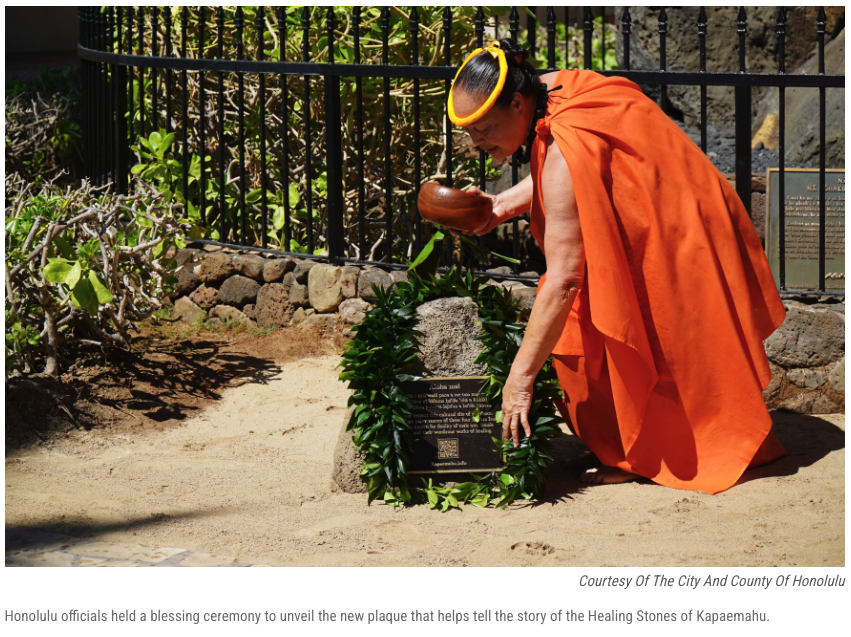
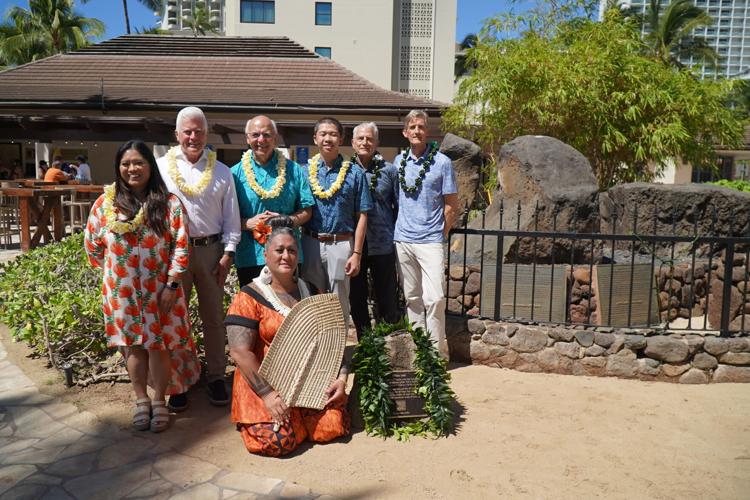
    Honolulu officials held a ceremony Tuesday to unveil the new plaque installed on a stone outside of the gated Healer Stones of Kapaemahu.

    The stones pay homage to the healers’ contributions in Hawaiʻi. According to the moʻolelo, the Tahitian healers transferred their powers into the stones that had remained in Waikīkī for hundreds of years. They were mahu, people of dual male and female spirit.

    The stones have endured years of neglect, including being buried under a bowling alley for over two decades until they were recovered in 1963. The stones are now located at the western end of Kūhiō Beach Park.

    Many visitors have passed the site, unaware of the history behind the stones. While older plaques exist inside the fence, they can be difficult to read.

    There were incidents where people sat on the stones or placed their boards on them, according to Kehau Noe, a computer science PhD student at the University of Hawaiʻi at Mānoa. She’s part of the project to diversify and share the stones’ history.

    “The stones are in a highly tourist-centric area,” Noe said. “People don’t realize how important they are.”

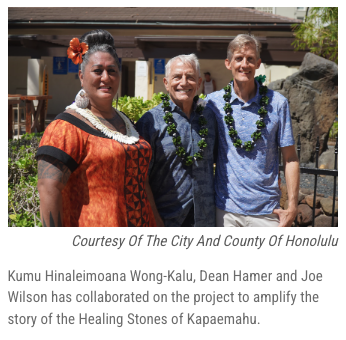
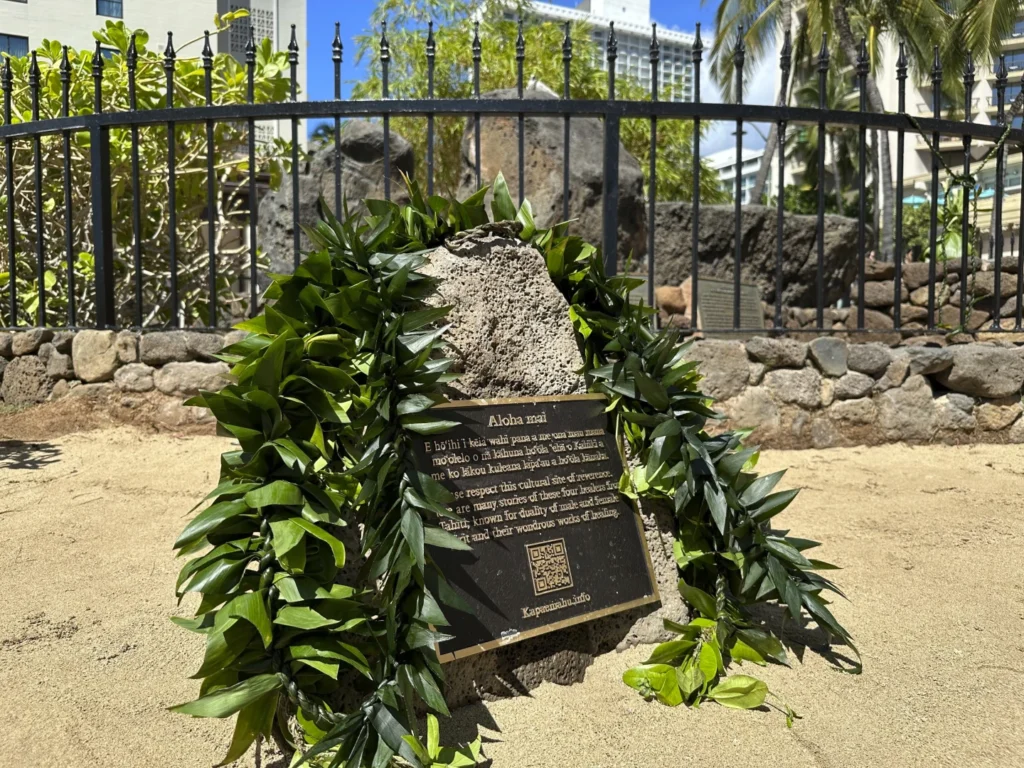
    A QR code engraved in the plaque takes visitors to a webpage providing stories and interpretations. What’s new is a virtual reality tour guide of the stones, created by Noe in collaboration with cultural advocate Kumu Hinaleimoana Wong-Kalu and filmmakers Dean Hamer and Joe Wilson.

    Noe helped create an augmented reality application, which is the real-time use of virtual audio and graphics woven into real-world environments. The team came up with scripts and filmed Wong-Kalu telling the story.

    The AR app will briefly introduce the stones, their genealogy and history while providing a creative outlet for visitors to experience the stones virtually in detail.

    “By telling it through all these different mediums, we’re finding different ways to bring life to the story and to perpetuate it in ways that will work for everyone,” Noe said.

    The stones are well-protected today, Hamar said.

    “They’re beautifully displayed, but as Hawaiʻi changed, so did the story,” Hamer said. “The part about the healers being mahu and the connection to gender duality was nearly erased. But fortunately, it wasn’t completely forgotten.”

    Hamer emphasized that the news AR app will help reach a broader audience.

    “The Stones of Kapaemahu are more than a tourist site, and they deserve to be better understood by locals and visitors alike, “Wong-Kalu said in a news release. “They are an insight into our Pacific understandings of male and female, life and healing, and the spiritual connections between us all.”

    Listen and read full article here.

  • Honolulu tells story of healers with dual male and female spirit through new plaque in Waikiki

    Honolulu tells story of healers with dual male and female spirit through new plaque in Waikiki

    Honolulu tells story of healers with dual male and female spirit through new plaque in Waikiki

    by Audrey McAvoy – AP News – October 24, 2023:

    HONOLULU (AP) — Honolulu officials on Tuesday introduced a new interpretive plaque for four large boulders in the center of Waikiki that honor Tahitian healers of dual male and female spirit who visited Oahu some 500 years ago.

    The centuries-old boulders — one for each of the four visiting healers — are protected by an iron fence in a beachside park surrounded by hotels and shops in the heart of the world-renowned tourist district. The monument is known as the stones of Kapaemahu, after the group’s leader.

    According to stories handed down orally, the boulders were placed on Waikiki’s shore at the time of the healers’ visit. But the stones became neglected more recently. In 1941, a bowling alley was even built over them and remained there for two decades.

    The earlier plaque dates to 1997. It doesn’t acknowledge the healers were “mahu,” which in Hawaiian language and culture refers to someone with dual male and female spirit and a mixture of gender traits.

    Scholars blame that omission on the homophobia and transphobia pervasive in Hawaii after the introduction of Christianity. Missionaries pushed aside gender fluidity’s deep roots in Hawaiian culture and taught believers to suppress anything that deviated from clearly defined male and female gender roles and presentations.

    The new plaque is attached to a stone in front of the iron fence.

    “Please respect this cultural site of reverence,” the sign says. “There are many stories of these four healers from Tahiti, known for duality of male and female spirit and their wonderous works of healing.” The plaque includes a QR code and the address to a website with more information about the stones and their history.

    Kumu Charlani Kalama, whose title “kumu” is the Hawaiian language term for master teacher, performed a blessing with ti leaves and salt. Kumu Hinaleimoana Wong-Kalu draped lei on the fence.

    Joe Wilson, a member of a group that pushed for signage acknowledging a more complete story of the stones, said monuments and public art are powerful symbols of who and what are valued by a community.
     

    “Kapaemahu should and will be a shining example of a city that honors and celebrates its culture, diversity and all who visit or call it home,” Wilson said at the blessing ceremony.

    The story of the stones was initially handed down orally, like all tales in Hawaii before the introduction of the written language in the 1800s. The first written account appeared in a 1906 manuscript by James Alapuna Harbottle Boyd, the son-in-law of Archibald Cleghorn, who owned the Waikiki property where the stones were at the time.

    Wong-Kalu, who is mahu and a community leader, said she stopped by Boyd’s grave before the ceremony to pay her respects and express her gratitude that he wrote down the story for subsequent generations.

    “If not for his recordation of this, we would not be able to tell this story today,” Wong-Kalu said.

    Honolulu’s mayor said the future of tourism lies in teaching visitors about the culture of a place so they appreciate it for more than its beautiful beaches and the ocean. The stones can help do that, he said.

    “I’m hoping that the people who are interested will realize that it’s just not four stones in Waikiki. There’s a meaning and a history and even a spirituality,” Mayor Rick Blangiardi said after the ceremony.

    Full article here.

  • Honolulu tells story of healers with dual male and female spirit through new plaque in Waikiki

    Honolulu tells story of healers with dual male and female spirit through new plaque in Waikiki

    Honolulu tells story of healers with dual male and female spirit through new plaque in Waikiki

    by Audrey McAvoy – AP News – October 24, 2023:

    HONOLULU (AP) — Honolulu officials on Tuesday introduced a new interpretive plaque for four large boulders in the center of Waikiki that honor Tahitian healers of dual male and female spirit who visited Oahu some 500 years ago.

    The centuries-old boulders — one for each of the four visiting healers — are protected by an iron fence in a beachside park surrounded by hotels and shops in the heart of the world-renowned tourist district. The monument is known as the stones of Kapaemahu, after the group’s leader.

    According to stories handed down orally, the boulders were placed on Waikiki’s shore at the time of the healers’ visit. But the stones became neglected more recently. In 1941, a bowling alley was even built over them and remained there for two decades.

    The earlier plaque dates to 1997. It doesn’t acknowledge the healers were “mahu,” which in Hawaiian language and culture refers to someone with dual male and female spirit and a mixture of gender traits.

    Scholars blame that omission on the homophobia and transphobia pervasive in Hawaii after the introduction of Christianity. Missionaries pushed aside gender fluidity’s deep roots in Hawaiian culture and taught believers to suppress anything that deviated from clearly defined male and female gender roles and presentations.

    The new plaque is attached to a stone in front of the iron fence.

    “Please respect this cultural site of reverence,” the sign says. “There are many stories of these four healers from Tahiti, known for duality of male and female spirit and their wonderous works of healing.” The plaque includes a QR code and the address to a website with more information about the stones and their history.

    Kumu Charlani Kalama, whose title “kumu” is the Hawaiian language term for master teacher, performed a blessing with ti leaves and salt. Kumu Hinaleimoana Wong-Kalu draped lei on the fence.

    Joe Wilson, a member of a group that pushed for signage acknowledging a more complete story of the stones, said monuments and public art are powerful symbols of who and what are valued by a community.
     

    “Kapaemahu should and will be a shining example of a city that honors and celebrates its culture, diversity and all who visit or call it home,” Wilson said at the blessing ceremony.

    The story of the stones was initially handed down orally, like all tales in Hawaii before the introduction of the written language in the 1800s. The first written account appeared in a 1906 manuscript by James Alapuna Harbottle Boyd, the son-in-law of Archibald Cleghorn, who owned the Waikiki property where the stones were at the time.

    Wong-Kalu, who is mahu and a community leader, said she stopped by Boyd’s grave before the ceremony to pay her respects and express her gratitude that he wrote down the story for subsequent generations.

    “If not for his recordation of this, we would not be able to tell this story today,” Wong-Kalu said.

    Honolulu’s mayor said the future of tourism lies in teaching visitors about the culture of a place so they appreciate it for more than its beautiful beaches and the ocean. The stones can help do that, he said.

    “I’m hoping that the people who are interested will realize that it’s just not four stones in Waikiki. There’s a meaning and a history and even a spirituality,” Mayor Rick Blangiardi said after the ceremony.

    Full article here.

  • Unveiling the past: New plaque illuminates the history of Kapaemahu Stones

    Unveiling the past: New plaque illuminates the history of Kapaemahu Stones

    Unveiling the past: New plaque illuminates the history of Kapaemahu Stones

    ABC KITV Island News – October 25, 2023:

  • ‘Aikane’ Short Animation by Dan Sousa, Dean Hamer & Joe Wilson: Queer Indigenous Feeling

    ‘Aikane’ Short Animation by Dan Sousa, Dean Hamer & Joe Wilson: Queer Indigenous Feeling

    ‘Aikane’ Short Animation by Dan Sousa, Dean Hamer & Joe Wilson: Queer Indigenous Feeling

    by Vassilis Kroustallis – Zippy Frames – 15 October 2023:

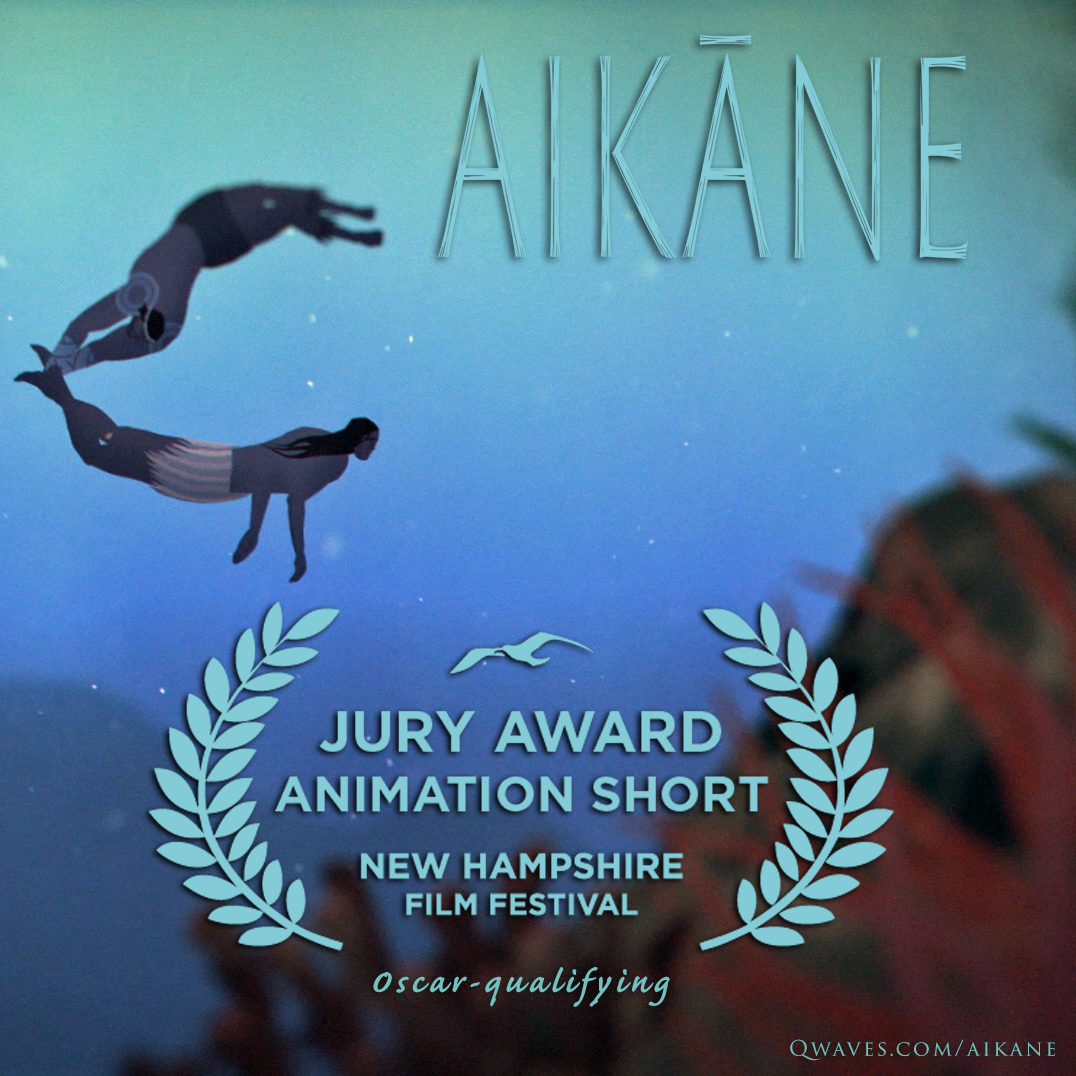
    The creative quartet of Dean Hamer, Joe Wilson, Dan Sousa, and Hinaleimoana Wong-Kalu create films that consistently tell an indigenous experience in precise animated terms. In their previous effort, ‘Kapaemahu’, the Hawaiian indigenous past was revealed in the commercialized present (more about the film). In the new short animation, the queer-themed ‘Aikāne’ (the term meaning intimate friend of the same sex) a queer romance is developed between two men in the very distant past, full of colonial implications.

    A valiant island warrior, wounded in battle against foreign invaders, falls into a mysterious underwater world.  When the octopus who rescued him transforms into a handsome young man, they become aikāne, intimate friends bound by love and trust, and an epic adventure begins – Film Synopsis

    The film has now become Oscar-qualified, after it won the Animated Shorts Jury Award, at the 2023 New Hampshire Film Festival. Other notable festival selections: Frameline, Chicago International Children’s Film Festival, Hawai’i International Film Festival, Adelaide Film Festival, Thessaloniki Film Festival, Outfest LA, DC Asian Pacific American Film Festival – Best Narrative winner).

    We talked to the ‘Aikāne’ team:  Dean Hamer (director and writer), Joe Wilson (director), Daniel Sousa (director and animator), and Hinaleimoana Wong-Kalu (producer). They all had to say some interesting things. 

    ZF:  Why the need to go back in time to tell this story? Is it the need to say something that might otherwise be forgotten or the need to move a little away from our current post-pandemic world and take some stock from another era?

    DH:  The present is not a good time to set a queer love story.  As students and teachers across the country are being told to not say gay, books are banned from libraries, parents are being criminalized for providing their kids with gender-affirming health care, and people like me and my husband and co-director Joe Wilson are being labeled groomers and pedophiles, it seems like we are in a period of moving backward rather than forwards. 

    Fortunately, this has not always been the case, and the past offers a rich panoply of societies and cultures where same-sex love was not only spoken but praised.  The homoerotic writings of ancient Greece, the cut-sleeve stories of imperial China, the Indian temple paintings of womanly embraces, and the love poems of medieval Ireland are but a few examples.  Because we live in Hawaii and have been working on films about Pacific Islander lives and voices for many years, that’s where we first turned for inspiration – but it wasn’t the only place. We drew from our histories and experiences too. 

    ZF:  ‘Aikāne’ means intimate friend of the same sex, not just a same-sex partner. What is the differentiation here and why is this title in the film?

    JW:  Translations of words and cultural concepts from one language to another are never ideal. And while same-gender-loving folks have existed across place and time, it seems like only a few societies have named us in a way that denotes dignity and respect, one of them being Hawaiʻi, where we’ve become immersed in community efforts to help restore these kinds of hidden histories. In Hawaiian culture, Aikāne were not just same-sex lovers, they were friends, trusted confidants, equal partners, and sometimes even co-rulers of the land.

    We considered many other possible titles, but the closer we got to the release date, all of us involved in the project, especially Hina, knew that Aikāne made the most sense because it reflected the deep relationship between the protagonists. There was just no need to conjure up an English equivalent because there really is none.

    ZF:  The two characters are designed differently; the first has more ‘manly’ characteristics, and the second with more ‘feminine’ ones. Was this intentional?

    JW:  In a way, this speaks to traditional gender stereotypes and viewers’ preconceived ideas as much as it does to our intentions. Like most cisgender men, we were raised to live by rigid rules of what it means to be a man, to be stereotypically masculine. But, as guys who are attracted to and fall in love with other guys, those rules don’t necessarily apply to us, which is liberating. It allows us the freedom to be whatever we want or have the courage, to be, and to defy societal expectations. We wanted to play with that in the film.

    That’s also why shapeshifting is an element – the idea of a character being, or becoming, something or someone else to survive in an environment where you feel like you don’t belong. Most queer folks know exactly what this is like, subconsciously, to constantly have to shapeshift to be safe or accepted at home, at school, in the workplace, or out in their community.  The twist in the film is that these shape-shifting, same-gender-loving characters get a happy ending, something that is still too rare for queer people, both on and off-screen. We hope Aikāne can be a small part of changing that narrative.

    ZF:  What were the challenges of the animation process (2D/3D)? Here we have a lot of underwater scenes and a lot of battle scenes at the same time

    DS:  The challenges were also the most enjoyable parts of the process I always try to push areas of filmmaking that I may not be familiar with, or aesthetics that are counter to what I have explored in the past. And this film definitely fits the bill! Designing colorful, light-drenched environments, swatch-buckling action set-pieces, and underwater luminous spaces were all new areas of exploration that I had never tried. 

    Placing the 2D characters within 3D environments was fairly straightforward and not terribly challenging. But making sure the marriage was convincing and didn’t distract from the storytelling required a lot of nuance.

    ZF:  How did you envisage the visual world of ‘Aikāne’? It is very varied and full of light. I suppose you have Hawaii references, but how did you mix those in the film?

    DS:  We wanted the characters and environments to feel genuine, but not specific to a particular group of people or historical events. The story needed to live on its own, outside of time and space. So we pulled mostly from Hawaiian references, but also Celtic, and invented the rest. Additionally, the film required a lot of research on underwater photography (and swimming), period costumes, ships, landscapes, and color palettes. Juggling all the influences and finding the perfect combination that felt natural and uncompromising was certainly challenging, but I think we found a good balance.

    ZF: How was the script drafted? Did you have a single story serving as reference, a collection of fables or did you come up with something completely original?

    DH:  Joe and I are fortunate to live close to the ocean and swim or surf nearly every day of the year.  I especially love to take long dives under the surface; it is like entering a new world, silent and slow-moving, far from the noise and chaos above.

    The inspiration for ‘Aikāne’ came in a flash during one of those underwater sessions.  I wanted to share the sense of connection and dependence that happens when two people enter that silent underwater universe, and I wanted to do it through a romance.  It was only later that I began to think about how elements from the many different legends and myths of same-sex love that I had read might be incorporated into the narrative arc.  

    ZF:  Aikāne is an epic adventure in 14 minutes. Did you have to change a lot during the process to make all elements of your story fit? Any particular scene that was added at the last moment?

    DH:  This was my first try at fiction.  Having spent my entire life writing non-fiction papers, essays, books, and documentaries, I thought it would be easy.  I was so wrong! The first draft was about 20 pages long and included dozens of characters including a healer, a king, a jealous woman, and angry villagers.  As we talked with our animator Daniel Sousa and story consultant Will Csaklos about what each character contributed to the dramatic arc, this was slowly stripped down to just the two protagonists, and the number of scenes was reduced by half. 

    What we ended with was a classic love story with a beginning, middle, and end.  I know thatʻs considered a bit old-fashioned and corny, but in the world of queer fi,lms itly a novelty.

    ZF:  ʻAikāneʻ and ‘Kapaemahu’ are two different films, but they both tell of the need to have empathy and learn. Can you pinpoint the differences between the two films?

    HWK:  In the Western view, the difference between these films is that Kapaemahu focuses on gender fluidity whereas Aikāne deals with sexual orientation.  But in our Hawaiian culture, people are judged not by the pronoun they use or the people they love but by their kuleana, or responsibility.  The kuleana of māhū, people like me of dual male and female spirit is to act as caretakers, healers, and teachers of ancient traditions. For aikāne, it is to support, nurture, and aloha one another.  Seen through this Polynesian lens, Kapaemahu and Aikāne represent two facets of a culture where all people are valued and respected.

    ZF: What is the festival experience from showing ‘Aikāne’, and most importantly, the audience reaction? The film has been shown internationally, as well as in Hawaii, so you can have a measure of the different audience reactions.

    JW: The festival experience has been varied, which has made it interesting and surprising. Some festivals have put it in programs for mature audiences only, while others have screened in children’s programs. It has been popular in queer, native, ethnographic, and even horror and fantasy festivals, but not so much in traditional animation festivals, which may say more about the industry’s lingering discomfort with LGBTQ storylines than it does about the film. We’re glad that Zippy Frames is helping to break that reluctance with its Queer Animation section.

    As for audience reactions, it has been exactly what we hoped for, with younger and older viewers alike sharing emotional responses to watching a film whose characters are powerful and heroic not despite who they love but because of it. Our favorite comment, overheard in a theater hallway, was “Did you see the Disney film about the merman?”  

    ZF:  Aikāne’ and ‘Kapaemahu’ both describe the indigenous Hawaiʻi experience. Do you plan to continue in that vein in the future?

    DH:  Given how much we love Hawaiʻi, and what fun it is to collaborate with Daniel, it would be difficult not to, and I am delighted to announce that Iʻll be playing a role in an exciting new film about the Kingdom of Hawaiʻi called The Queens Flowers, directed by Ciara Lacy and produced by Concepcion Saucedo.  

    Ultimately, though, we are as interested in impact as we are in the art of filmmaking, which in the case of Kapaemahu led to a public television documentary, a children’s book, a major museum exhibition, and a contextualizing signage addition to the physical monument in Waikiki.  Aikāne will find its permanent place as part of a new, foundation-funded public memory project on The Queer Histories of Hawaiʻi that we hope will open even more opportunities to combine creative storytelling with action for change.

    Film Review (Vassilis Kroustallis):
    In a world in which stories of coming out have become more abundant on the big and small screen, ‘ Aikāne’ does something different. It starts from the established point of a queer love (which dares speaks its name) and moves beyond the erotic aspect to encompass a partnership ready to stand the test of danger -and extraneous social interference. Even if fictional, ‘Aikāne’ is deeply entrenched in its indigenous Hawaiian culture; its visual palette is strong and tender at the same time, just like its two main characters. By adopting the epic hero’s journey (here in partnership), the film succeeds in showing that queer love and partnership can be a reality, not a pipe dream -despite all dangers and inhuman odds. Both characters are complimentarily defined, and the scene transition follows closely (and interestingly) the mishaps from the small to the most dangerous. The film is empathetic and mysterious at the same time, as if advising that a two-way intimate partnership needs to keep its secrets. An engaging film ready to be explored, which makes us ponder how the obvious queer love still needs to be stated as such.

    CREDITS:

    Aikane (2023)
    Directed by Daniel Sousa, Dean Hamer, Joe Wilson | Producer Hinaleimoana Wong-Kalu | Design and Animation Daniel Sousa. Sound and Music Dan Golden | Executive Producers Judith Light, Daniel Karslake

    More details on Aikane

    Full article here.
  • THE 21ST ANNUAL NEW HAMPSHIRE FILM FESTIVAL ANNOUNCES AWARD RECIPIENTS

    THE 21ST ANNUAL NEW HAMPSHIRE FILM FESTIVAL ANNOUNCES AWARD RECIPIENTS

    THE 21ST ANNUAL NEW HAMPSHIRE FILM FESTIVAL ANNOUNCES AWARD RECIPIENTS

    New Hampshire Film Festival – October 15, 2023

    Portsmouth, New Hampshire (October 15, 2023) – That’s a wrap! New Hampshire’s largest film festival has announced the recipients of the New Hampshire Film Festival’s (NHFF) prestigious awards after four packed days of screenings, panels, and parties. The city of Portsmouth was abuzz as the 21st annual New Hampshire Film Festival attracted an estimated ten thousand film enthusiasts, filmmakers, writers, and students, who gathered to celebrate and discuss cinema and view more than 100 independent films that were selected from thousands of submissions.

    This is the second year the NHFF is an Academy Awards qualifying festival for short films, making live action and animated shorts jury award recipients eligible to submit for Oscar consideration. NHFF Executive Director Nicole Gregg says, “We are so energized that once again, the New Hampshire Film Festival distinguished itself as an important opportunity for filmmakers who come from near and far, and for audiences, who not only get to see the films, but are encouraged to interact with directors, writers, producers, actors, and cinematographers.”

    The awards, affectionately called “Granny Awards” for the solid granite trophy – a nod to the Granite State, can help filmmakers build visibility and potentially secure a distribution deal.

    The bulk of the awards honoring excellence in filmmaking and screenwriting were presented on Sunday night, including the Live Action Shorts Jury Award and Animation Shorts Jury Award:

    • Shorts Jury Award, Animation (Academy-Qualifying): Aikāne (directed by Daniel Sousa, Dean Hamer & Joe Wilson)

    • Best Screenplay: Imogene’s Tornado (written by Andrew Braunbhar)

    • Best Student Film: Homing (directed by Ricardo Varona)

    • Best Short Comedy: Catherine & Michael (directed by Kathy Fusco)

    • Best Short Drama: Mandarins (directed by Chelsie Pennello)

    • Audience Choice, Documentary: In the Whale (directed by David Abel)

    • Audience Choice, Narrative: Hangdog (directed by Matt Cascella)

    • Grand Jury Award, Documentary: Hummingbirds (directed by Silvia Del Carmen Castaños & Estefanía “Beba” Contreras)

    • Grand Jury Award, Narrative: Mountains (directed by Monica Sorelle)

    • Shorts Jury Award, Documentary: Denial (directed by Paul Moakley and Daniel Lombroso)

    • Shorts Jury Award, Live Action (Academy-Qualifying): The Fuse (directed by Kevin Haefelin)

    • Best Documentary Feature: Maestra (directed by Maggie Contreras)

    • Best Narrative Feature: Our Son (directed by Bill Oliver)

    Full article here.

  • Kapaemahu Selected for Great Reads from Great Places

    Kapaemahu Selected for Great Reads from Great Places

    Kapaemahu Selected for Great Reads from Great Places

    Great Reads from Great Places is a project of the Library of Congress Center for the Book. Each year, the 56 Affiliated Centers for the Book choose a book for kids and one for adults that represents their states’ or territories’ literary heritage. In this video, Kapaemahu authors Dean Hamer & Joe Wilson discuss their Hawaii-inspired book and why they write for young people.

  • First Impression: Kapaemahu

    First Impression: Kapaemahu

    First Impression: Kapaemahu

    by Ethan Seavey – Pride and Less Prejudice – August 5, 2023:

    When I was planning to write a “first impression” style article about an LGBTQ+ inclusive children’s book, my first instinct was to talk about what the book would have taught me when I was young. I did not expect to pick up a book that would teach me, a queer adult, about new aspects of queerness. That changed when I first opened Kapaemahu. 

    In this book, authors Hinaleimoana Wong-Kalu, Dean Hamer, and Joe Wilson share the traditional Hawaiian story, The Healer Stones of Kapaemahu. The story is told in simplified Olelo Niihau, the language spoken by the few Native Hawaiian people who still live on Niihau island, as well as English. While it is told in a language that children would have no problem understanding, it demonstrates the importance of highlighting Hawaiian stories which have been erased by white colonists. In this case, the erasure of this story goes hand in hand with the intentional erasure of the Mahu people.

    In the story, four Tahitian people arrive to Wakiki, where they are welcomed by the Hawaiian people. They learn that these people call themselves “mahu” and are neither male nor female. “They were mahu—a mixture of both in mind, heart, and spirit.” As the story goes, these four visitors are blessed with rich healing powers which they share with the village. In gratitude, the Hawaiian people erect four enormous stones, and the mahu people transfer their healing powers into the monument.

    Here, the story takes a turn. The traditional story fades away, but the book continues, telling us that the stones were sacred for centuries, until American colonizers took control and built a bowling alley on top of the rocks. Finally, the book ends with the re-creation of the traditional Hawaiian monument, and a young child who engages with the mahus’ power, still strong, in the rocks.

    At the end of the book is further information for adults and curious children alike. One can learn that the main author, Wong-Kalu, is mahu herself, and implores young children to embrace the male and female spirits inside of everyone. One can also learn about the importance of this story in the wake of a worldwide pandemic, or about the origins of this story, or about the language Olelo Niihau.

    I feel a lot of pride working with PLP knowing that this book is on our list. I believe every student who reads this book will take many lessons from it, and I know the same is true for the teachers sharing it. Wong-Kalu introduces her audience to a story and a culture which has been purposefully destroyed by American imperialists out of fear of their power.

    Moreover, the illustrations of Daniel Sousa accompany the story and bring life to each page with warm yellow and red tones—except the brief depiction of the way American tourism has forever changed the beautiful land of the Hawaiian people. The distinction is stark and begs the audience to reconstruct our image of what Hawaii is and what our relationship to it should be. It begs us to do our research and listen to the Native Hawaiian people who are still living and demanding to be heard, to be respected, and to receive retributions for the decades of oppression under American rule.

    It appears that this is part of the reason that the niche community that can read this dialect of Olelo Niihau is given priority in the text, as the English language translations always appear second. It is an effort to demonstrate this problem and to undo the assumption that American English is the default.

    The experience of listening to Wong-Kalu read her story is an exceptional one. She brings reverence to each line and delivers the words, in both languages, beautifully. To conclude her read-aloud, she shares more knowledge about being mahu and what her Hawaiian heritage means to her. You can find this read-aloud in the dedicated read-aloud category on PLP’s website, under the resources tab.

    The historic oppression of the mahu people began with prejudice and discrimination against mahu performers and continues to this day. Across human history and in many different cultural spheres, people have been choosing to live outside the binaries of sex and gender which were constructed by Europeans and enforced onto other communities through colonialism. Today it is essential that we deconstruct those binaries in our minds. Maybe that starts with reading Kapaemahu.

    Full article here.

  • KAPAEMAHU AUTHOR TALK: DEAN HAMER AND HINA WONG-KALU

    KAPAEMAHU AUTHOR TALK: DEAN HAMER AND HINA WONG-KALU

    KAPAEMAHU AUTHOR TALK: DEAN HAMER AND HINA WONG-KALU

    by Hawai’i State Public Library System – July 25, 2023:

    Join us in the first floor reading room of Hawaii State Library for a book discussion with this year’s Great Reads from Great Places selectees, chosen by the Hawai‘i Center for the Book to represent Hawai‘i at the 2023 National Book Festival in Washington, D.C. in August.  This year’s selected titles are Kapaemahu by Hinaleimoana Wong-Kalu, Dean Hamer and Joe Wilson and Island Wisdom by Kainoa Daines and Annie Daly.  Authors Hina Wong-Kalu, Dean Hamer, and Kainoa Daines will be attending to discuss their titles.  The featured books will be available for purchase at the event (cash only.)

    Anyone who requires an auxiliary aid or service for effective communication, or a modification of policies or procedures to participate in a program, service or activity should contact library staff as soon as possible. Advance requests 48 hours or more before the event are encouraged, but not required.

    Details and Directions here.

  • The LGBTQ+ History Series – Honolulu and The Healer Stones of Kapaemahu

    The LGBTQ+ History Series – Honolulu and The Healer Stones of Kapaemahu

    The LGBTQ+ History Series – Honolulu and The Healer Stones of Kapaemahu

    OUTtv hosts Christian and Kim attend pride in Honolulu, Hawaii to learn about Māhū identity, the “I Am A Boy” buttons and the healer stones of Kapaemahu.